Rohan Deshmukh Data Scientist, Payments Risk San Jose, 95126, United States [email protected] · (408) 555-1534
16 September 2026
Dr. Priya Venkataraman Credit Risk Data Science Berryessa Lending San Jose, United States
Application for Senior Data Scientist, Berryessa Lending
Dear Dr. Venkataraman,
I am applying for the Senior Data Scientist post on the credit risk team at Berryessa Lending. At Alviso Payments I own the card-not-present fraud model that scores every authorization in under 40 milliseconds, about 380 million a year, and I have taken two other models from a notebook to live traffic. Risk modeling with a real latency budget is the work I want to keep doing.
The fraud model is the one worth describing. It replaced a 140-rule engine with recall of 0.62 at a 0.5 percent decline rate. On a time-based holdout the gradient boosted model lifted precision-recall AUC from 0.29 to 0.44 and recall to 0.71 at the same decline rate, and I designed the switchback test that measured the launch, including the power calculation and a success criterion agreed before we started. Chargebacks moved from 18 basis points to 11 over three quarters, and a calibrated confidence band agreed with risk operations took about 34 percent of volume out of the manual review queue. Since launch I have run weekly population stability checks on 22 features, a quarterly retrain, one off-cycle retrain after a drift alert, and one rollback when a merchant onboarding shifted the input distribution.
Your engineering blog describes moving underwriting decisions from a scorecard to a model-based process this year. That transition usually fails on evaluation design rather than modeling: the holdout leaks, the baseline is never written down, and nobody agrees in advance what would count as success. In a first quarter I would want to fix the baseline and the holdout before touching an algorithm, and get the monitoring plan agreed before the first launch rather than after it.
I work in Python and SQL against Snowflake, tune gradient boosted models, and have shipped through shadow deployment and a traffic ramp with a documented rollback path. I can start within six weeks. Thank you for your time.
Sincerely, Rohan Deshmukh
Summary
A data scientist cover letter names one model that reached production, the baseline it had to beat, and the business number that moved afterwards. This guide gives you a full adaptable letter, how to write about a model that never shipped, what to say about monitoring, and the openings that get a strong file read rather than skimmed.
Data Scientist cover letter examples by experience level
A data scientist cover letter is a one-page letter that names one model you took to production, the baseline it had to beat, and what changed for the business after it launched.
One model, not five. The resume lists the portfolio. The letter has room for a single story told properly, and the story that gets read is the one where something was decided differently afterwards.
Guide to a data scientist cover letter
This guide and the corresponding data scientist cover letter example will cover:
- How to structure the letter, paragraph by paragraph
- Why the baseline belongs in the first three sentences
- How to write about a model that never reached production
- What monitoring and retraining say about you
How to write a data scientist cover letter
| Paragraph | Its job | Length |
|---|---|---|
| Opening | The post, the domain, and one model you own | 2 to 3 sentences |
| Evidence | Baseline, offline metric, business metric, production status | 4 to 6 sentences |
| Fit | Their problem, and what you would do in the first quarter | 3 to 4 sentences |
| Close | Stack, availability, thanks | 2 sentences |
Put the baseline in before the metric
Every data science letter quotes a number. Almost none quote what the number beat, which is why almost none are persuasive.
"Improved fraud detection accuracy to 94 percent" is unreadable: on an imbalanced problem the majority class alone can reach 99 percent. "Lifted precision-recall AUC from 0.29 on the 140-rule engine to 0.44, at the same 0.5 percent decline rate" tells a hiring manager what you replaced, what you measured and what you held fixed.
A baseline is also the cheapest way to sound senior. It shows you know that shipping a model is a comparison against something already running, not a score in isolation.
A data scientist cover letter example you can adapt
Dear Dr. Venkataraman,
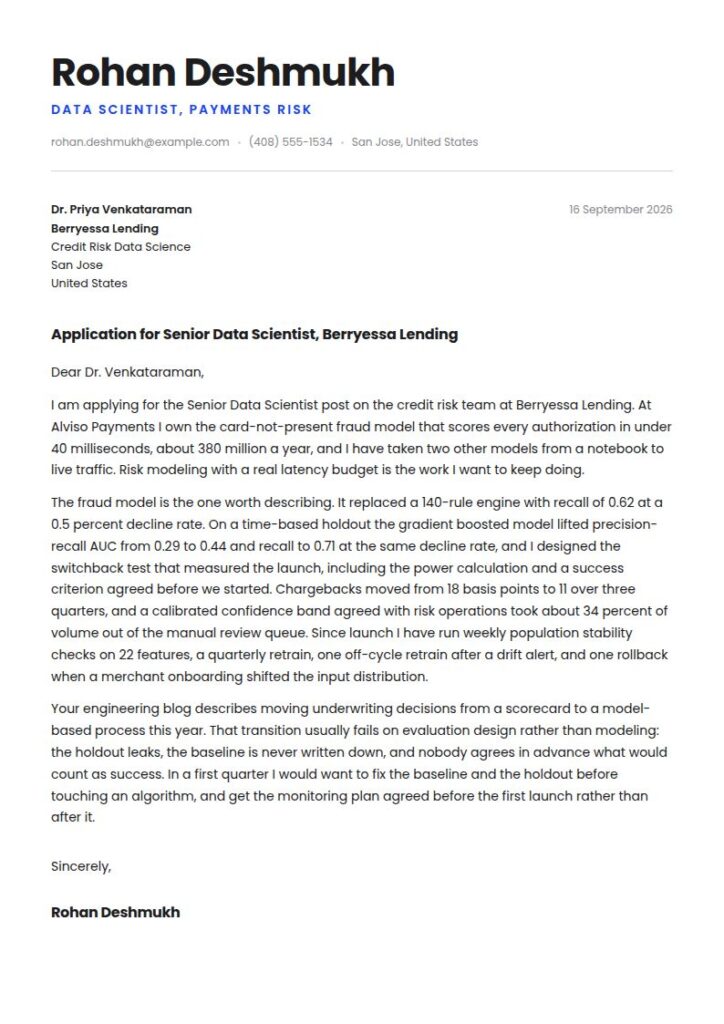
I am applying for the Senior Data Scientist post on the credit risk team at Berryessa Lending. At Alviso Payments I own the card-not-present fraud model that scores every authorization in under 40 milliseconds, about 380 million a year, and I have taken two other models from a notebook to live traffic. Risk modeling with a real latency budget is the work I want to keep doing.
The fraud model is the one worth describing. It replaced a 140-rule engine with recall of 0.62 at a 0.5 percent decline rate. On a time-based holdout the gradient boosted model lifted precision-recall AUC from 0.29 to 0.44 and recall to 0.71 at the same decline rate, and I designed the switchback test that measured the launch, including the power calculation and a success criterion agreed before we started. Chargebacks moved from 18 basis points to 11 over three quarters, and a calibrated confidence band agreed with risk operations took about 34 percent of volume out of the manual review queue. Since launch I have run weekly population stability checks on 22 features, a quarterly retrain, one off-cycle retrain after a drift alert, and one rollback when a merchant onboarding shifted the input distribution.
Your engineering blog describes moving underwriting decisions from a scorecard to a model-based process this year. That transition usually fails on evaluation design rather than modeling: the holdout leaks, the baseline is never written down, and nobody agrees in advance what would count as success. In a first quarter I would want to fix the baseline and the holdout before touching an algorithm, and get the monitoring plan agreed before the first launch rather than after it.
I work in Python and SQL against Snowflake, tune gradient boosted models, and have shipped through shadow deployment and a traffic ramp with a documented rollback path. I can start within six weeks. Thank you for your time.
Sincerely, Rohan Deshmukh
Openings that work
| Instead of | Use |
|---|---|
| I am passionate about machine learning and its potential to transform business | I own the card-not-present fraud model that scores every authorization in under 40 milliseconds |
| I am writing to express my interest in the Data Scientist position | I am applying for the Senior Data Scientist post on the credit risk team |
| I have experience with Python, R, TensorFlow, PyTorch and scikit-learn | I have taken three models from a notebook to live traffic, two of which I still monitor |
| I delivered models with 94 percent accuracy | I lifted precision-recall AUC from 0.29 on the rules baseline to 0.44 at a flat decline rate |
The right column names what was replaced and what was held constant. The left column is what the rest of the folder says.
Writing about a model that did not ship
Most data scientists have more unshipped work than shipped work, and a letter built on a model that never launched can still be strong if it is honest about where it stopped.
Say what the model was for, what the baseline was, how you evaluated it, and the actual reason it stopped: a feature was not available at serving time, the latency budget could not be met, the labels arrived too late, or the business changed direction. Then say what you would do differently.
That beats a vague success claim, because the reader learns you understand the constraints that kill models. Do not stretch a proof of concept into a launch; the follow-up question is always "who uses it", and the answer is what the interview turns on.
What monitoring and retraining say about you
Name the baseline in the same sentence as the metric. Give the production status and the launch date. Say who uses the output. Describe one drift alert, one retrain or one rollback; it is the clearest evidence you have operated a model rather than delivered one. Name the evaluation design, including how the holdout was built.
Do not quote accuracy on an imbalanced problem. Do not describe a proof of concept in language that implies production. Do not claim a team model as your own; the interview will find it. Do not open with a library list. Do not write "state of the art" about a model whose baseline you have not named.
Almost everyone uses AI; a minority have scaled it
The 2026 AI Index Report from the Stanford Institute for Human-Centered AI, reporting a 2025 global survey by McKinsey and Company, found 88 percent of surveyed organizations using AI in at least one business function, up from 78 percent the previous year, with 79 percent regularly using generative AI in at least one function.
Scaling is much rarer: 39 percent of companies above $5 billion in revenue reported scaling or fully scaled AI use, against 5 percent of those under $100 million (Stanford HAI, 2026 AI Index Report, citing McKinsey and Company, 2025). Meanwhile the occupation itself is projected to grow 35 percent between 2025 and 2035, with about 24,800 openings a year and a median wage of $120,230 as of May 2025 (BLS Occupational Outlook Handbook, 2025-35 projections and May 2025 wage data).
A letter proving you have operated a model in production, with drift alerts and a rollback, aims straight at the part of the market short of people. That beats another paragraph about frameworks.
Length, format and sending it
One page, four paragraphs, 250 to 400 words. PDF unless the portal says otherwise, named for yourself and the post: rohan-deshmukh-senior-data-scientist-cover-letter.pdf.
Use the same figures as your resume. Our data scientist resume example is written with the numbers used here, and a mismatch between the two documents costs you the credibility of both.
Address a person. Data science leadership is usually visible through conference talks, an engineering blog or professional profiles, and a letter specific everywhere except the greeting reads as a template.
Key takeaways
- Name one model and one baseline in the first three sentences.
- Pair the offline metric with a business metric, or say who uses the output.
- Give the production status, the launch date and the operating constraint.
- Describe one drift alert, retrain or rollback; it is your strongest evidence.
- Be honest about what you supported rather than owned.
- Say what you would do in the first quarter, specifically.
- Address a named person and keep it to one page.
Write your data scientist cover letter in 10 minutes with our AI cover letter builder.
Data scientist cover letter questions, answered
How long should a data scientist cover letter be?
One page, four paragraphs, 250 to 400 words. The reader is looking for one checkable claim about a model that shipped, and length makes it harder to find rather than more convincing.
Do I need a PhD to write a convincing data science letter?
No. The Bureau of Labor Statistics gives the typical entry-level education for data scientists as a bachelor's degree (BLS Occupational Outlook Handbook, 2025-35 projections). What the letter needs is a model that reached production with a baseline attached. A doctorate is useful where the method is the product and largely neutral everywhere else.
What if all my work is confidential?
Give the shape without the absolutes. The decision the model served, the class of baseline, the relative movement and the operating constraint are almost never confidential. "Cut chargebacks by about 40 percent relative at a flat decline rate" is usable where the dollar figure is not.
Should I mention Kaggle or open-source work?
One line, in the closing sentence, if it is relevant to the posting. Competitions show modeling on clean data against a fixed metric, which is the part of the job production least resembles. A maintained library is stronger, because someone else depends on it.
How do I write to a team earlier in its data maturity than I am?
Say what you would build first and why, without implying they are behind. A team moving from scorecards to models needs an evaluation design, a written baseline and a monitoring plan before it needs a better algorithm, and a letter that names that order shows judgment rather than criticism.