Hana Sugimoto Lead Data Engineer Seattle, 98115, United States [email protected] · (206) 555-1834
11 September 2026
Mr. Chidi Okafor Data Platform Pacific Anchor Retail Group Seattle, United States
Application for Senior Data Engineer, Pacific Anchor Retail Group
Dear Mr. Okafor,
I am applying for the Senior Data Engineer post at Pacific Anchor Retail Group. I lead a four-person team at Kestrel Health Systems on an AWS lakehouse of 320 TB in Amazon S3, fed by 140 AWS Glue jobs, Amazon MSK and AWS Database Migration Service, and served to 11 analytics teams through Amazon Athena and Amazon Redshift.
The work I would most want to bring with me is the claims pipeline. It arrived as gzipped JSON written straight to S3 with no partitioning, which meant an ordinary daily query scanned the whole history and the reporting team had built their schedule around the timeout. I rewrote it into Apache Parquet partitioned by date and payer, moved cold partitions to S3 Intelligent-Tiering, and retired two Amazon EMR clusters that each ran nightly for a single job Glue now handles. That combination took $41,000 a month off the platform bill with no reduction in retained history, and the daily query went from a timeout to under a minute.
Your posting describes moving off a nightly batch into near real time for inventory. I have run that transition once, from a DMS batch into an MSK stream with Step Functions handling replay, and the part I would want to settle first is what happens to a late-arriving correction, because that is where these projects usually get expensive. I would also want to look at the partitioning before anything else, since it is usually the cheapest thing on the list.
I hold the AWS Certified Data Engineer - Associate credential, earned in 2025, and I can start with four weeks of notice. Thank you for your time.
Sincerely, Hana Sugimoto
Summary
An AWS data engineer cover letter names one pipeline, the AWS services inside it, the volume moving through it each day, and what it stopped costing after you rebuilt it. This guide gives you a full adaptable letter, the openings that work, what AWS publishes about its data engineering credential, and what to write when your cost figures are confidential.
AWS Data Engineer cover letter examples by experience level
An AWS data engineer cover letter is a one-page letter about one pipeline: which services it is made of, how much moves through it, and what it cost before and after.
That is narrower than most applicants write, and deliberately so. A hiring manager for this role is carrying a bill they cannot fully explain and a nightly job that fails often enough to be somebody's problem. A letter about fixing exactly those two things is a letter about their week.
Guide to an AWS data engineer cover letter
This guide and the corresponding AWS data engineer cover letter example will cover:
- How to structure the letter, paragraph by paragraph
- Why one pipeline in depth beats a list of AWS services
- The four numbers that make a technical claim credible
- What to write when your cost figures are confidential
- Openings that read as an operator rather than a course graduate
How to write an AWS data engineer cover letter
| Paragraph | Its job | Length |
|---|---|---|
| Opening | The role, the platform you run, and its scale | 2 to 3 sentences |
| Evidence | One pipeline: services, volume, what you changed, what it cost | 4 to 5 sentences |
| Fit | Something real about their stack, and what you would take on first | 3 to 4 sentences |
| Close | Credential with its year, availability, thank you | 2 sentences |
One pipeline, four numbers
The service list belongs on the resume, and even there it should be short. The letter has room for one pipeline, and one told properly beats a paragraph of coverage.
Give it four numbers: what lands per day, what it is stored as and partitioned by, what the run does when it fails, and what it costs now against before. Four numbers and a reader can reconstruct your architecture in their head, which is the state you want them in when they decide whether to book a call.
If the dollar figure is confidential, give the proportional one. "Bytes scanned on the daily operations query fell from 1.4 TB to 90 GB" is a cost claim in a unit you are allowed to say.
An AWS data engineer cover letter example you can adapt
Dear Mr. Okafor,
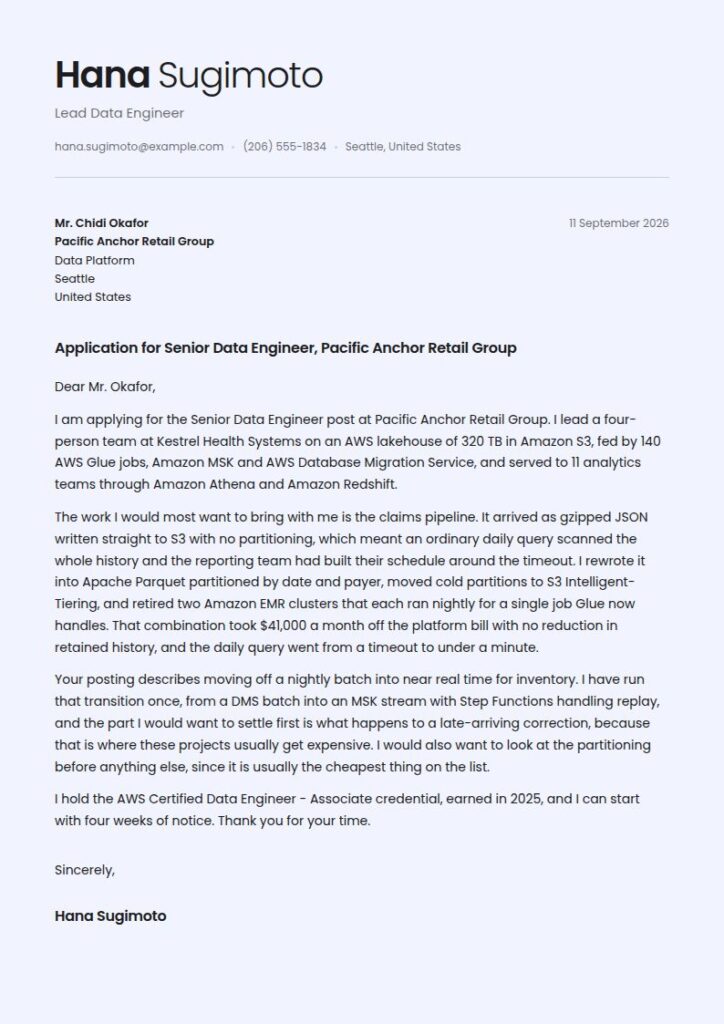
I am applying for the Senior Data Engineer post at Pacific Anchor Retail Group. I lead a four-person team at Kestrel Health Systems on an AWS lakehouse of 320 TB in Amazon S3, fed by 140 AWS Glue jobs, Amazon MSK and AWS Database Migration Service, and served to 11 analytics teams through Amazon Athena and Amazon Redshift.
The work I would most want to bring with me is the claims pipeline. It arrived as gzipped JSON written straight to S3 with no partitioning, which meant an ordinary daily query scanned the whole history and the reporting team had built their schedule around the timeout. I rewrote it into Apache Parquet partitioned by date and payer, moved cold partitions to S3 Intelligent-Tiering, and retired two Amazon EMR clusters that each ran nightly for a single job Glue now handles. That combination took $41,000 a month off the platform bill with no reduction in retained history, and the daily query went from a timeout to under a minute.
Your posting describes moving off a nightly batch into near real time for inventory. I have run that transition once, from a DMS batch into an MSK stream with Step Functions handling replay, and the part I would want to settle first is what happens to a late-arriving correction, because that is where these projects usually get expensive. I would also want to look at the partitioning before anything else, since it is usually the cheapest thing on the list.
I hold the AWS Certified Data Engineer - Associate credential, earned in 2025, and I can start with four weeks of notice. Thank you for your time.
Sincerely, Hana Sugimoto
Openings that work
| Instead of | Use |
|---|---|
| I am passionate about big data and cloud technologies | I lead a four-person team on a 320 TB AWS lakehouse fed by 140 Glue jobs and Amazon MSK |
| I am writing to express my interest in the Data Engineer role | I am applying for the Senior Data Engineer post, and I have run the batch to streaming transition your posting describes |
| I have experience with S3, Glue, Redshift, Athena, EMR, Lambda and Kinesis | I rewrote a claims pipeline from unpartitioned JSON into Parquet partitioned by date and payer |
| I am results-driven and detail-oriented | That change took $41,000 a month off the platform bill with no reduction in retained history |
The four numbers, and where they come from
| Number | Where to find it | Why it lands |
|---|---|---|
| Daily volume landing | Job logs, or S3 bucket metrics | Makes every service name mean something |
| Format and partitioning key | Your table definitions | The biggest lever on query cost, and a reader knows it |
| Failure behavior | The state machine or scheduler | Says what happens at three in the morning, and who it wakes up |
| Cost before and after | The billing console, or bytes scanned | The only number a non-technical reader can evaluate alone |
AWS documents why the second matters. Amazon Athena SQL is priced on the data a query scans, and AWS's own worked example shows a 3 TB uncompressed text file costing twelve times what the same data costs after compression to 1 TB and conversion to Apache Parquet, because Athena then reads only the column the query needs (AWS, Amazon Athena pricing, retrieved 17 September 2026). Naming your partitioning key is not a detail. It is the cost paragraph.
What to write with no production AWS pipeline yet
Build one small pipeline end to end and write about it with the same four numbers, including what it costs a month, however small. Name the services you operated rather than the ones you read about. Read their postings for the warehouse, the orchestration tool and the streaming layer, and name one accurately. Date your AWS credential.
Do not open with a list of services; it is the commonest opening in the stack and reads as a copy of the posting. Do not claim a service you have only watched a video about, because the screen is a whiteboard and a failure mode. Do not invent a dollar figure. Do not send a letter with no employer name in it.
The published occupation splits in two, and the letter decides which half you land in
The Bureau of Labor Statistics publishes no Occupational Outlook Handbook profile under the title AWS data engineer, so the reader files you against a published occupation instead. The closest is database administrators and architects, at a combined median annual wage of $126,760 in May 2025 across 144,500 jobs (BLS Occupational Outlook Handbook, May 2025 wage data).
The interesting part is the split. Administrators alone had a median of $104,620 and are projected at 0 percent through 2035, losing 100 jobs. Architects alone had a median of $139,500 and are projected at 9 percent, adding 6,500, which is all the growth in the occupation (BLS, 2025 to 2035 projections, published 27 August 2026).
A letter about keeping pipelines running describes the flat half. One about deciding the partitioning, the storage lifecycle and the orchestration describes the half with the growth and $34,880 more at the median. Same person, different paragraph.
Length, format and sending it
One page, four paragraphs, 250 to 400 words. PDF unless the portal asks otherwise, named for yourself and the role: hana-sugimoto-data-engineer-cover-letter.pdf.
Address a person. Data platform teams are small and usually visible in engineering blog posts or the posting itself, and a generic greeting wastes the effort in the rest of the letter.
Keep the numbers identical to your resume. Our AWS data engineer resume example uses the same pipeline.
Key takeaways
- Write about one pipeline, not a list of services.
- Give the daily volume, the format, the partitioning key and the cost.
- Say what happens when a run fails; that is the operational question.
- Use a proportional figure when the dollar figure is confidential.
- Name one real thing about their stack, from their own postings.
- Date the AWS credential; AWS publishes a three year validity period.
- Address a named person and keep it to one page.
Write your AWS data engineer cover letter in 10 minutes with our AI cover letter builder.
AWS data engineer cover letter questions, answered
How long should an AWS data engineer cover letter be?
One page, four paragraphs, 250 to 400 words. The paragraph worth cutting is the service inventory, because the reader wrote that list into the posting.
Should I mention certifications in the letter?
One, in the closing sentence, with the year. AWS states its certifications are valid for three years and that you recertify by passing the latest version of the exam (AWS, retrieved 17 September 2026), so the year is what carries information.
What if I cannot share cost figures?
Use the unit you are allowed to use: bytes scanned, runtime, cluster hours retired, storage moved to a colder tier, or a percentage. Any reader who runs the same services converts it into money without help, and an invented dollar figure is the fastest way to lose them.
Do I need a cover letter if my GitHub shows the work?
Yes; they answer different questions. A repository shows how you write code. The letter says what the pipeline replaced, what it moves a day, what it costs, and what it does when an upstream system sends a day of duplicates.
How do I research a company's data stack before writing?
Read their job postings, including ones you are not applying for. Postings name the warehouse, the orchestration tool, the streaming layer and often the scale. One accurate sentence about what they run is the part of the letter that cannot be reused anywhere else.