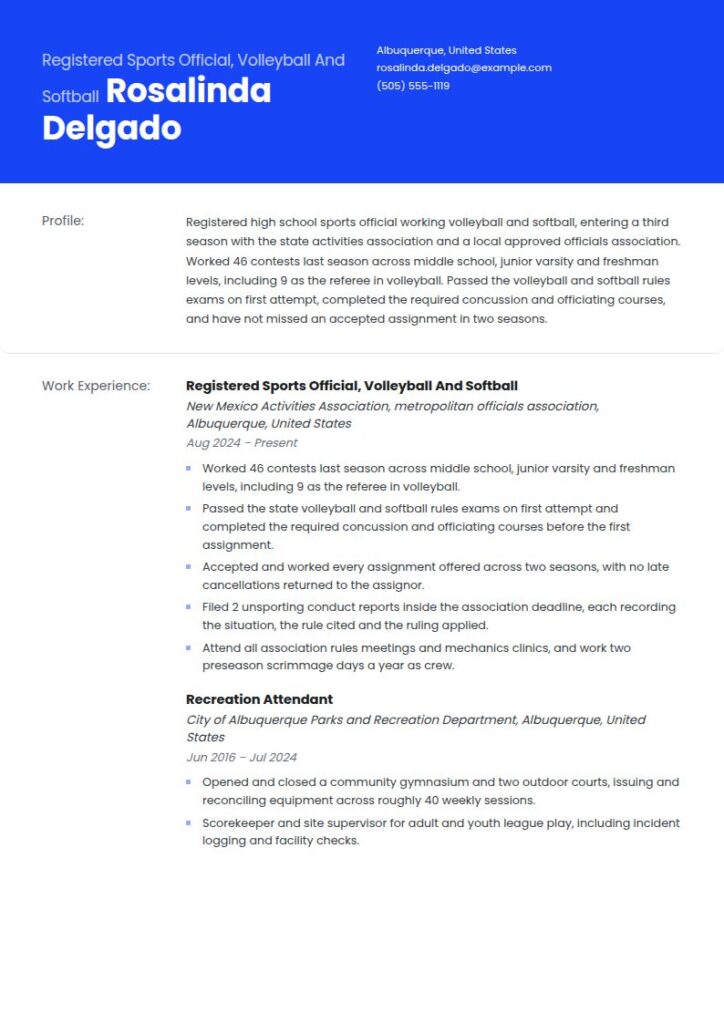
Registered Sports Official, Volleyball and Softball Rosalinda Delgado
Registered Sports Official, Volleyball and Softball
[email protected] | (505) 555-1119 | Albuquerque, United States
Profile
Registered high school sports official working volleyball and softball, entering a third season with the state activities association and a local approved officials association. Worked 46 contests last season across middle school, junior varsity and freshman levels, including 9 as the referee in volleyball. Passed the volleyball and softball rules exams on first attempt, completed the required concussion and officiating courses, and have not missed an accepted assignment in two seasons.
Work Experience
08/2024 - Present, Registered Sports Official, Volleyball and Softball, New Mexico Activities Association, metropolitan officials association, Albuquerque, United States
- Worked 46 contests last season across middle school, junior varsity and freshman levels, including 9 as the referee in volleyball.
- Passed the state volleyball and softball rules exams on first attempt and completed the required concussion and officiating courses before the first assignment.
- Accepted and worked every assignment offered across two seasons, with no late cancellations returned to the assignor.
- Filed 2 unsporting conduct reports inside the association deadline, each recording the situation, the rule cited and the ruling applied.
- Attend all association rules meetings and mechanics clinics, and work two preseason scrimmage days a year as crew.
06/2016 - 07/2024, Recreation Attendant, City of Albuquerque Parks and Recreation Department, Albuquerque, United States
- Opened and closed a community gymnasium and two outdoor courts, issuing and reconciling equipment across roughly 40 weekly sessions.
- Scorekeeper and site supervisor for adult and youth league play, including incident logging and facility checks.
Education
08/2011 - 05/2015, Bachelor of Science, Exercise Science, University of New Mexico, Albuquerque, United States
Coursework in kinesiology, sport administration and injury recognition.
Skills
NFHS volleyball rules, 75
NFHS softball rules, 70
Two-official and three-official mechanics, 65
Pregame conference with crew and coaches, 70
Scorebook and lineup verification, 80
Incident and unsporting conduct reporting, 70
Assignment platform and availability management, 85
Languages
English, native
Spanish, native
Certificates
08/2024, State officiating registration, volleyball and softball, New Mexico Activities Association, NM-8841
Sub-varsity approved. Registration renewed annually.
07/2024, Interscholastic Officiating, NFHS Learning Center
Approved for 3 clock hours.
07/2026, Concussion in Sports, NFHS Learning Center
Completed annually.
02/2026, CPR, AED and First Aid, American Red Cross
Summary
A referee resume is a one to two page document naming the sport and level you are registered to work, the association and assignor who carry you, the games you worked last season, your rules exam result and your rating. This guide gives you three adaptable versions, the assignment record most officials leave off, and current Bureau of Labor Statistics pay for sports officials.
Referee resume examples by experience level
A referee resume is a one to two page document that names the sport and level you are registered to work, the association and assignor who carry you, the games you actually worked last season, the rules exam you passed and the rating you hold.
That is an unusual shape for a resume and it is the right one. In fact, nobody in officiating hires an official on a narrative. Instead, an association adds you to a list, and an assignor checks the list against a register. An assignor filling a varsity schedule, an athletic director hiring a coordinator and a recreation department staffing a youth league all ask the same four questions: are you registered, did you pass the exam, how many games have you worked at this level, and what did the evaluations say. So answer those four in that order and your file does in ten seconds what most officiating resumes never do.
Resume guide for a referee resume
For that reason, this guide and the corresponding referee resume example will cover:
- First, how to write a referee resume, section by section
- Then, why registration, exam and assignment volume belong above your work history
- Also, three adaptable summaries: newly registered, varsity official and officials coordinator
- In addition, how to write ratings, evaluations and the reports you file after an ejection
- Finally, what sports officials earn and where the pay comes from
How to write a referee resume
Overall, six blocks: contact header, summary, registration and certification, assignment record, experience, and skills. Generally, one page for your first several seasons, two once you work varsity across multiple sports, supervise, evaluate or assign.
However, that order is deliberate and it is not the standard one. Registration comes before experience because it is a gate. The Bureau of Labor Statistics puts it plainly: officials typically register with the state or local agency that oversees high school athletics and typically need to pass an exam on the rules of the particular sport (BLS Occupational Outlook Handbook, Umpires, Referees, and Other Sports Officials, last modified 27 August 2026).
| Block | What it is answering | Where it goes |
|---|---|---|
| Sport, level and registration | Can this person legally be assigned to my contests? | Header, directly under the name |
| Rules exam and rating | Did they clear the bar, and what did evaluators say? | Its own short block, with scores and years |
| Assignment record | Have they worked my level, at my volume? | A table or list by season and level |
| Experience and reports | What happens when a game goes wrong with them on it? | Reverse chronological, with the reports named |
Put the sport, the level and the registering body on the first line
Write the first line like a registration entry, because that is what it is: "Volleyball and softball, varsity, registered with the state activities association since 2019, current for 2026 to 2027." A reader can act on that immediately.
Then add the assignor. Assignors hand out the work in this profession, and naming the ones who carry you is a reference that has already been checked.
Run the finished file through the ATS resume checker before you send it. Districts, universities and recreation departments take applications through portals that parse the document before anyone opens it.
Choosing the best resume format for a referee resume
Reverse chronological, single column, plain type, with a separate assignment table. One page for your first several seasons, two once you carry varsity assignments across more than one sport or hold a supervisory or assigning role.
The format decision unique to this career is whether the assignment record sits inside your job entries or in its own block. Put it in its own block. In practice, officiating is rarely one employer: you register with a state association, belong to a local approved association, take work from two or three assignors and collect a per game fee from a dozen schools. Listed as separate jobs, that reads as casual work rather than a career.
Include your contact information
| ✅ Right | ❌ Wrong |
|---|---|
| Rosalinda Delgado | Rosalinda Delgado |
| Volleyball and Softball Official, Varsity, State Registered #NM-8841 | Experienced sports referee |
| Albuquerque, NM. Available weeknights, Saturdays and tournament weekends | Albuquerque, NM |
| (505) 555-1119, [email protected] | (505) 555-1119, [email protected] |
The registration number belongs on the page, because whoever hires you checks it against a register anyway. The availability line matters more here than in most jobs, since officiating is scheduled against a calendar of contests that already exists.
Make use of a summary
Four lines: sport and level, how long registered, the volume you worked last season, and one fact about how you are rated.
Registered high school sports official working volleyball and softball, entering a third season with the state activities association and a local approved officials association. Worked 46 contests last season across middle school, junior varsity and freshman levels, including 9 as the referee in volleyball. Passed the volleyball and softball rules exams on first attempt, completed the required concussion and officiating courses, and have not missed an accepted assignment in two seasons.
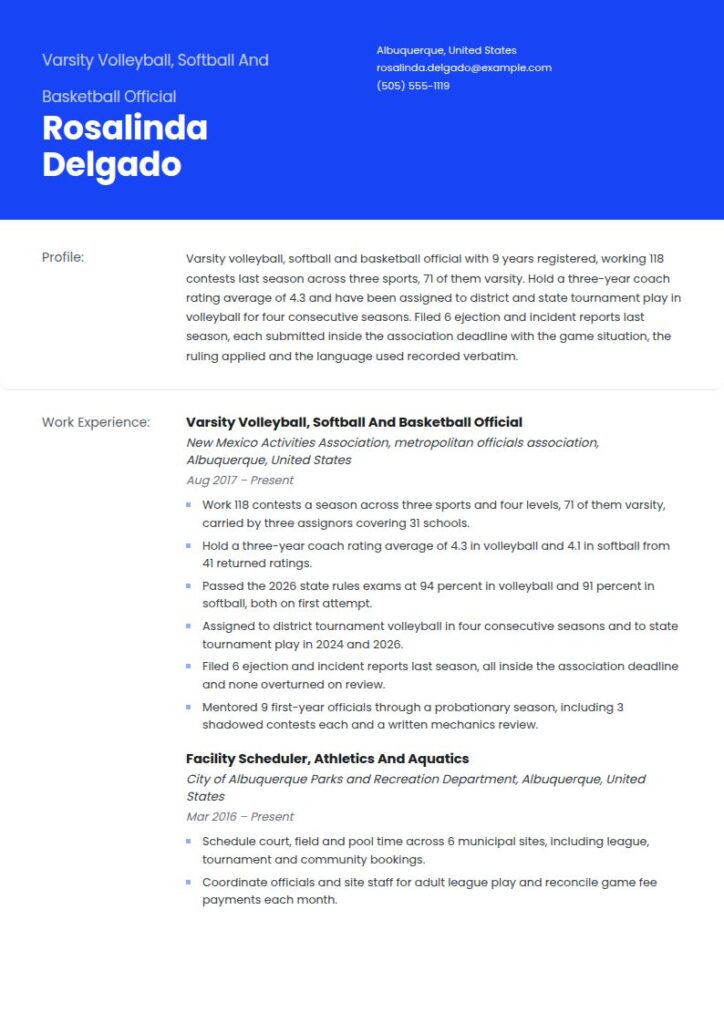
Varsity volleyball, softball and basketball official with 9 years registered, working 118 contests last season across three sports, 71 of them varsity. Hold a three-year coach rating average of 4.3 and have been assigned to district and state tournament play in volleyball for four consecutive seasons. Filed 6 ejection and incident reports last season, each submitted inside the association deadline with the game situation, the ruling applied and the language used recorded verbatim.
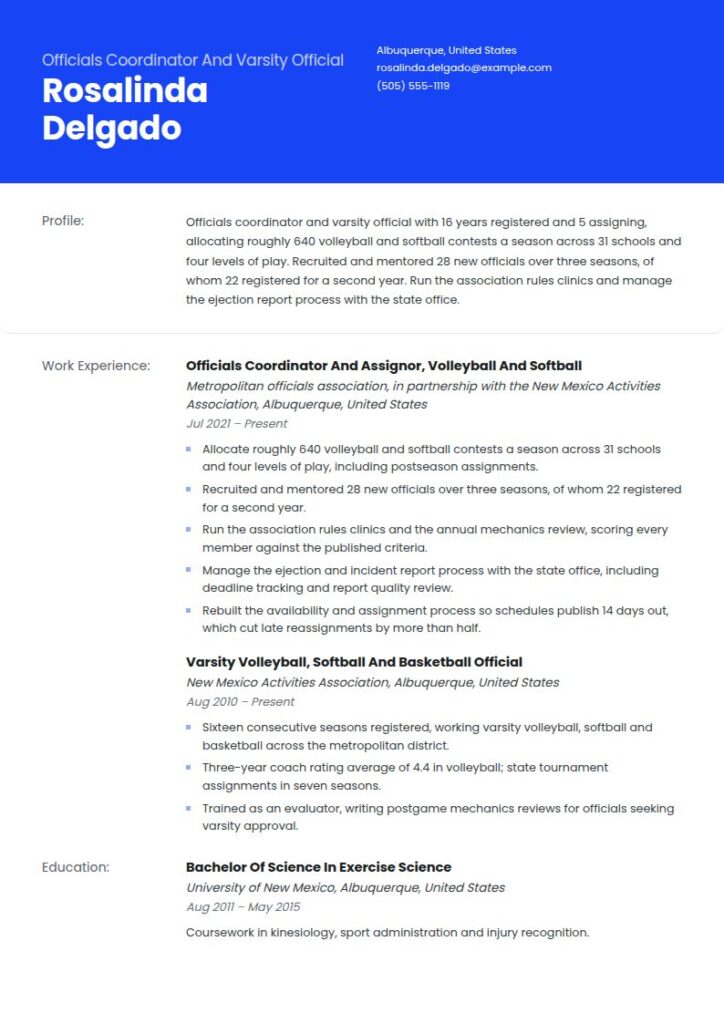
Officials coordinator and varsity official with 16 years registered and 5 assigning, allocating roughly 640 volleyball and softball contests a season across 31 schools and four levels of play. Recruited and mentored 28 new officials over three seasons, of whom 22 registered for a second year. Run the association rules clinics and manage the ejection report process with the state office.
Right vs wrong: the same referee summary, twice
| ✅ Right | ❌ Wrong |
|---|---|
| Varsity volleyball, softball and basketball official with 9 years registered, working 118 contests last season, 71 of them varsity. | Experienced referee with a strong knowledge of the rules and a love of the game. |
| Three-year coach rating average of 4.3 and district and state tournament assignments in volleyball for four consecutive seasons. | Trusted to officiate important games at a high level. |
| Filed 6 ejection and incident reports last season, each inside the association deadline with the ruling applied recorded verbatim. | Able to stay calm under pressure and manage difficult situations. |
For example, everyone who applies for officiating work says they know the rules and stay calm. Those are entry conditions, not evidence. The left column can be verified in a database; by contrast, the right column cannot be verified at all, which is why it reads as filler.
Outline your officiating experience
Association, sport, level, volume and seasons. Then three to five bullets, each naming something an assignor or supervisor can check.
| Instead of | Use |
|---|---|
| Officiated high school sports | Worked 118 contests across volleyball, softball and basketball last season, 71 of them varsity |
| Selected for playoff games | Assigned to district tournament volleyball in four consecutive seasons and to the state tournament in 2024 and 2026 |
Varsity Volleyball, Softball and Basketball Official, registered with the state activities association, Albuquerque, NM, August 2017 to Present. 118 contests last season across three sports and four levels.
Work a three-season calendar: volleyball in the fall, basketball in the winter and softball in the spring, carried by three assignors covering 31 schools.
Hold a three-year coach rating average of 4.3 in volleyball and 4.1 in softball, which has produced district tournament assignments in four consecutive seasons and state assignments in 2024 and 2026.
Filed 6 ejection and incident reports last season under the association reporting rule, each inside the deadline and recording the situation, the rule cited and the ruling applied verbatim; none was overturned on review.
Mentored 9 first-year officials through a probationary season, including 3 shadowed contests each and a written review of mechanics and game management.
Write the registration, the exam and the assignment record
Even so, this is the block that decides officiating hiring and the one almost nobody writes. In short, your resume is a registration and a schedule, and six facts carry it.
Sport, level and registering body. Name the sport, the levels you are approved to work, the state association and the registration year. A permit is not a general license: several associations grade it. The Ohio High School Athletic Association issues three permit classes, where Class 1 may officiate all levels, Class 2 all levels except varsity football, basketball, baseball and softball and the referee position in volleyball, and Class 3 is restricted to seventh, eighth and ninth grade (ohsaa.org, retrieved 17 September 2026). If your state grades permits, write the class.
The association and the assignor. Most state associations expect membership of a local approved association on top of state registration, and the local body runs your clinics and mechanics reviews. Name it, then name the assignors, because they hold the schedule.
Referee games worked and rules exam
Games worked per season, split by level. This is the number the trade runs on and the one most resumes replace with an adjective. Write the count and split it: varsity, junior varsity, freshman, middle school, club and tournament. A hundred middle school contests and a hundred varsity contests are not the same season.
The rules exam. Give the exam, the score and the year. However, each state sets its own requirements; there is no national standard. Ohio requires 75 percent on the mechanics and rules exams plus a proficiency portion, along with concussion training, before issuing a permit (ohsaa.org, retrieved 17 September 2026). Michigan requires new registrants to pass a Principles of Officiating quiz at 70 percent within three attempts and an Officials Guidebook test at 70 percent, with a mechanics exam at 70 percent in basketball and football, alongside a criminal history check and a minimum age of 18 (mhsaa.com, retrieved 17 September 2026). If you passed above the bar, say so, because the bar is public.
Ratings, evaluations and the reports you filed
Your rating or evaluation. Ratings allocate postseason work and are the closest thing officiating has to a performance review. Michigan's postseason requirements are explicit: complete the current year rules meeting, pass a rules exam at 80 percent or better, work a minimum number of regular season contests ranging by sport from 5 in cross country and soccer to 10 in volleyball, basketball and wrestling and 12 in baseball, softball and ice hockey, hold at least 16 coach ratings compiled over the previous three years with a three-year average between 2.7 and 4.25 depending on tournament level, belong to a local approved association in good standing, and submit a season schedule and available tournament dates (mhsaa.com, retrieved 17 September 2026). Your state's numbers will differ, but your rating average and the count behind it belong on the page.
The reports you filed. Ejections, unsporting conduct, injuries and suspended contests generate written reports to the association or the state office, usually on a deadline measured in hours. Write how many you filed, that they went in inside the deadline, and what a good one contains: the situation, the rule cited, the ruling applied and the language used, recorded verbatim. As a result, an official whose reports hold up is one an assignor can send to a hostile gym.
Registration: Volleyball, softball and basketball, varsity approved, state activities association, registered since 2017, current for 2026 to 2027, permit #NM-8841. Member in good standing, metropolitan officials association.
Assignors: Metro volleyball assignor (31 schools), district softball assignor, metro basketball assignor.
Contests last season: 118 total. Volleyball 52 (34 varsity, 12 junior varsity, 6 freshman). Softball 38 (24 varsity, 14 junior varsity). Basketball 28 (13 varsity, 15 sub-varsity). Positions: volleyball R1 and R2; softball plate and base.
Rules exams, 2026: volleyball 94 percent, softball 91 percent, both first attempt. Ratings: three-year coach average 4.3 volleyball and 4.1 softball, from 41 returned ratings.
Postseason: district tournament volleyball 2021, 2022, 2024 and 2026; state tournament volleyball 2024 and 2026.
Reports: 6 ejection and incident reports filed last season, all inside the association deadline, none overturned on review.
Build a snapshot of your key referee skills
Specifically, ten to fourteen entries in three groups: rules and mechanics, game management, and the administration around the contest. Name the thing, not the quality.
Rules and mechanics: NFHS volleyball and softball rules, Two-official and three-official mechanics, R1 and R2 positioning, Plate and base mechanics
Game management: Pregame conference with crew and coaches, Preventive officiating and communication, Unsporting conduct and ejection procedure, Injury stoppage and return to play protocol, Weather and lightning suspension procedure
Administration: Ejection and incident report writing, Contest scheduling and availability management, Assignment platform use, Scorebook and lineup verification, Rules clinic instruction
List your education and certifications
Registration and exams first with dates, then the courses your association requires, then insurance, then any degree. The block is short, current and checked, because most of it is a condition of being on the court.
State activities association officiating registration, volleyball, softball and basketball, varsity approved, #NM-8841, current 2026 to 2027. In New Mexico, registration fees include the National Federation rulebooks, testing material and liability insurance, and registration is subject to a background investigation (nmact.org, retrieved 17 September 2026).
Interscholastic Officiating, NFHS Learning Center, approved for 3 clock hours (nfhslearn.com, retrieved 17 September 2026). Concussion in Sports, annually since 2018.
National Association of Sports Officials member since 2019. CPR, AED and first aid, American Red Cross, current 2026.
Bachelor of Science, Exercise Science, University of New Mexico, Albuquerque, NM, 2015.
Carry your own insurance and say so
Officials work most assignments as independent contractors, so who covers a claim is an open question worth answering on the page.
Answer it twice. Some state associations bundle liability coverage into the registration fee, and if yours does, say so. Then name your own membership: NASO membership carries general liability coverage of up to $6 million per occurrence with a $14 million per official policy aggregate, extending to officiating activities for recognized sport organizations, leagues and associations (naso.org, retrieved 17 September 2026).
A tournament operator reading two otherwise identical files takes the one that has already answered the question.
Choose the right layout and design
In practice, that means single column, 11 or 12 point body type, no photograph, no team or league logos. Keep the assignment record as a short table or labeled list rather than a chart, because a parsed record keeps text and loses graphics.
Put the sport, level, registering body and registration number in the header. Give the games worked last season and split them by level. State your rules exam score and the year. Write your rating average and how many ratings it came from. Name your local association and the assignors who carry you. Say how many reports you filed and that they went in inside the deadline. Write your availability.
Do not claim a registration, permit class or rating you do not currently hold, because every one sits in a database somebody can open. Do not describe yourself as fair, impartial or calm under pressure; that is the job description, not an achievement. Do not write about a particular call or ejection in a way that identifies anyone involved. Do not list every school as a separate employer. Do not let the file drift into coaching language, because an official is not hired on player development.
Referee job market and outlook
Sports officiating is a small published occupation with steady replacement demand, and the level you are assigned to matters more to your pay than anything else on the resume.
| Measure | Value |
|---|---|
| Umpire, referee and sports official jobs, 2025 | 18,200 |
| Projected change, 2025-35 | 5%, 900 jobs |
| Projected annual openings | ~4,300 |
| Typical entry-level education | High school diploma or equivalent |
| Typical on-the-job training | Moderate-term on-the-job training |
| Median annual wage, May 2025 | $40,710 |
Source: U.S. Bureau of Labor Statistics, Occupational Outlook Handbook, Umpires, Referees, and Other Sports Officials, May 2025 wage data and 2025 to 2035 projections, last modified 27 August 2026.
Read the openings column rather than the change column. An occupation of 18,200 jobs projected to add 900 over a decade still turns over roughly 4,300 positions a year, so the market is almost entirely replacement. Officials leave, so a resume showing consecutive seasons registered, ratings that held up and a record of coming back answers what the market is short of.
The industry you officiate in moves your pay more than the title does
Umpires, referees and other sports officials held 18,200 jobs in 2025, with about 4,300 openings projected each year on average over the 2025 to 2035 decade and a median annual wage of $40,710 in May 2025 (BLS Occupational Outlook Handbook, last modified 27 August 2026).
The spread inside that median is where the career decisions sit. Officials in performing arts and spectator sports had a median of $52,790 in May 2025, those in amusement, gambling and recreation $39,060, those in local government excluding education and hospitals $37,440, and those in educational services $35,310. The largest share, 32 percent, works in local government and 17 percent in spectator sports (BLS, May 2025).
That is a gap of more than $17,000 between the top and bottom industry medians for the same skill, bought with registration, exam results, ratings and assignments completed at level. Those are what the assignment record documents.
What salary you can expect as a referee
The median annual wage for umpires, referees and other sports officials was $40,710 as of May 2025, with the lowest 10 percent under $26,540 and the highest 10 percent over $82,960 (BLS Occupational Outlook Handbook, last modified 27 August 2026).
Read those figures carefully, because officiating pay is rarely a salary. It is a game fee multiplied by assignments, so the annual figure is the sum of a schedule. Volume is income: an official working 118 contests earns roughly twice the one working 60 at the same fee, so a file that states the count states its own earning capacity. Level is rate: varsity pays above sub-varsity and postseason above regular season, and the higher levels are allocated on permit class, exam results and ratings rather than on availability.
Industry is the other lever. The 17 percent of officials in performing arts and spectator sports had a median of $52,790 in May 2025 against $37,440 for the 32 percent in local government excluding education and hospitals (BLS, May 2025). Moving between those markets is a progression through registration, evaluation and assignment that takes seasons; that is why the record on your page is what documents it.
Key takeaways for a referee resume
- Lead with sport, level, registering body and registration number, because registration is a gate.
- Write games worked last season and split the count by level, because the levels are not interchangeable.
- Give your rules exam score and the year, since the association publishes the passing bar and yours is comparable to it.
- State your rating average and how many ratings it came from; that is what allocates postseason work.
- Name your local association and the assignors who carry you.
- Also, count the ejection and incident reports you filed and say they went in inside the deadline.
- Name the state association that sets your requirements rather than claiming a national standard.
Build your referee resume in 15 minutes with our AI resume builder.
Related sport and fitness resume examples
- Coach resume
- Sports resume
- Basketball coach resume
- Football coach resume
- Soccer coach resume
- Volleyball coach resume
- Baseball coach resume
- Hockey coach resume
- Track coach resume
- Athletic trainer resume
- Recreational facility attendant resume
- Lifeguard resume
Pair it with a matching referee cover letter.
Referee resume questions, answered
How long should a referee resume be?
One page for your first several seasons. Two once you work varsity across more than one sport, hold postseason assignments, or supervise, evaluate or assign other officials. The assignment record is usually what justifies the second page.
What do I put on a referee resume with no games worked yet?
Write the registration process itself as progress, because it is. Your state registration with its date, the rules exam and the score, the officiating and concussion courses, your local association membership, and any scrimmage, camp or shadowed contest. Then write availability plainly. What an assignor wants to know about a new official is whether you are registered, whether you will answer the phone, and whether you will still be there in March.
How do I write about ejections without naming anyone?
Describe the procedure, not the person. Write the number of reports filed, that each went in inside the deadline, and what they contain: the situation, the rule cited, the ruling applied and the language used, recorded verbatim. Never name or describe a coach, player or spectator, and never write about a specific contest in a way that identifies one.
Do I need certification to referee, and who issues it?
For high school contests, yes, and it is issued locally rather than nationally. BLS reports that officials typically register with the state or local agency overseeing high school athletics and typically need to pass a rules exam for the sport (BLS Occupational Outlook Handbook, last modified 27 August 2026). Specifics differ by state: Ohio requires 75 percent on mechanics and rules exams plus a proficiency portion and concussion training before issuing a permit (ohsaa.org, retrieved 17 September 2026), while Michigan sets a minimum age of 18, a criminal history check and tests at 70 percent for new registrants (mhsaa.com, retrieved 17 September 2026). Name your own state's body rather than a national rule.
Is officiating a full-time career?
For most people it is contract work paid by the contest, which is why the BLS median of $40,710 in May 2025 sits alongside a tenth percentile under $26,540 and a ninetieth over $82,960 (BLS, May 2025). The salaried roles are administrative: assignors, coordinators of officials, conference supervisors and state office staff, filled from officials who already have a rating history.