Athletic Trainer Camille Beauchamp MS, ATC
Athletic Training Student, Immersive Clinical Placements
[email protected] | (615) 555-0208 | Nashville, United States
Profile
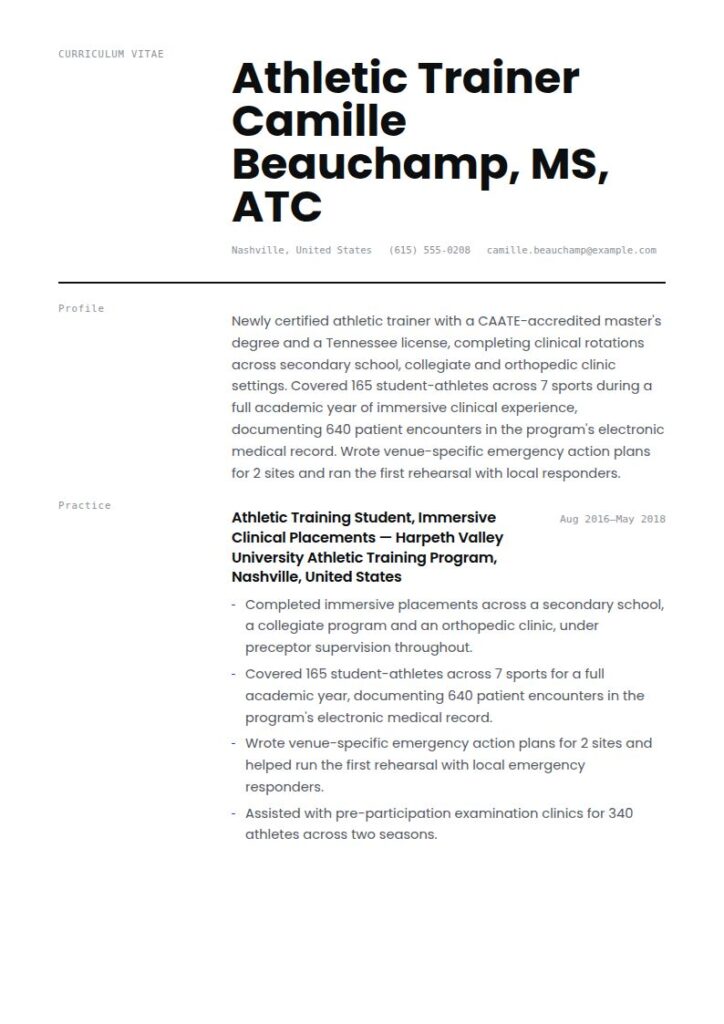
Newly certified athletic trainer with a CAATE-accredited master's degree and a Tennessee license, completing clinical rotations across secondary school, collegiate and orthopedic clinic settings. Covered 165 student-athletes across 7 sports during a full academic year of immersive clinical experience, documenting 640 patient encounters in the program's electronic medical record. Wrote venue-specific emergency action plans for 2 sites and ran the first rehearsal with local responders.
Work Experience
08/2016 - 05/2018, Athletic Training Student, Immersive Clinical Placements, Harpeth Valley University Athletic Training Program, Nashville, United States
- Completed immersive placements across a secondary school, a collegiate program and an orthopedic clinic, under preceptor supervision throughout.
- Covered 165 student-athletes across 7 sports for a full academic year, documenting 640 patient encounters in the program's electronic medical record.
- Wrote venue-specific emergency action plans for 2 sites and helped run the first rehearsal with local emergency responders.
- Assisted with pre-participation examination clinics for 340 athletes across two seasons.
06/2015 - 05/2016, Rehabilitation Aide, Cumberland Sports Medicine, Murfreesboro, United States
- Prepared treatment areas, set up therapeutic exercise equipment and logged patient arrivals for an outpatient sports medicine clinic.
- Maintained supply inventory and modality cleaning schedules under clinician direction.
Education
08/2016 - 05/2018, Master of Science, Athletic Training, Harpeth Valley University, Nashville, United States
CAATE-accredited professional athletic training program. Immersive clinical placements across secondary school, collegiate and orthopedic clinic settings.
08/2012 - 05/2016, Bachelor of Science, Exercise Science, Harpeth Valley University, Nashville, United States
Coursework in human anatomy, biomechanics and exercise physiology.
Skills
Orthopedic evaluation of the upper and lower extremity, 65
Taping and bracing, 80
Emergency cardiac care and automated external defibrillator use, 85
Emergency action plan development, 60
Concussion assessment and graded return to play, 65
Athletic training electronic medical record documentation, 75
Languages
English, native
Spanish, intermediate
Certificates
06/2018, BOC Certified Athletic Trainer (ATC), Board of Certification for the Athletic Trainer, 180417
Current through the 2026 to 2028 certification maintenance period. Emergency cardiac care maintained continuously.
07/2018, Licensed Athletic Trainer, Tennessee, State of Tennessee, TN-AT-4192
Current through 2027.
02/2026, Emergency Cardiac Care, CPR and AED for the Professional Rescuer, American Red Cross
Adult, pediatric and second rescuer CPR with AED, renewed on schedule.
Summary
An athletic trainer resume is a one to two page clinical document naming your state license, your BOC certification, the physician you practice under and the emergency action plan you have rehearsed at each venue. This guide gives you three adaptable versions, the scope-of-practice block most applicants leave out, and current Bureau of Labor Statistics pay and outlook.
Athletic Trainer resume examples by experience level
An athletic trainer resume is a one to two page clinical document that names your state license, your Board of Certification credential, the physician you practice under, and the emergency action plan you have rehearsed at every venue you cover.
It is a healthcare resume, and the pages that get filtered out are the ones that read like coaching resumes. The National Athletic Trainers' Association describes athletic trainers as "highly qualified, multi-skilled health care professionals who render service or treatment, under the direction of or in collaboration with a physician, in accordance with their education, training and the state's statutes, rules and regulations" (nata.org, retrieved 17 September 2026). Every clause there is a line a hiring reader checks for.
The reader is a clinical supervisor, a practice manager or an athletics administrator with a risk officer behind them, and their question is narrow: can this person legally do the work here, under whose orders, and what happens when someone collapses on the field.
Resume guide for an athletic trainer resume
This guide and the corresponding athletic trainer resume example will cover:
- How to write an athletic trainer resume, section by section
- Why license, credential and physician direction belong above experience
- Three adaptable summaries: newly certified, practicing and head athletic trainer
- The emergency action plan block that almost nobody writes
- What the job market pays, and what your setting is worth
How to write an athletic trainer resume
Six blocks: contact header, summary, credentials and scope, clinical experience with population counts, emergency preparedness, skills, and education.
The order is the argument. Credentials sit above experience because they are a gate, not an achievement. An applicant without the license the state requires is a no whatever else the page says.
| Block | What it is answering | Where it goes |
|---|---|---|
| License and certification | Can this person legally practice here, and is it current? | Directly under the summary |
| Settings and population | What have they actually covered, and how many people? | Header line of each role |
| Emergency preparedness | What happens at this venue when it goes wrong? | Its own short block |
Write the population, the settings and the sports in the header line of every role
Athletic training roles are not interchangeable, and the difference is almost entirely load. Covering 190 athletes across eight sports at one secondary school is a different job from covering one collegiate contact sport with a staff of four.
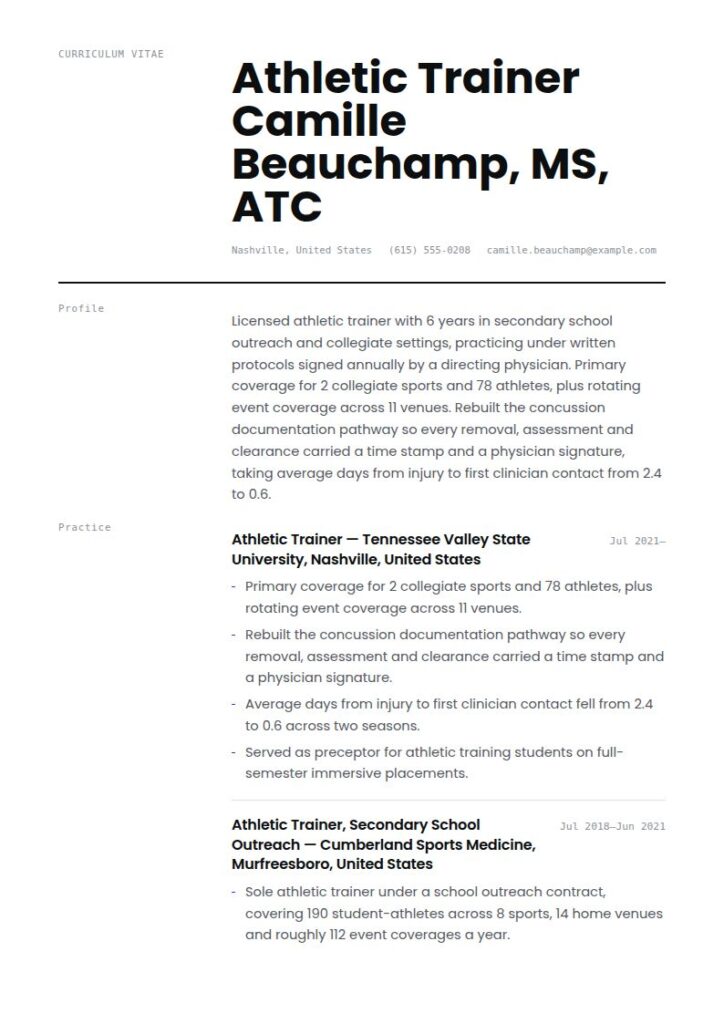
Write it as a count, not an adjective: "sole athletic trainer for 190 student-athletes across 8 sports, 14 home venues", or "one of four staff athletic trainers, primary coverage for 2 sports and 78 athletes". A reader who knows the work can tell from that line whether you have run a service alone. None of it survives a bullet beginning "responsible for the health and safety of student-athletes".
Run the finished file through the ATS resume checker before you send it. Hospital systems and university athletics departments both screen through portals that read the file into a structured record first, and credential fields are what they parse hardest.
Choosing the best resume format for an athletic trainer resume
Reverse chronological, single column, plain type. One page for your first five years, two once you carry a supervisory line, a clinical education appointment or several settings.
Functional formats fail because the reader is checking credential currency against a timeline: a format that hides when you worked also hides whether certification lapsed between two roles. Keep clinical language clinical. "Evaluated, treated and returned to play" is a scope statement; "helped athletes get better" is not.
Include your contact information
| ✅ Right | ❌ Wrong |
|---|---|
| Camille Beauchamp, MS, ATC | Camille Beauchamp |
| Licensed Athletic Trainer, Tennessee #TN-AT-4192 | Certified athletic trainer |
| BOC #180417, current through the 2026 to 2028 reporting period | BOC certified |
| (615) 555-0208, [email protected], Nashville, TN | (615) 555-0208, [email protected] |
Put the credential letters after your name and the license number on the page. Human resources verifies both before anyone calls.
Make use of a summary
Four lines: credential and license, setting and population, one result with a number, and emergency preparedness.
Newly certified athletic trainer with a CAATE-accredited master's degree and a Tennessee license, completing clinical rotations across secondary school, collegiate and orthopedic clinic settings. Covered 165 student-athletes across 7 sports during a full academic year of immersive clinical experience, documenting 640 patient encounters in the program's electronic medical record. Wrote venue-specific emergency action plans for 2 sites and ran the first rehearsal with local responders.
Licensed athletic trainer with 6 years in secondary school outreach and collegiate settings, practicing under written protocols signed annually by a directing physician. Primary coverage for 2 collegiate sports and 78 athletes, plus rotating event coverage across 11 venues. Rebuilt the concussion documentation pathway so every removal, assessment and clearance carried a time stamp and a physician signature, taking average days from injury to first clinician contact from 2.4 to 0.6.
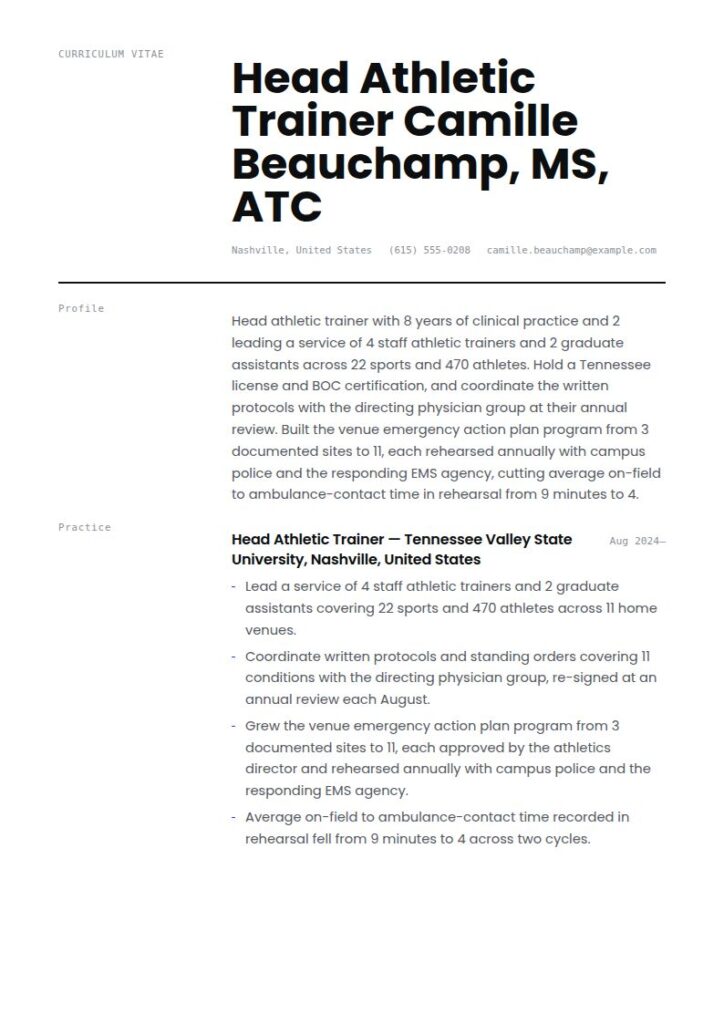
Head athletic trainer with 8 years of clinical practice and 2 leading a service of 4 staff athletic trainers and 2 graduate assistants across 22 sports and 470 athletes. Hold a Tennessee license and BOC certification, and coordinate the written protocols with the directing physician group at their annual review. Built the venue emergency action plan program from 3 documented sites to 11, each rehearsed annually with campus police and the responding EMS agency, cutting average on-field to ambulance-contact time in rehearsal from 9 minutes to 4.
Right vs wrong: the same athletic trainer summary, twice
| ✅ Right | ❌ Wrong |
|---|---|
| Licensed athletic trainer with 6 years in secondary school outreach and collegiate settings, practicing under written protocols signed annually by a directing physician. | Experienced sports medicine professional with a strong background in athletic training. |
| Primary coverage for 2 collegiate sports and 78 athletes, plus rotating event coverage across 14 venues. | Provided care to student-athletes in a fast-paced collegiate environment. |
| Took the average days from injury to first clinician contact from 2.4 to 0.6. | Committed to keeping athletes healthy and performing at their best. |
The left column is a scope of practice a supervisor can sign off on. The right column is an attitude, and nobody signs off a scope of practice on one.
Outline your athletic trainer experience
Employer, setting, city, population covered and dates. Then four to six bullets, each naming a clinical activity, a system or a program, and each carrying a number.
| Instead of | Use |
|---|---|
| Provided athletic training services to student-athletes | Sole athletic trainer for 190 student-athletes across 8 sports, 14 home venues, 112 event coverages a year |
| Evaluated and treated injuries | Documented 1,340 patient encounters a year in the athletic training electronic medical record, same-day notes on every acute evaluation |
| Worked with team physicians | Practiced under written protocols reviewed and signed annually by the directing physician, standing orders covering 11 conditions |
| Handled emergency situations | Wrote venue-specific emergency action plans for 11 sites, each rehearsed annually with the responding EMS agency |
Head Athletic Trainer, Tennessee Valley State University, Nashville, TN, August 2024 to Present
Lead a service of 4 staff athletic trainers and 2 graduate assistants covering 22 sports and 470 athletes, with responsibility for coverage assignments, protocol review and the emergency action plan program.
Practice under written protocols and standing orders agreed with the directing physician group and re-signed at an annual review, with scope limits stated rather than assumed.
Grew the venue emergency action plan program from 3 documented sites to 11, each written to the venue, approved by the athletics director and rehearsed annually with campus police and the responding EMS agency.
Average on-field to ambulance-contact time in rehearsal fell from 9 minutes to 4 across two cycles, once the gate access problem behind most of the delay was fixed.
Standardized documentation so every acute evaluation carries a same-day note, taking the audit exception rate from 14 percent to under 2 percent. Preceptor for 6 athletic training students.
Your practice act, your directing physician and the emergency action plan you rehearsed
This is the block that separates an athletic trainer resume from everything else in the folder, and most applicants leave all three parts out.
Start with the practice act, because it is not one rule. NATA states that athletic trainers "are licensed or otherwise regulated in 50 states and the District of Columbia" and that "most require ATs to hold the Board of Certification credential of 'Athletic Trainer Certified' (ATC)" (nata.org, retrieved 17 September 2026). BLS puts it more cautiously: nearly all states require a license or certification, requirements vary by state, and certification typically requires graduating from an accredited program and passing a qualifying exam (BLS Occupational Outlook Handbook, Athletic Trainers, last modified 27 August 2026).
Read those together and the instruction is clear. There is no national scope of practice to appeal to. Your own state's practice act governs you, and it differs from the one next door in what you may evaluate, what you may treat, who must direct you, and what has to be in writing. Write your own state's requirement, and never borrow scope language from a state you do not work in.
| The line on your resume | The question it answers | What makes it credible |
|---|---|---|
| State license and number | May this person practice here on day one? | The issuing board named, the number, the expiry date |
| BOC certification | Do they hold the credential the state relies on? | The certification number and the reporting period it is current through |
| Directing or collaborating physician | Under whose orders do they work? | The relationship named, plus when the protocols were last signed |
| Emergency action plans | What happens when it goes wrong here? | Venues documented, rehearsal frequency, who attended |
The second part is the physician relationship, and clinical supervisors read it closest. NATA's definition puts the work "under the direction of or in collaboration with a physician", so the resume line is not "worked with team physicians". It is the arrangement: who directs you, what the protocols cover, when they were last signed.
The third part is the emergency action plan, the most under-written section in the occupation. The NATA position statement on emergency action plan development and implementation in sport, published in the Journal of Athletic Training in 2024, states that "institutions and organizations that sponsor athletic events have a responsibility to develop a written EAP for all sponsored activities" and that they "should develop EAPs specific to each venue and sport". It adds that the plan should be reviewed "at least annually", rehearsed "at least annually (ie, 1 time per year or more)" with rehearsals that "involve all members of the health care team, including local emergency responders", and that it "should be approved by organizational leadership" (nata.org, retrieved 17 September 2026).
Four things there become four numbers on your resume: how many venues you have a written plan for, when each was last reviewed, when each was last rehearsed, and who was in the room. A rehearsal that included the responding EMS agency is a different claim from a plan that lives in a binder.
License and certification: Licensed Athletic Trainer, Tennessee, #TN-AT-4192, current through 2027. BOC Certified Athletic Trainer, #180417, current through the 2026 to 2028 reporting period, emergency cardiac care maintained continuously.
Physician direction: Written protocols and standing orders agreed with the directing physician group, covering 11 conditions, reviewed and re-signed each August.
Settings covered: Collegiate athletics, 22 sports and 470 athletes, 11 home venues. Previously secondary school outreach under a clinic contract, 190 student-athletes across 8 sports.
Emergency action plans: 11 venue-specific written plans, each approved by the athletics director, reviewed and rehearsed annually with campus police and the responding EMS agency, debriefs documented.
Documentation: Athletic training electronic medical record, roughly 1,340 patient encounters a year across the service, same-day notes on all acute evaluations.
Write those five lines and the reader has your scope of practice in twenty seconds. Leave them out and the page reads like a coaching resume with medical vocabulary in it.
Build a snapshot of your key athletic trainer skills
Ten to fourteen entries in three groups: clinical, emergency and risk, and administration and systems. Name modalities and frameworks, not qualities.
Clinical: Orthopedic evaluation of the upper and lower extremity, Concussion assessment and graded return to play, Therapeutic exercise and rehabilitation programming, Manual therapy within state scope, Taping and bracing
Emergency and risk: Emergency action plan development and rehearsal, Emergency cardiac care and automated external defibrillator use, Spine motion restriction and equipment removal, Exertional heat illness recognition and cooling
Administration and systems: Protocol and standing order review with a directing physician, Coverage scheduling across venues, Preceptor supervision of athletic training students, Athletic training electronic medical record and injury surveillance reporting, Pre-participation examination workflow
List your education and certifications
Degree first, then certification, then license, then the continuing education you are current on.
The degree level is not a preference. The Commission on Accreditation of Athletic Training Education states that professional programs "lead to eligibility to sit for the Board of Certification (BOC) Certification Examination", and that after fall 2022 baccalaureate programs stopped enrolling new students, so entrants now come through graduate programs (caate.net, retrieved 17 September 2026). NATA puts it plainly: "athletic trainers must graduate from an accredited master's program" (nata.org, retrieved 17 September 2026).
Certification maintenance is worth its own line, because it is checked. The Board of Certification runs a maintenance period ending 31 January 2028 and publishes two renewal routes: legacy renewal requiring 50 continuing education units including at least 10 from Category A, and continuing professional certification renewal requiring 40 units including at least 10 from Category A for those certified before 2026. It also requires ongoing emergency cardiac care certification throughout the reporting period, for which no units are awarded, and compliance with the BOC Standards of Professional Practice (bocatc.org, retrieved 17 September 2026).
Master of Science, Athletic Training, CAATE-accredited professional program, Harpeth Valley University, Nashville, TN, 2018. Immersive placements across secondary school, collegiate and clinic settings.
Bachelor of Science, Exercise Science, Harpeth Valley University, Nashville, TN, 2016.
BOC Certified Athletic Trainer, #180417, since 2018, current through the 2026 to 2028 reporting period, emergency cardiac care maintained continuously. Licensed Athletic Trainer, Tennessee, #TN-AT-4192, current through 2027.
Continuing education: 52 units reported in the last completed period, 14 of them Category A in emergency care and concussion management.
Choose the right layout and design
Single column, 11 or 12 point body type, clear headings, no photograph, no rating bars. Two-column templates are where a credential number gets parsed away from its authority.
Put the credential letters after your name and the license number and expiry in the header. Name your own state's practice act requirement. State the physician direction arrangement and when the protocols were last signed. Give athlete counts, sport counts and venue counts. List emergency action plans by venue with the last rehearsal date and who attended.
Do not describe your scope in language from a state you have not worked in, because practice acts differ and the reader knows theirs. Do not write "certified athletic trainer" with no number. Do not let a lapsed credential sit on the page undated. Do not borrow coaching vocabulary such as "developed athletes" for clinical work. Do not name an athlete, a patient, or an injury that could identify someone.
That last point is not style. An athletic training service is small enough that one identifying detail names a person. Describe the population and the process, never the case.
Athletic trainer job market and outlook
A small occupation growing quickly in percentage terms, producing far fewer openings than that rate suggests.
| Measure | Value |
|---|---|
| Athletic trainer jobs, 2025 | 35,200 |
| Projected change, 2025-35 | 13%, +4,400 |
| Projected annual openings | ~2,400 |
| Typical entry-level education | Master's degree |
| Median annual wage, May 2025 | $62,520 |
Source: BLS Occupational Outlook Handbook, Athletic Trainers, May 2025 wage data and 2025 to 2035 projections, last modified 27 August 2026.
Thirteen percent growth, about 2,400 openings a year
Athletic training is projected to grow 13 percent from 2025 to 2035, adding 4,400 jobs, with about 2,400 openings projected each year on average over the decade (BLS Occupational Outlook Handbook, last modified 27 August 2026).
Those numbers belong together. A 13 percent rate on a base of 35,200 jobs is a small absolute number of new posts, and about 2,400 openings a year nationally is a thin market. Applicants read the percentage as an easy job search and are surprised.
For the page it means your resume competes against other qualified athletic trainers, all of whom hold the credential. Separation comes from the scope block: venues, protocols, rehearsals, documentation.
Where the jobs sit, and what each setting pays:
| Setting | Share of employment | Median annual wage (May 2025) |
|---|---|---|
| Educational services, state, local and private | 40% | $64,340 |
| Hospitals | 16% | $62,690 |
| Offices of physical, occupational and speech therapists and audiologists | 14% | $61,060 |
| Offices of physicians | 11% | $61,820 |
| Arts, entertainment and recreation | 7% | $71,810 |
Source: BLS Occupational Outlook Handbook, Athletic Trainers, May 2025.
That table is the real trade in this occupation. Educational services holds 40 percent of the jobs at $64,340; arts, entertainment and recreation holds 7 percent at $71,810, a difference of $7,470 a year. The better-paying sector is a fifth the size and its schedules run on events, not a school calendar.
What salary you can expect as an athletic trainer
The median annual wage for athletic trainers was $62,520 as of May 2025. The lowest 10 percent earned less than $48,180 and the highest 10 percent more than $88,760 (BLS Occupational Outlook Handbook, last modified 27 August 2026).
That is a narrow spread for a master's-entry healthcare occupation, and the reason is structural: most of these jobs sit inside salary bands set by school districts, university athletics departments, hospital systems and physician groups. Little of the range is negotiation and most of it is setting, which the industry table prices. Moving from educational services at $64,340 to arts, entertainment and recreation at $71,810 is the largest published step in the occupation, and it is a move between working patterns rather than a promotion.
Inside a setting the resume still moves money, just less of it. Supervisory responsibility, clinical education appointments, an outreach contract you are the named provider on, and specialty roles attached to a physician practice all sit above the base band, and all are awarded against documentation rather than tenure. Weighing an offer, compare what never appears in a wage figure: how many venues you would cover alone, and who signs the protocols.
Key takeaways for an athletic trainer resume
- Lead with the license, the state, the number and the expiry; it is a gate, not an achievement.
- Put the BOC certification number and the reporting period it is current through beside it.
- Name the physician direction arrangement and when the protocols were last signed.
- Write your own state's requirement; practice acts differ and there is no national rule.
- Give the population by number: athletes or patients, sports, venues, encounters a year.
- List emergency action plans by venue with the last rehearsal date and who attended.
- Keep every clinical claim non-identifying.
Build your athletic trainer resume in 15 minutes with our AI resume builder.
Related sport and fitness resume examples
- Personal trainer resume
- Fitness instructor resume
- Nutritionist resume
- Lifeguard resume
- Coach resume
- Football coach resume
- Soccer coach resume
- Basketball coach resume
- Hockey coach resume
- Student athlete resume
- Sports resume
- Yoga instructor resume
Pair it with a matching athletic trainer cover letter.
Athletic trainer resume questions, answered
How long should an athletic trainer resume be?
One page for your first five years. Two once you supervise staff, hold a clinical education appointment, run an outreach contract, or cover enough settings that collapsing them loses the point.
Do I need to list my license number and BOC number?
Yes, with the issuing authority and the currency date. Both are verifiable and the reader will check. "BOC certified" with no number forces a human to go looking before they can shortlist you.
How do I write about scope of practice when I am applying to another state?
Write your current license and state exactly, then say that you are eligible for or have applied for licensure in the target state, with the date. Do not describe your clinical scope in the target state's language before you hold its credential. NATA reports that athletic trainers are licensed or otherwise regulated in 50 states and the District of Columbia and that requirements differ (nata.org, retrieved 17 September 2026).
What do I put on an athletic trainer resume with no paid experience yet?
Your immersive clinical placements, written as jobs: the setting, the sports, the athlete count, the encounter count, and any emergency action plan work you contributed to. A newly certified applicant who can describe a documented rehearsal is ahead of most of the pile.
How do I show clinical results without breaking confidentiality?
Report process and population, never cases. Time from injury to first clinician contact, documentation exception rates at audit, rehearsal times, coverage ratios. All are numbers the reader can trust, and none can be traced to a person.