Personal Trainer, NASM-CPT Tunde Adeyemi-Clarke
Personal Trainer (employed, hourly plus session commission)
[email protected] | (225) 555-1882 | Baton Rouge, United States
Profile
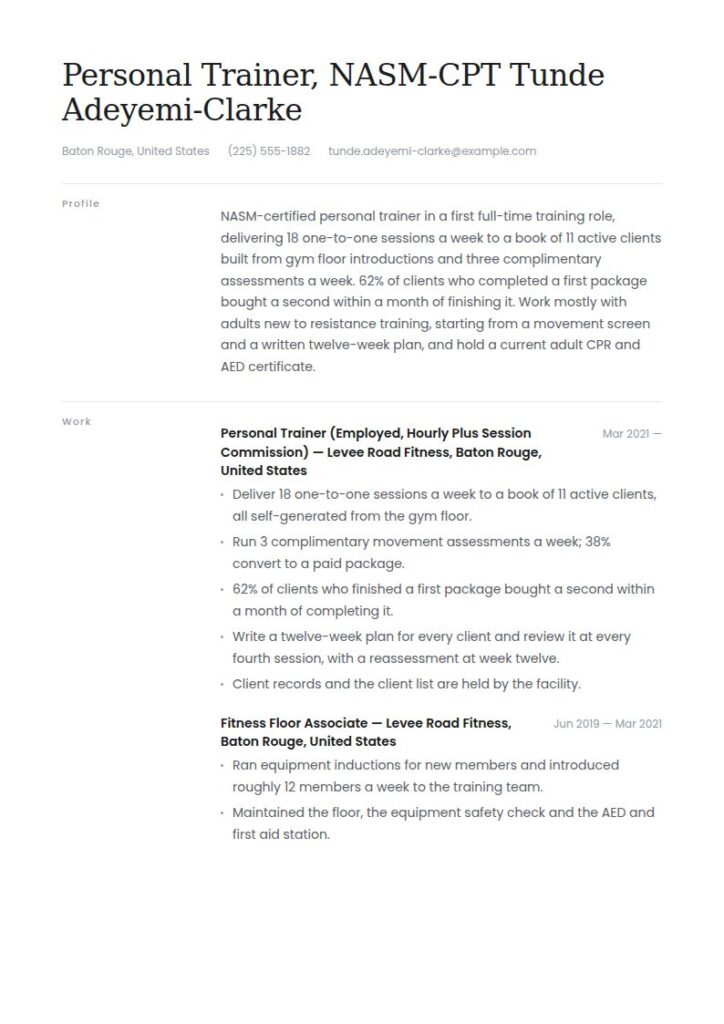
NASM-certified personal trainer in a first full-time training role, delivering 18 one-to-one sessions a week to a book of 11 active clients built from gym floor introductions and three complimentary assessments a week. 62% of clients who completed a first package bought a second within a month of finishing it. Work mostly with adults new to resistance training, starting from a movement screen and a written twelve-week plan, and hold a current adult CPR and AED certificate.
Work Experience
03/2021 - Present, Personal Trainer (employed, hourly plus session commission), Levee Road Fitness, Baton Rouge, United States
- Deliver 18 one-to-one sessions a week to a book of 11 active clients, all self-generated from the gym floor.
- Run 3 complimentary movement assessments a week; 38% convert to a paid package.
- 62% of clients who finished a first package bought a second within a month of completing it.
- Write a twelve-week plan for every client and review it at every fourth session, with a reassessment at week twelve.
- Client records and the client list are held by the facility.
06/2019 - 03/2021, Fitness Floor Associate, Levee Road Fitness, Baton Rouge, United States
- Ran equipment inductions for new members and introduced roughly 12 members a week to the training team.
- Maintained the floor, the equipment safety check and the AED and first aid station.
Education
08/2015 - 05/2019, Bachelor of Science, Kinesiology, Louisiana State University, Baton Rouge, United States
Coursework in exercise physiology, biomechanics and resistance training program design.
Skills
Movement screening and reassessment, 75
Twelve-week program design, 70
Resistance training technique coaching, 80
Assessment to package conversion, 65
PAR-Q and health history screening, 80
Trainerize program delivery, 75
Languages
English, native
Yoruba, native
Certificates
02/2021, NASM Certified Personal Trainer, National Academy of Sports Medicine
NCCA-accredited credential. Renewal every two years requires 2.0 approved Continuing Education Units, including 0.1 CEUs from a required CPR and AED certification.
06/2025, Adult CPR and AED, American Red Cross
Summary
A personal trainer resume is a one to two page document describing the book of clients you carry: how many sessions you deliver a week, how many clients stay over a stated window, how many packages renew, and who pays you. This guide gives you three adaptable versions, the client book block almost nobody writes, and current Bureau of Labor Statistics pay and outlook.
Personal Trainer resume examples by experience level
A personal trainer resume is a one to two page document describing the book of clients you carry: how many sessions you deliver in a week, how many clients are still training with you a year later, how many packages renew, how many clients arrive by referral, and who is actually paying you.
That last question is not a detail. A fitness manager is trying to work out whether you were an employee with clients assigned from the gym floor, a commission trainer who built a book inside someone else's facility, or an independent contractor renting space. Those are three different jobs, and a resume that does not say which one you had leaves the reader guessing at the thing that predicts whether you will succeed in theirs.
Resume guide for a personal trainer resume
This guide and the corresponding personal trainer resume example will cover:
- How to write a personal trainer resume, section by section
- The client book block: sessions, retention, renewals, referrals and who pays
- Three adaptable summaries: first training role, established book and manager
- What NASM and ACE publish about certification, accreditation and renewal
- What the market looks like and what you can expect to earn
How to write a personal trainer resume
Six sections: contact header with your certification, summary, a client book block, training experience, certifications and skills. The client book block goes directly under the summary, because everything else on the page is a proxy for it.
| Section | What it is answering | Where it goes |
|---|---|---|
| Certification | Is this person insurable, and is the credential accredited? | Header line, then a block with dates |
| Client book | Can this person hold a book, or only fill a schedule once? | Its own block, under the summary |
| Training experience | What kind of clients, and what did their training actually change? | Reverse chronological, with numbers |
| Employment status | Employee, commission trainer, or independent contractor? | Stated plainly in each role line |
Write retention as a percentage with a window attached
"Excellent client retention" appears on almost every personal trainer resume and means nothing, because retention without a window is not a measurement.
Write it the way a fitness manager tracks it: "71% of clients who started in 2025 were still training with me twelve months later." Or, if your gym counts by package: "64% bought a second package, and 41% a third."
Both can be wrong, which is why they are worth writing. A number that could be checked is a different kind of claim from an adjective, and the manager already knows what a normal retention figure looks like in their own facility.
Run the finished file through the ATS resume checker before you send it. Gym groups and corporate wellness employers parse applications before a person reads them.
Choosing the best resume format for a personal trainer resume
Reverse chronological. One page for your first three years, two once you carry a full book or manage other trainers.
The format question that matters here is not chronological against functional. It is whether each role line says how you were engaged: "Personal Trainer (employed, hourly plus session commission)" or "Personal Trainer (independent contractor, monthly floor rent)". That parenthesis answers a question the interviewer would otherwise spend ten minutes on.
Include your contact information
| ✅ Right | ❌ Wrong |
|---|---|
| Tunde Adeyemi-Clarke | Tunde Adeyemi-Clarke |
| Personal Trainer, NASM-CPT | Fitness coach and transformation specialist |
| 34 sessions a week, 28 active clients, 71% twelve-month retention | Helping clients become the best version of themselves |
| (225) 555-1882, [email protected], Baton Rouge, LA | (225) 555-1882, [email protected] |
Put three numbers in the header: sessions a week, active clients, and retention with its window. A manager can price you from those three lines, and pricing you is what they are doing.
Make use of a summary
Four lines: certification, the size and shape of your book, one retention or renewal number with a window, and the clients you are best with.
NASM-certified personal trainer in a first full-time training role, delivering 18 one-to-one sessions a week to a book of 11 active clients built from gym floor introductions and three complimentary assessments a week. 62% of clients who completed a first package bought a second within a month of finishing it. Work mostly with adults new to resistance training, starting from a movement screen and a written twelve-week plan, and hold a current adult CPR and AED certificate.
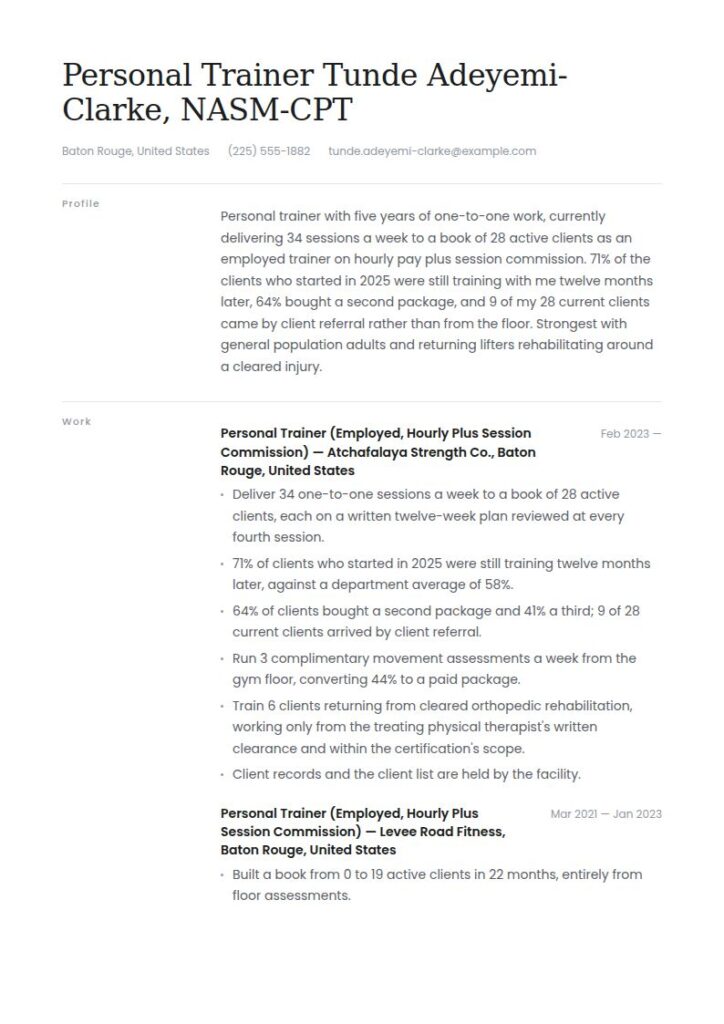
Personal trainer with five years of one-to-one work, currently delivering 34 sessions a week to a book of 28 active clients as an employed trainer on hourly pay plus session commission. 71% of the clients who started in 2025 were still training with me twelve months later, 64% bought a second package, and 9 of my 28 current clients came by client referral rather than from the floor. Strongest with general population adults and returning lifters rehabilitating around a cleared injury.
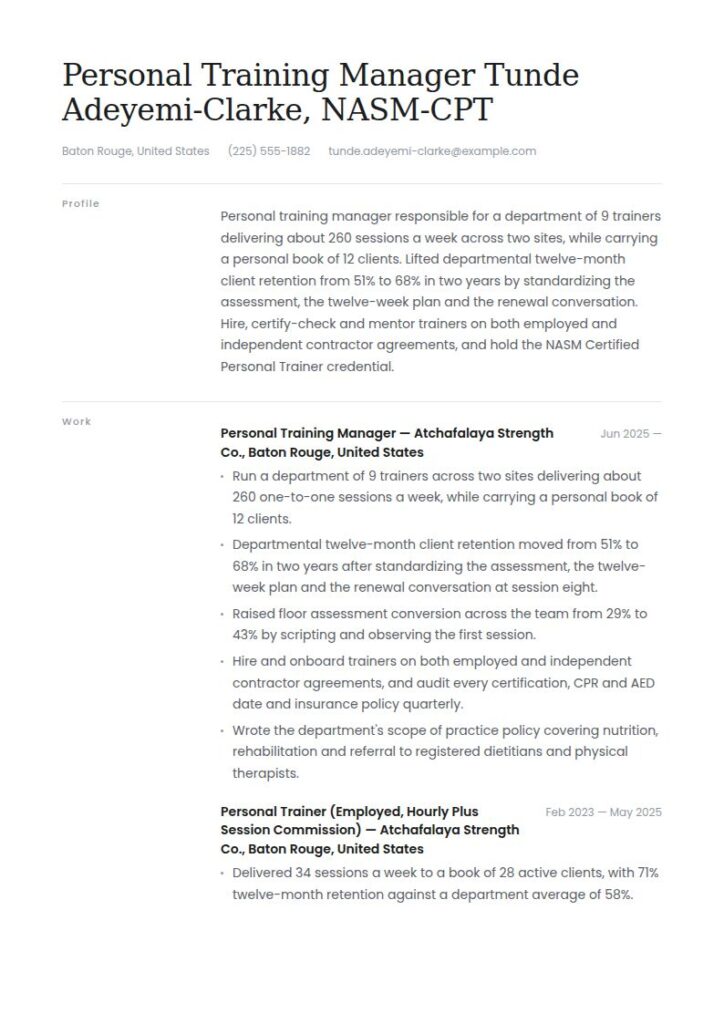
Personal training manager responsible for a department of 9 trainers delivering about 260 sessions a week across two sites, while carrying a personal book of 12 clients. Lifted departmental twelve-month client retention from 51% to 68% in two years by standardizing the assessment, the twelve-week plan and the renewal conversation. Hire, certify-check and mentor trainers on both employed and independent contractor agreements, and hold the NASM Certified Personal Trainer credential.
Right vs wrong: the same personal trainer summary, twice
| ✅ Right | ❌ Wrong |
|---|---|
| Delivering 34 sessions a week to a book of 28 active clients as an employed trainer on hourly pay plus session commission. | Experienced personal trainer with a passion for changing lives. |
| 71% of clients who started in 2025 were still training with me twelve months later. | Excellent client retention and strong relationship-building skills. |
| 9 of my 28 current clients came by client referral rather than from the floor. | Proven ability to generate new business and grow a client base. |
Every line in the right column is a number a manager can compare to their own floor. Nothing in the left column compares to anything.
Outline your personal training experience
Facility, city, how you were engaged, book size, sessions a week and dates. Then three to five bullets, each with a number tied to clients rather than effort.
| Instead of | Use |
|---|---|
| Designed personalized workout programs for clients | Delivered 34 sessions a week to 28 active clients, each on a written twelve-week plan reviewed every fourth session |
| Built strong relationships and retained clients | 71% of clients who started in 2025 were still training twelve months later |
| Grew my client base | Took a book from 11 to 28 active clients in 18 months, 9 of them by referral |
| Conducted fitness assessments | Ran 3 complimentary assessments a week; 44% converted to a paid package |
| Motivated clients to reach their goals | 64% of clients bought a second package and 41% a third |
| Worked with clients with injuries | Trained 6 clients returning from cleared orthopedic rehabilitation, working from the physical therapist's written clearance |
Personal Trainer (employed, hourly plus session commission), Atchafalaya Strength Co., Baton Rouge, LA, February 2023 to Present
Deliver 34 one-to-one sessions a week to a book of 28 active clients, each on a written twelve-week plan reviewed at every fourth session.
71% of clients who started in 2025 were still training twelve months later, against a department average of 58%.
64% of clients bought a second package and 41% a third; 9 of 28 current clients arrived by client referral.
Run 3 complimentary movement assessments a week from the gym floor, converting 44% to a paid package.
Train 6 clients returning from cleared orthopedic rehabilitation, working only from the treating physical therapist's written clearance and within the certification's scope.
Your book of clients: retention, session volume and who pays you
This is the block the rest of the page exists to support, and it has two halves: what your book looks like, and the contractual question almost every applicant leaves out. Start with the book.
Sessions delivered: 34 one-to-one sessions a week, plus 2 small-group sessions of 3 to 4 clients.
Active book: 28 clients, average tenure 14 months, longest 4 years.
Retention: 71% of clients who started in 2025 were still training twelve months later, against a department average of 58%.
Renewal: 64% bought a second package, 41% a third.
Referral: 9 of 28 current clients arrived by client referral; the rest came from floor assessments and two corporate wellness introductions.
Acquisition: 3 complimentary movement assessments a week, 44% converting to a paid package.
Engagement: Employed, hourly base plus session commission. Client records and the client list belong to the facility.
Six numbers and one sentence. That is the whole argument, and it beats a page of adjectives because every line is falsifiable.
Two lines are worth expanding. Session volume is what managers price you on: a trainer delivering 34 sessions is a different revenue line from one delivering 18, and both are respectable. Acquisition predicts your first ninety days: a trainer who has built a book from floor assessments can rebuild one, and a trainer who inherited assigned clients may never have had to.
Now the half that is usually missing.
| Engagement | What it usually means | What a resume should say |
|---|---|---|
| Employed trainer | Hourly or salaried, sessions scheduled by the facility, clients assigned as well as self-generated | Say "employed", and say whether the book was assigned or self-built |
| Employed plus commission | Base pay with a per-session or revenue commission, book usually self-built from the floor | Give the split, and give your acquisition number |
| Independent contractor | You rent space or pay a percentage, set your own rates, invoice your own clients | Say "independent contractor", and say what you paid for: rent, revenue share or both |
| Studio owner or sole trader | Your business, your premises or your equipment, your liability insurance | Say so, and give the client count rather than a job title |
Then answer the question that decides how the rest of your numbers are read: who owns the client list.
If you were employed, the facility almost certainly owns the client records and the relationships, and your agreement may restrict you from soliciting them afterward. If you were a contractor, the position can be different, but it is set by the contract you signed, not by custom. Either way the honest line is about what you built: "Book of 28 self-generated clients; client records held by the facility." A resume that implies you will arrive with someone else's clients raises a legal question in the first thirty seconds.
Certification comes before clients, and it is the one hard rule here
The Bureau of Labor Statistics states that personal trainers usually must be certified before they begin working with clients, and that most fitness trainers and instructors hold certification in the area of fitness they specialize in (BLS Occupational Outlook Handbook, May 2025 wage data and 2025 to 2035 projections, published 27 August 2026).
That is unusual in an occupation whose typical entry-level education is a high school diploma or equivalent with short-term on-the-job training. The credential, not the degree, is the gate.
NASM states that its Certified Personal Trainer credential is accredited by the National Commission for Certifying Agencies, which it describes as "a nationally recognized third party agency that accredits certification programs which are able to meet and comply with its standards", and that the credential must be renewed every two years by earning 2.0 approved Continuing Education Units, including 0.1 CEUs from a required CPR and AED certification (NASM, nasm.org, retrieved 17 September 2026).
Put that cycle on the page with its expiry date. It is the first thing a manager verifies before you touch a client.
Build a snapshot of your key personal trainer skills
Ten to fourteen entries in three groups: what you do with a client, what you do with a book, and the systems the facility runs.
With a client: Movement screening and reassessment, Twelve-week periodized program design, Resistance training technique coaching, Progressive overload and deload planning, Return-to-training around cleared rehabilitation, Habit and adherence coaching, Body composition and performance tracking
With a book: Complimentary assessment to package conversion, Renewal conversations at session eight, Referral requests without pressure, Scheduling and cancellation policy, Rate card and package structure
Systems and compliance: Trainerize and TrueCoach program delivery, Mindbody and ABC Ignite scheduling, PAR-Q and health history screening, Incident reporting and AED location, Scope of practice and referral to registered dietitians and physical therapists
The last line matters more than it reads. Nutrition prescription, diagnosis and rehabilitation sit outside a personal training certification, and a resume that says so is one a facility's insurer is comfortable with.
List your education and certifications
Certification first with issuing body, accreditation and expiry, then continuing education, then any degree.
NASM Certified Personal Trainer, National Academy of Sports Medicine, certified February 2021, current through February 2027. NCCA-accredited credential; renewal requires 2.0 approved Continuing Education Units every two years, including 0.1 CEUs from a required CPR and AED certification.
Adult CPR and AED, American Red Cross, current through June 2027.
Continuing education: 1.9 CEUs completed in the current cycle, including coursework in program design for older adults and in behavior change coaching.
Bachelor of Science, Kinesiology, Louisiana State University, Baton Rouge, LA, 2019.
Liability insurance: professional liability policy held in own name, current.
The liability insurance line is optional for employed roles and close to essential for contractor work, because a facility will not let a contractor on the floor without it.
If you hold the ACE Certified Personal Trainer credential instead, ACE publishes an NCCA-accredited examination of 150 multiple choice questions with a three-hour limit and a passing scaled score of 500, requires candidates to be at least 18 with a high school diploma or equivalent and a current adult CPR and AED certificate carrying a hands-on skills check, and renews on a two-year cycle requiring 20 hours of ACE-approved continuing education credits, 2.0 CECs (American Council on Exercise, acefitness.org, retrieved 17 September 2026). Write whichever you hold, with the same three facts: issuing body, accreditation, expiry.
Choose the right layout and design
Single column, 11 or 12 point type, clear headings, no photograph. Put the client book block in a compact table or short labeled list so the numbers read in one pass, and keep each role line carrying its engagement type. Two pages is normal once you manage trainers or carry a book across two facilities. A mission statement about transformation is not worth the space.
Give sessions a week, active clients and retention with a window. Say how you were engaged in every role line, and who owns the client records. Give your acquisition number. Put the certification's accreditation and expiry on the page. State the scope boundary on nutrition and rehabilitation.
Do not write "excellent client retention" without a percentage and a window. Do not imply you will bring another facility's clients with you. Do not name a client or describe their body, weight, diagnosis or progress, even anonymously. Do not claim nutrition prescription or rehabilitation you are not credentialed for. Do not use before-and-after photographs.
Personal trainer job market and outlook
A growing occupation of 388,400 people in which about one worker in seven is self-employed, and in which the credential rather than the degree is the gate.
The Bureau of Labor Statistics publishes no separate Handbook profile for personal trainers. One-to-one training is counted inside the occupation it calls exercise trainers and group fitness instructors, published as fitness trainers and instructors, so every figure below covers personal trainers and group instructors together.
| Measure | Value |
|---|---|
| Exercise trainer and group fitness instructor jobs, 2025 | 388,400 |
| Projected change, 2025-35 | 7%, 28,500 jobs |
| Projected annual openings | ~68,000 |
| Typical entry-level education | High school diploma or equivalent |
| On-the-job training | Short-term |
| Median annual wage, May 2025 | $47,160, or $22.67 per hour |
Source: U.S. Bureau of Labor Statistics, Occupational Outlook Handbook, 2025 to 2035 projections and May 2025 wage data, published 27 August 2026.
One trainer in seven works for themselves
Self-employed workers make up 15 percent of exercise trainers and group fitness instructors, second only to fitness and recreational sports centers at 55 percent, ahead of civic and social organizations at 8 percent, educational services at 7 percent and government outside education and hospitals at 4 percent (BLS Occupational Outlook Handbook, 2025 data).
For personal training that 15 percent is the career decision the occupation is organized around. The employed route gives you a floor, a stream of introductions and someone else's marketing, and the facility keeps the client relationship. The independent route gives you your rates and your list, and hands you rent, insurance, scheduling and acquisition.
Make clear which side of that line each role sat on. A gym hiring an employed trainer wants floor conversion; a studio taking on a contractor wants a book that already exists.
Where the work sits:
| Setting | Share of employment | Median annual wage (May 2025) |
|---|---|---|
| Fitness and recreational sports centers | 55% | $48,140 |
| Self-employed workers | 15% | Not published |
| Civic and social organizations | 8% | $38,640 |
| Educational services (state, local, private) | 7% | $45,350 |
| Government (excluding education and hospitals) | 4% | $48,300 |
Source: U.S. Bureau of Labor Statistics, May 2025.
What salary you can expect as a personal trainer
The median annual wage for exercise trainers and group fitness instructors was $47,160 as of May 2025, or $22.67 an hour. The lowest 10 percent earned less than $28,800 and the highest 10 percent more than $83,100 (BLS Occupational Outlook Handbook, May 2025).
Read the top of that range as session volume and rate, not seniority. An employed trainer is usually paid an hourly base plus a per-session commission, so pay is sessions delivered multiplied by a rate you did not set. A contractor sets the rate and pays rent out of it: a higher headline figure and a thinner, more variable margin.
This is why the client book block is the highest-value section on the page. Sessions a week is what a manager multiplies. Retention says whether those sessions will still be there in a year. Acquisition says what happens in the first ninety days. A file carrying all three is priced quickly; a file carrying none is priced at the bottom of the band.
Key takeaways for a personal trainer resume
- Lead with sessions a week, active clients and retention with a window.
- Write retention as a percentage over a stated period, never as an adjective.
- Give renewal and referral numbers; they say different things.
- Say how you were engaged in every role line: employed, commission or contractor.
- Say who owns the client records, and never imply you are bringing clients with you.
- Put the certification's issuing body, accreditation and expiry on the page.
- State the scope boundary on nutrition and rehabilitation in one line.
Build your personal trainer resume in 15 minutes with our AI resume builder.
Related sport and fitness resume examples
- Fitness instructor resume
- Yoga instructor resume
- Athletic trainer resume
- Nutritionist resume
- Sport and fitness resume
- Sports resume
- Coach resume
- Student athlete resume
- Football coach resume
- Baseball coach resume
- Rowing coach resume
- Referee resume
Pair it with a matching personal trainer cover letter.
Personal trainer resume questions, answered
How long should a personal trainer resume be?
One page for your first three years. Two once you carry a full book, manage trainers or work across two facilities, because the client book block and the certification block both need room.
Do I need a certification to work as a personal trainer?
In practice, yes. The Bureau of Labor Statistics states that personal trainers usually must be certified before they begin working with clients (BLS Occupational Outlook Handbook, May 2025). Facilities and insurers generally require an NCCA-accredited credential, so name yours, name the accrediting body and give the expiry date.
What do I put on a personal trainer resume with no clients yet?
Everything that shows you can start a book: assessments run and their conversion rate, small-group work, shadowed sessions with a count, an internship with a session number, and any floor role where you introduced members to training. Then your certification with its expiry and your CPR and AED date.
Should I put client results or transformation photos on my resume?
No photographs, and no individual clients. Write results at the level of your book: retention, renewal, referral, adherence, sessions completed against sessions booked. One client's outcome is a privacy problem and a weaker claim than a figure covering everyone you train.
How do I explain a book I cannot take with me?
Plainly, in the same sentence as what you built. "Book of 28 self-generated clients; client records held by the facility" is a strong line: it says you generate clients and understand the agreement you worked under.
Is a personal trainer resume the same as a group fitness resume?
No. A group instructor is hired against a timetable of formats, slots and class sizes, and a yoga teacher against counted training hours and a registration. A personal trainer is hired against a book: sessions, retention, renewals and acquisition.