Assistant Wrestling Coach, Grades 9 to 12 Malik Brennan
Assistant Wrestling Coach, Grades 9 to 12
[email protected] | (502) 555-1121 | Louisville, United States
Profile
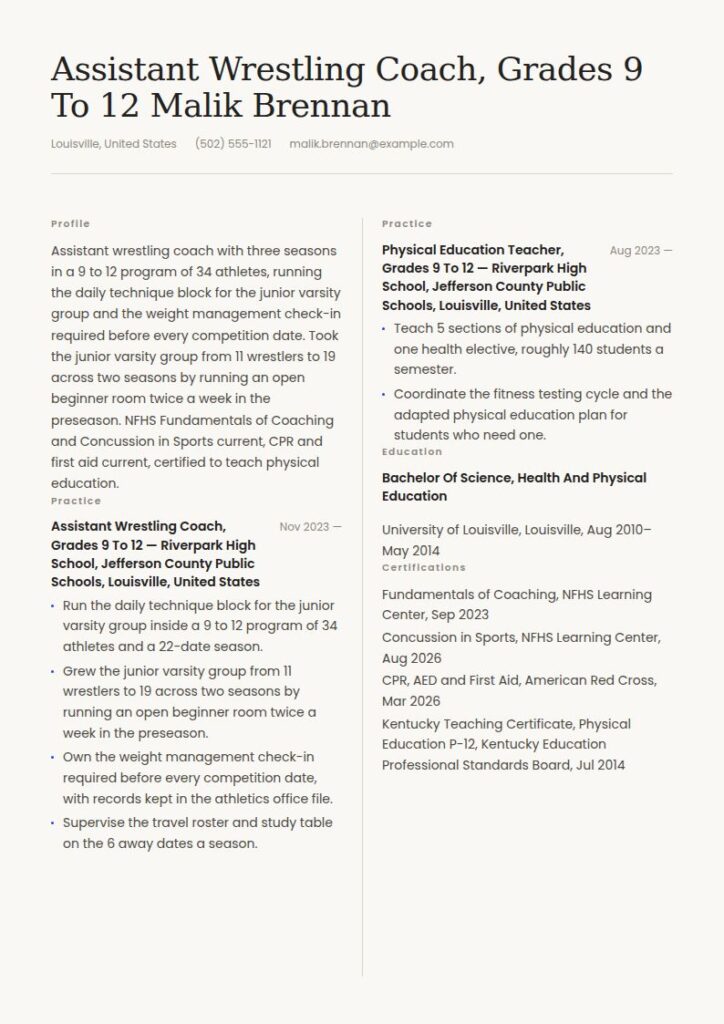
Assistant wrestling coach with three seasons in a 9 to 12 program of 34 athletes, running the daily technique block for the junior varsity group and the weight management check-in required before every competition date. Took the junior varsity group from 11 wrestlers to 19 across two seasons by running an open beginner room twice a week in the preseason. NFHS Fundamentals of Coaching and Concussion in Sports current, CPR and first aid current, certified to teach physical education.
Work Experience
11/2023 - Present, Assistant Wrestling Coach, Grades 9 to 12, Riverpark High School, Jefferson County Public Schools, Louisville, United States
- Run the daily technique block for the junior varsity group inside a 9 to 12 program of 34 athletes and a 22-date season.
- Grew the junior varsity group from 11 wrestlers to 19 across two seasons by running an open beginner room twice a week in the preseason.
- Own the weight management check-in required before every competition date, with records kept in the athletics office file.
- Supervise the travel roster and study table on the 6 away dates a season.
08/2023 - Present, Physical Education Teacher, Grades 9 to 12, Riverpark High School, Jefferson County Public Schools, Louisville, United States
- Teach 5 sections of physical education and one health elective, roughly 140 students a semester.
- Coordinate the fitness testing cycle and the adapted physical education plan for students who need one.
Education
08/2010 - 05/2014, Bachelor of Science, Health and Physical Education, University of Louisville, Louisville, United States
Kentucky teaching certificate, Physical Education P-12, #KY-207744.
Skills
Practice planning, 75
Technique instruction and progression, 80
Weight management procedures, 85
Concussion protocol, 85
Eligibility and academic monitoring, 70
Parent and guardian communication, 70
Travel and roster coordination, 75
Languages
English, native
Certificates
09/2023, Fundamentals of Coaching, NFHS Learning Center
Core course, approved for 12 clock hours.
08/2026, Concussion in Sports, NFHS Learning Center
Completed annually.
03/2026, CPR, AED and First Aid, American Red Cross
07/2014, Kentucky Teaching Certificate, Physical Education P-12, Kentucky Education Professional Standards Board, KY-207744
Summary
Coach is one word covering several unrelated hiring markets, and a coach resume has to say which one it belongs to in its first line. This guide gives you a table mapping each kind of coaching to who hires it and what it is bought on, then builds the sport coaching resume in full, with three adaptable versions and current Bureau of Labor Statistics pay and outlook.
Coach resume examples by experience level
In short, a coach resume is a one to two page document, and the first decision it has to make is which kind of coach you are.
That sounds obvious until you read a folder of them. In fact, "Coach" is one word covering at least seven hiring markets that share almost nothing: the credential differs, the buyer differs and the evidence differs. For example, a resume headed "Coach" with a summary about helping people reach their potential could be a high school wrestling coach, a corporate executive coach, a board certified health coach or a call center quality coach. As a result, a reader who cannot tell within one line stops reading.
So name it in the first line. This page gives you the table that tells you which line to write, then builds the sport coaching resume in full, because that is the market this category covers.
Resume guide for a coach resume
For that reason, this guide and the corresponding coach resume example will cover:
- First, how to write a coach resume, section by section
- Then, the seven coaching markets, who hires each and what each is bought on
- Also, three adaptable summaries: assistant coach, head coach and program director
- In addition, what a sport coaching resume needs that a general resume does not
- Finally, what coaches earn, and what the certification requirement really is
How to write a coach resume
Overall, six blocks: contact header, summary, coaching experience, program record, certifications, and skills. Generally, one page for your first several seasons, two once you have run a program, managed staff or held a budget.
The first line of the header does more work here than in any other job on this site. It names the coaching market, the sport or domain, and the level, because those three facts route the file. "Head Wrestling Coach, Grades 9 to 12" is routed in a second. "Coach" is not routed at all.
| Block | What it is answering | Where it goes |
|---|---|---|
| Market, domain and level | Which kind of coach is this, and at what level? | The header line, above everything |
| Credential | Are they cleared to coach here, and who says so? | Its own short block with dates |
| Program record | Roster, staff, season length, budget, retention | A block or table, not scattered in bullets |
| Results | What changed, measured the way this domain measures it | Inside the experience bullets, with numbers |
Write the market into the first line, then never make the reader guess again
The fastest fix available on a coach resume costs six words. Replace "Coach" in your header with the market, the domain and the level.
"Head Wrestling Coach, Grades 9 to 12, 34 athletes, 3 assistants." "Executive Coach, ICF Professional Certified Coach, 500 coaching hours." "National Board Certified Health and Wellness Coach, employer wellness programs."
Each tells a reader within one line which pile the file belongs in, and each carries a number a competitor's header does not. The rest of the document then has one job, which is to be consistent with that line.
Run the finished file through the ATS resume checker before you apply. Districts, universities, clubs and corporate employers parse applications into structured records before a person opens them.
Choosing the best resume format for a coach resume
Reverse chronological, single column, plain type. In other words, one page for your first several seasons, two once you have led a program, supervised assistants or carried a budget.
Seasonal and part-time coaching is normal, so label it rather than disguise it. For instance, six consecutive seasons written as "2020 to 2026, seasonal, November to March" reads as continuity; the same seasons written as six entries reads as six departures.
Do not use a functional format, because whoever hires a coach reads for a run of seasons in one program: how long you stayed, what the roster did, and whether the athletes came back.
Include your contact information
| ✅ Right | ❌ Wrong |
|---|---|
| Malik Brennan | Malik Brennan |
| Head Wrestling Coach, Grades 9 to 12, 34 athletes, 3 assistants | Coach |
| Louisville, KY. NFHS Fundamentals of Coaching, CPR and first aid current | Louisville, KY |
| (502) 555-1121, [email protected] | (502) 555-1121, [email protected] |
The third line is deliberate. Districts check coaching certifications before they write a contract, and a header saying the mandatory courses are current removes the first administrative obstacle between you and the post.
Make use of a summary
In practice, four lines: the market and level, how long in the role, the size of what you ran, and one measured result in the terms your domain uses.
Assistant wrestling coach with three seasons in a 9 to 12 program of 34 athletes, running the daily technique block for the junior varsity group and the weight management check-in required before every competition date. Took the junior varsity group from 11 wrestlers to 19 across two seasons by running an open beginner room twice a week in the preseason. NFHS Fundamentals of Coaching and Concussion in Sports current, CPR and first aid current, certified to teach physical education.
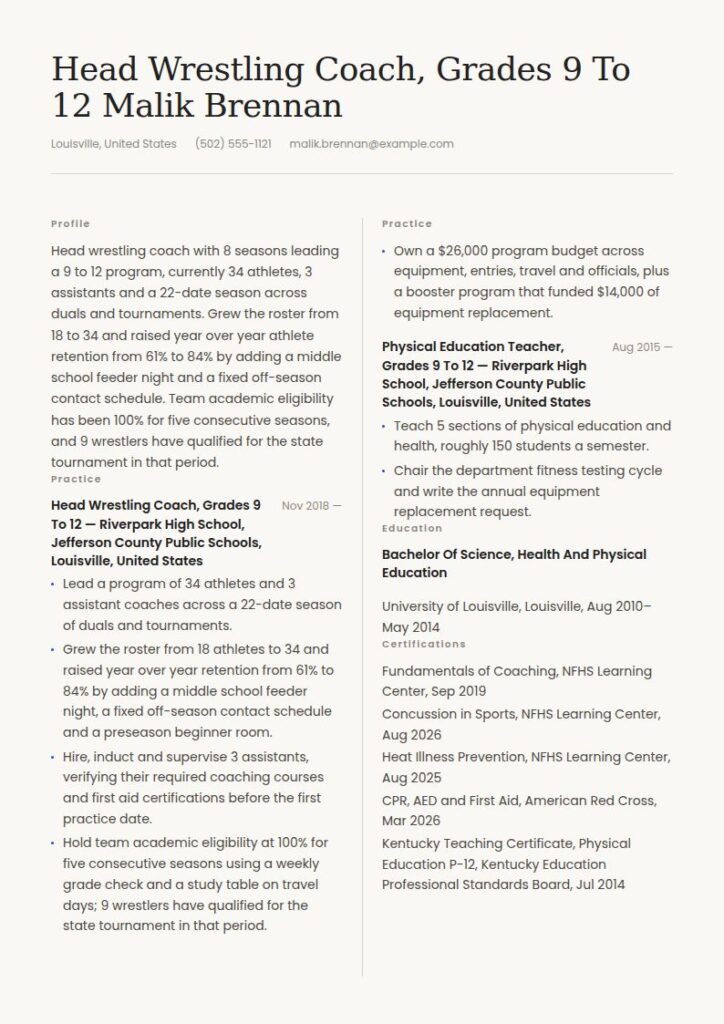
Head wrestling coach with 8 seasons leading a 9 to 12 program, currently 34 athletes, 3 assistants and a 22-date season across duals and tournaments. Grew the roster from 18 to 34 and raised year over year athlete retention from 61% to 84% by adding a middle school feeder night and a fixed off-season contact schedule. Team academic eligibility has been 100% for five consecutive seasons, and 9 wrestlers have qualified for the state tournament in that period.
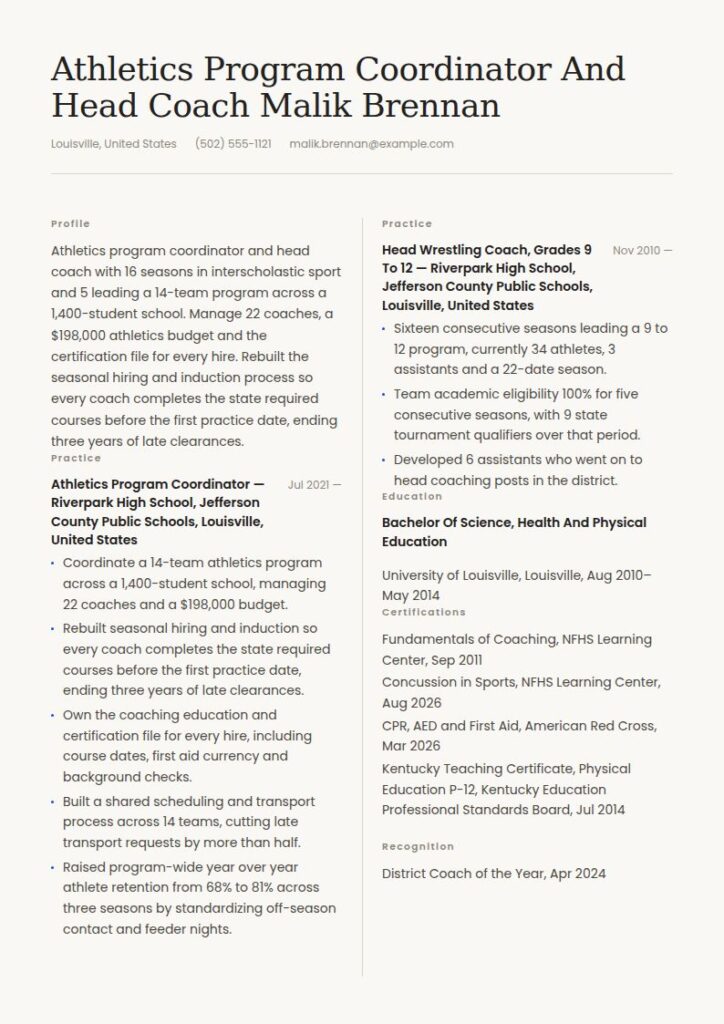
Athletics program coordinator and head coach with 16 seasons in interscholastic sport and 5 leading a 14-team program across a 1,400-student school. Manage 22 coaches, a $198,000 athletics budget and the certification file for every hire. Rebuilt the seasonal hiring and induction process so every coach completes the state required courses before the first practice date, ending three years of late clearances.
Right vs wrong: the same coach summary, twice
| ✅ Right | ❌ Wrong |
|---|---|
| Head wrestling coach with 8 seasons leading a 9 to 12 program, currently 34 athletes, 3 assistants and a 22-date season. | Experienced coach with a track record of building successful teams. |
| Grew the roster from 18 to 34 and raised year over year retention from 61% to 84%. | Known for motivating athletes and bringing out their best. |
| Team academic eligibility 100% for five consecutive seasons, with 9 state tournament qualifiers. | Committed to developing the whole person, on and off the field. |
The right column answers the question an athletic director is really asking, which is whether the program will be bigger and better staffed in three years than it is today.
Outline your coaching experience
Next, list the program, organization, level, group size and seasons. Then three to five bullets, each carrying a count, a rate or a period of time.
| Instead of | Use |
|---|---|
| Coached the wrestling team | Led a 9 to 12 program of 34 athletes and 3 assistants across a 22-date season of duals and tournaments |
| Improved team performance | Took the roster from 18 to 34 athletes and year over year retention from 61% to 84% over four seasons |
| Raised money for the program | Ran a booster program that funded $14,000 of equipment replacement and 11 tournament entry fees over three seasons |
Head Wrestling Coach, Grades 9 to 12, Riverpark High School, Louisville, KY, November 2018 to Present. 34 athletes, 3 assistants, 22-date season.
Grew the roster from 18 athletes to 34 and raised year over year retention from 61% to 84% by adding a middle school feeder night, a fixed off-season contact schedule and an open beginner room in the preseason.
Hire, induct and supervise 3 assistant coaches, including verifying their required coaching courses and first aid certifications before the first practice date.
Hold team academic eligibility at 100% for five consecutive seasons using a weekly grade check and a study table on travel days; 9 wrestlers have qualified for the state tournament over that period.
Own a $26,000 program budget across equipment, entries, travel and officials, plus a booster program that funded $14,000 of equipment replacement.
Which kind of coach are you? Name it in the first line
Seven markets use this word. Moreover, they do not share a credential, they do not read each other's resumes, and a file that does not say which one it belongs to gets read by the wrong reader or by nobody.
| Kind of coaching | Who hires it | What credential it asks for | What it is bought on |
|---|---|---|---|
| Sport coaching, school | Athletic directors and principals | State association registration, coaching education courses, first aid and CPR | Seasons in post, roster size, retention, staff supervised, eligibility and results |
| Sport coaching, club and travel | Club directors and boards | The national governing body license or certification for that sport | Teams formed, athletes retained, placement of athletes to the next level |
| Sport coaching, college | Head coaches and athletic departments | Degree, recruiting and compliance knowledge, sport certification | Recruiting classes, retention, academic progress, results |
| Fitness and personal training | Gyms, studios and private clients | A certification, usually accredited, held before working with clients | Sessions delivered, client retention, class attendance |
| Health and wellness coaching | Health systems, employers and insurers | National Board Certified Health and Wellness Coach and similar | Participants enrolled, program completion, outcomes the payer measures |
| Executive and business coaching | Companies, learning and development teams, individual clients | An International Coaching Federation credential is the common request | Coaching hours, clients served, engagement outcomes and renewals |
| Workplace performance coaching | Employers, contact centers, sales teams | Usually none formal; internal certification programs | People coached, movement in the metric the business already tracks |
Life coaching is an eighth market with its own hiring logic, and it has its own page in this library rather than a paragraph here.
Coaching credentials with a published bar
Even so, two of those rows publish a bar worth quoting on your page. The International Coaching Federation sets its credentials at 60 or more hours of coach-specific education and 100 or more coaching hours for the Associate Certified Coach, 125 and 500 for the Professional Certified Coach, and 200 and 2,500 for the Master Certified Coach, each with 10 hours of mentor coaching (coachingfederation.org, retrieved 17 September 2026). Similarly, the National Board for Health and Wellness Coaching requires an approved training program, 50 health coaching sessions and an associate's degree or higher, 60 college credits, or 4,000 hours of work experience, before you sit the exam (nbhwc.org, retrieved 17 September 2026).
For school sport coaching, which is what the rest of this page builds, the requirement comes from local rules rather than a national one. The Bureau of Labor Statistics notes that public high school coaches may need to be certified or complete mandatory education courses, and that certification often requires coaches to be at least 18 years old and trained in cardiopulmonary resuscitation and first aid (BLS Occupational Outlook Handbook, Coaches and Scouts, last modified 27 August 2026).
School coach course requirements by state
In practice that is a state-by-state course list. New York issues a temporary coaching license against a state-approved first aid course, a state-approved CPR and AED course, child abuse recognition, school violence prevention and DASA training, plus fingerprinting; later renewals require either a state course in the principles and organization of athletics in education or the NFHS Accredited Interscholastic Coach certificate; and the professional coaching certificate at year five requires verification of three years of coaching plus further coursework or the Certified Interscholastic Coach sequence and a 30-hour internship (nysphsaa.org, retrieved 17 September 2026). The NFHS Learning Center's Fundamentals of Coaching, the course most often named in those requirements, is a core course approved for 12 clock hours, and the Learning Center tells coaches to check with their state association on whether it satisfies the state requirement (nfhslearn.com, retrieved 17 September 2026).
So write the courses by name with their dates, and name the state association that required them. An athletic director does not want a claim; they want to know the file is clear before the first practice date.
Market and level: Interscholastic sport coaching, wrestling, grades 9 to 12, head coach since 2018.
Program: 34 athletes, 3 assistant coaches, 22-date season, $26,000 budget.
Coaching education: NFHS Fundamentals of Coaching, 12 clock hours, 2019 and renewed 2025. Concussion in Sports, annually since 2018. Heat Illness Prevention, 2025.
Clearances: CPR, AED and first aid, American Red Cross, current 2026. State association coaching registration current for 2026 to 2027. District background check on file.
Build a snapshot of your key coaching skills
Specifically, ten to fourteen entries in three groups: coaching and instruction, program management, and the compliance work that sits underneath a season. Name the thing, not the quality.
Coaching and instruction: Season and practice planning, Individual athlete season plans, Technique instruction and progression, Competition strategy and lineup selection, Video review
Program management: Roster growth and retention, Assistant coach hiring and induction, Schedule and travel coordination, Budget and equipment ownership, Booster and fundraising programs
Compliance and welfare: Eligibility and academic monitoring, Concussion protocol, Heat illness prevention, Parent and guardian communication, Incident reporting
List your education and certifications
Certifications first with dates, because that is the block a district checks, then the degree, then anything sport specific. Also, give the issuing body for every item.
NFHS Fundamentals of Coaching, NFHS Learning Center, 12 clock hours, 2019, renewed 2025 (nfhslearn.com, retrieved 17 September 2026). Concussion in Sports, completed annually since 2018.
CPR, AED and first aid, American Red Cross, current through 2028. State association coaching registration current for 2026 to 2027, district background check on file.
Bachelor of Science, Health and Physical Education, University of Louisville, Louisville, KY, 2014. Kentucky teaching certificate, Physical Education P-12.
Sport specific: State coaches association clinic, annual attendance since 2017. USA Wrestling coach membership, current.
The certification requirement is real, and it is local
Coaching is often described as an occupation with no entry requirement. That is not what the published guidance says.
BLS lists a bachelor's degree as typical entry-level education for coaches and scouts and notes that public high school coaches may need to be certified or complete mandatory education courses, with certification often requiring coaches to be at least 18 and trained in cardiopulmonary resuscitation and first aid (BLS Occupational Outlook Handbook, last modified 27 August 2026).
The detail is set by each state association and the lists are long: New York's temporary coaching license alone requires a state-approved first aid course, a state-approved CPR and AED course, child abuse recognition, school violence prevention, DASA training and fingerprinting (nysphsaa.org, retrieved 17 September 2026).
Every item on that list is a resume line with a date, and most applicants put none of them there.
Choose the right layout and design
In short, single column, 11 or 12 point body type, no photograph, no team logos or action shots. Put the program record in a short labeled block rather than a graphic, since a parsed record keeps text and loses images.
Name the coaching market, the domain and the level in the header line. Give roster size, assistants supervised, season length and budget. Write retention as a year over year rate with the two numbers behind it. List every required course by name with its date and issuing body. Label seasonal coaching as seasonal, with the months, and show the run of consecutive seasons. Say who else you have developed, including assistants.
Do not write "Coach" alone as a title, because it routes to nobody. Do not lead with a win and loss record, which is one input among several and the one a reader can already look up. Do not name an individual athlete, their results or their circumstances. Do not claim a credential from a different coaching market to look broader, since the markets do not transfer. Do not hide a season out of the program.
Coach job market and outlook
Coaching is a large occupation with steady growth and heavy turnover; as a result, continuity in one program is unusually persuasive on a resume.
| Measure | Value |
|---|---|
| Coach and scout jobs, 2025 | 298,800 |
| Projected change, 2025-35 | 6%, 18,100 jobs |
| Projected annual openings | ~36,400 |
| Typical entry-level education | Bachelor's degree |
| Median annual wage, May 2025 | $47,320 |
Source: U.S. Bureau of Labor Statistics, Occupational Outlook Handbook, Coaches and Scouts, May 2025 wage data and 2025 to 2035 projections, last modified 27 August 2026.
In fact, about 36,400 openings a year against 18,100 net new jobs across the decade means most hiring is replacement. After all, coaches leave: for pay, for time, for the other job that pays the mortgage. Therefore, an applicant with five or six consecutive seasons in one program answers what the market is short of, which is somebody who stays.
Where coaches work, and what the industry does to the pay
Coaches and scouts held 298,800 jobs in 2025 with a median annual wage of $47,320 in May 2025, the lowest 10 percent under $28,790 and the highest 10 percent over $98,860, and about 36,400 openings projected each year on average over the 2025 to 2035 decade (BLS Occupational Outlook Handbook, last modified 27 August 2026).
Educational services employs 64 percent of them at a median of $46,890, arts, entertainment and recreation 22 percent at $48,440, religious, grantmaking, civic and professional organizations 2 percent at $43,870, and local government excluding education and hospitals 1 percent at $38,730, with about 8 percent self-employed (BLS, May 2025).
The sector medians are close together, so moving between them is not where the money is. The spread from under $28,790 to over $98,860 inside one occupation is mostly about level, scale and whether the post is attached to another contract. That is why roster size, staff supervised, budget and seasons in post belong on the page.
What salary you can expect as a coach
The median annual wage for coaches and scouts was $47,320 as of May 2025, with the lowest 10 percent under $28,790 and the highest 10 percent over $98,860 (BLS Occupational Outlook Handbook, last modified 27 August 2026).
Two things sit behind that spread. Much school coaching is a stipend on top of another job rather than a salary, so the occupational median mixes full-time posts with seasonal supplements. Also, districts usually set stipends by a published schedule: sport, level, head or assistant, and years in post. There is rarely a negotiation; instead, the resume's job is to qualify you for a higher line on the schedule rather than to argue for a number.
That points at what to document: head rather than assistant, a larger program, more assistants supervised, a budget owned, an extra season such as a summer camp or a feeder program, and the certifications that let a district assign you on day one. Meanwhile, in the other coaching markets the same logic runs through the credential, and the ICF and NBC-HWC thresholds above are the published ladders.
Key takeaways for a coach resume
- First, name the coaching market, the domain and the level in the first line, because "Coach" routes to nobody.
- Keep the whole document consistent with that line, including the credential you list.
- Then give the program record: roster, assistants, season length and budget.
- Write retention as a year over year rate with the two numbers behind it.
- Next, list every required course by name, with its date and issuing body.
- In short, say that your state association sets the requirements and name it, rather than claiming a national standard.
- Finally, show consecutive seasons in one program, because the market's shortage is people who stay.
Build your coach resume in 15 minutes with our AI resume builder.
Related sport and fitness resume examples
- Sports resume
- Referee resume
- Football coach resume
- Soccer coach resume
- Basketball coach resume
- Baseball coach resume
- Volleyball coach resume
- Hockey coach resume
- Swimming coach resume
- Track coach resume
- Tennis coach resume
- Athletic trainer resume
Pair it with a matching coach cover letter.
Coach resume questions, answered
How long should a coach resume be?
One page for your first several seasons, two once you have led a program, supervised assistants or held a budget.
What do I put on a coach resume with no head coaching experience?
Write what you ran inside someone else's program: the group you took, its size, the part of the practice plan you owned, and what changed across the season. Then the certifications, by name and date. An assistant who grew a junior varsity group and whose courses are current is a straightforward hire.
Should I put my win and loss record on the page?
Include it, but not first and not alone. A record is one output and it depends on schedule, roster and division. Roster growth, retention, staff developed, eligibility rates and athletes progressing to the next level describe what you did; the record describes what happened.
Do I need a certification to coach?
For public high school coaching, usually yes, and it is set locally. BLS notes that public high school coaches may need to be certified or complete mandatory education courses, with certification often requiring coaches to be at least 18 and trained in CPR and first aid (BLS Occupational Outlook Handbook, last modified 27 August 2026). The specifics come from your state association: New York's temporary coaching license requires state-approved first aid and CPR courses, child abuse recognition, school violence prevention, DASA training and fingerprinting (nysphsaa.org, retrieved 17 September 2026).
I coach in business, not sport. Does this page apply?
The structure does; the credential row does not. Find your row in the market table, then write the header line, the credential and the evidence your market buys. For executive and business coaching that usually means an International Coaching Federation credential, whose thresholds run from 60 education hours and 100 coaching hours at Associate Certified Coach to 200 and 2,500 at Master Certified Coach (coachingfederation.org, retrieved 17 September 2026). Keep one document per market rather than hedging between two, because a file that hedges looks uncertain in both.