Assistant Club Coach, 13s and 14s Marisol Aguirre
Assistant Club Coach, 13s and 14s
[email protected] | (402) 555-1105 | Omaha, United States
Profile
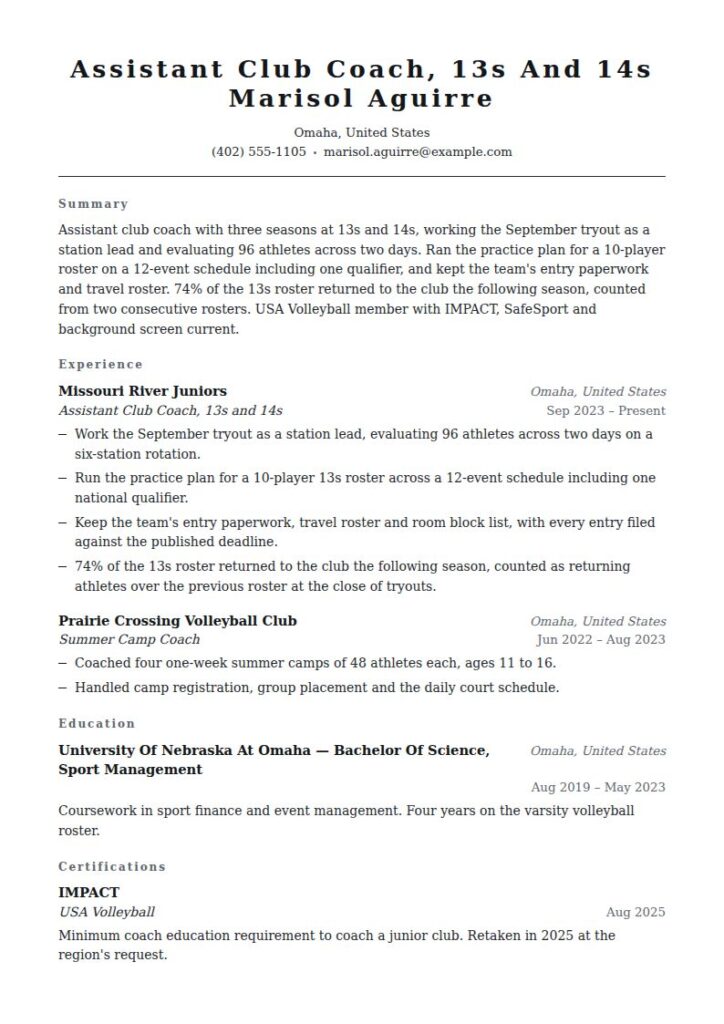
Assistant club coach with three seasons at 13s and 14s, working the September tryout as a station lead and evaluating 96 athletes across two days. Ran the practice plan for a 10-player roster on a 12-event schedule including one qualifier, and kept the team's entry paperwork and travel roster. 74% of the 13s roster returned to the club the following season, counted from two consecutive rosters. USA Volleyball member with IMPACT, SafeSport and background screen current.
Work Experience
09/2023 - Present, Assistant Club Coach, 13s and 14s, Missouri River Juniors, Omaha, United States
- Work the September tryout as a station lead, evaluating 96 athletes across two days on a six-station rotation.
- Run the practice plan for a 10-player 13s roster across a 12-event schedule including one national qualifier.
- Keep the team's entry paperwork, travel roster and room block list, with every entry filed against the published deadline.
- 74% of the 13s roster returned to the club the following season, counted as returning athletes over the previous roster at the close of tryouts.
06/2022 - 08/2023, Summer Camp Coach, Prairie Crossing Volleyball Club, Omaha, United States
- Coached four one-week summer camps of 48 athletes each, ages 11 to 16.
- Handled camp registration, group placement and the daily court schedule.
Education
08/2019 - 05/2023, Bachelor of Science, Sport Management, University of Nebraska at Omaha, Omaha, United States
Coursework in sport finance and event management. Four years on the varsity volleyball roster.
Skills
Serve receive systems, 75
Practice plan writing, 70
Tryout evaluation, 65
Event entry and deadlines, 75
Travel and room block booking, 70
Parent communication, 75
Languages
English, native
Spanish, native
Certificates
08/2025, IMPACT, USA Volleyball, NE-208114
Minimum coach education requirement to coach a junior club. Retaken in 2025 at the region's request.
06/2026, SafeSport Trained, U.S. Center for SafeSport
Refresher completed for the current season.
07/2026, Background Screen, USA Volleyball, NE-208114
Cleared and on file more than four weeks before the club's first event.
05/2025, CPR, AED and First Aid, American Red Cross
Current through May 2027.
Summary
A volleyball coach resume is a one to two page document showing the club year you ran as a calendar and a budget. This guide gives you three adaptable versions, the tryout-to-retention block most applicants leave out, USA Volleyball's junior club requirements stated accurately, and current Bureau of Labor Statistics pay and outlook for coaches and scouts.
Volleyball Coach resume examples by experience level
A volleyball coach resume is a one to two page document showing the club year you ran: the tryout you organized, the teams you formed out of it, the tournaments you entered, and how many families came back the following season.
Club volleyball is an administrative business with a sport attached. A director hiring a coach is not only asking whether you can run a practice. They are asking whether you can hold a September tryout, place 80 athletes into balanced teams by the following week, enter those teams before the entry deadlines, keep the season inside what families agreed to pay, and have most of them sign up again in the spring.
Resume guide for a volleyball coach resume
This guide and the corresponding volleyball coach resume example will cover:
- How to write a volleyball coach resume, section by section
- Why tryouts, teams formed and retention belong on the page
- Three adaptable summaries: assistant, head coach and club director
- What USA Volleyball requires of a junior club coach
- What the job market looks like and what you can expect to earn
How to write a volleyball coach resume
Six sections: contact header, summary, coaching experience, the club year block, certifications and screening, and education. The club year block sits high because it is the part a director cannot get from anybody else's file.
| Section | What it is answering | Where it goes |
|---|---|---|
| Coaching experience | Which age divisions, which teams, how long? | Reverse chronological, under the summary |
| The club year | Can this person run a tryout, a roster and a schedule? | Its own block |
| Certification and screening | Can the club roster them before the first event? | After the club year block |
| Education | Degree, plus sport management or administration work | Near the bottom |
Write the club year in counts and dates, not in seasons
"Coached club volleyball for five years" tells a director nothing. "Ran a two-day September tryout for 96 athletes, formed six teams across four age divisions inside nine days, entered 14 events including two qualifiers, and 71% of the athletes returned the next season" tells them whether they can hand you a program.
Give four numbers whenever you describe a club year: athletes at tryouts, teams formed, events entered, and the share who came back. All four sit in records the club already keeps, so a director can verify them in an evening. If the club does not track retention, count the returning names off two consecutive rosters yourself and say that is how you counted it.
Run the finished file through the ATS resume checker before you submit. Clubs, schools and parks departments parse applications before a human opens them.
Choosing the best resume format for a volleyball coach resume
Reverse chronological, with the age division named on every role. One page for an assistant, two once you have owned a full club year or run an age group.
Volleyball hiring reads the age division as seniority. A 12s coach, a 15s coach and an 18s coach are three different jobs: skill acquisition and parent management, the start of club travel, and a season run against a college recruiting calendar. Write the division on every line, because a reader who has to guess will guess low.
Include your contact information
| ✅ Right | ❌ Wrong |
|---|---|
| Marisol Aguirre | Marisol Aguirre |
| Club Director, 10s through 18s, 9 teams | Volleyball coach and former college player |
| USA Volleyball member, IMPACT, SafeSport and background screen current | USAV certified coach |
| (402) 555-1105, [email protected], Omaha, NE | (402) 555-1105, [email protected] |
Put screening status on the page, because it is a deadline rather than a credential. USA Volleyball states that "All USA Volleyball member coaches must also pass a background screen" and that IMPACT "is the minimum level coach education requirement for USAV in order to coach a junior club" (usavolleyball.org, retrieved 17 September 2026). A director filling a bench three weeks before the first tournament reads that line first.
Make use of a summary
Four lines: the age divisions you have run, the size of the tryout and roster you handled, the schedule you entered, and one retention number.
Assistant club coach with three seasons at 13s and 14s, working the September tryout as a station lead and evaluating 96 athletes across two days. Ran the practice plan for a 10-player roster on a 12-event schedule including one qualifier, and kept the team's entry paperwork and travel roster. 74% of the 13s roster returned to the club the following season, counted from two consecutive rosters. USA Volleyball member with IMPACT, SafeSport and background screen current.
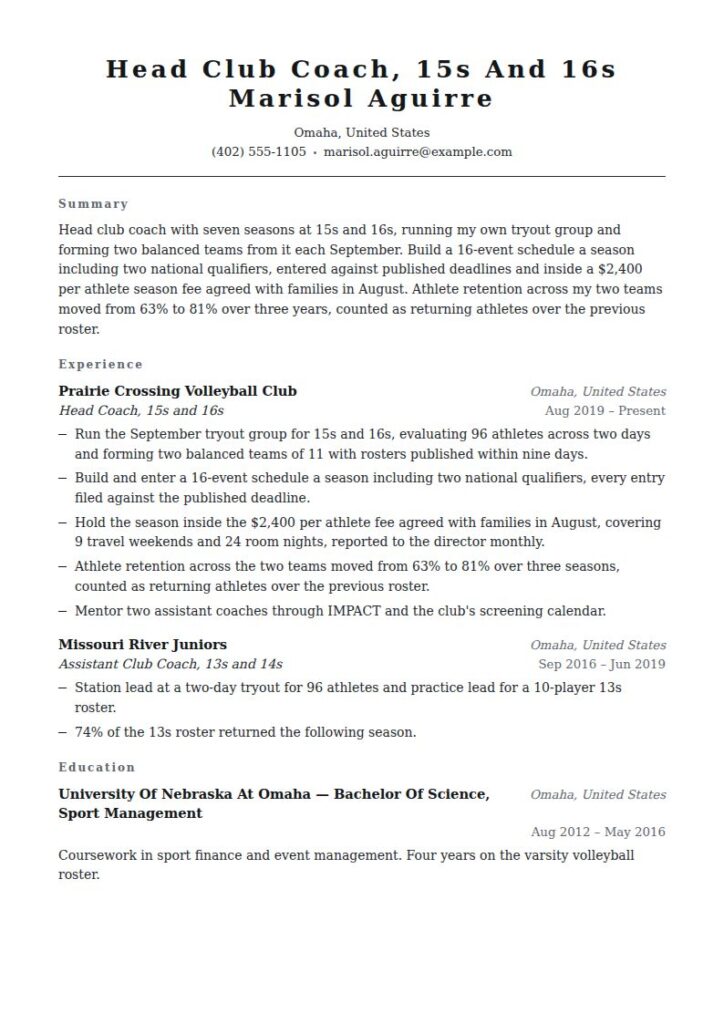
Head club coach with seven seasons at 15s and 16s, running my own tryout group and forming two balanced teams from it each September. Build a 16-event schedule a season including two national qualifiers, entered against published deadlines and inside a $2,400 per athlete season fee agreed with families in August. Athlete retention across my two teams moved from 63% to 81% over three years, counted as returning athletes over the previous roster.
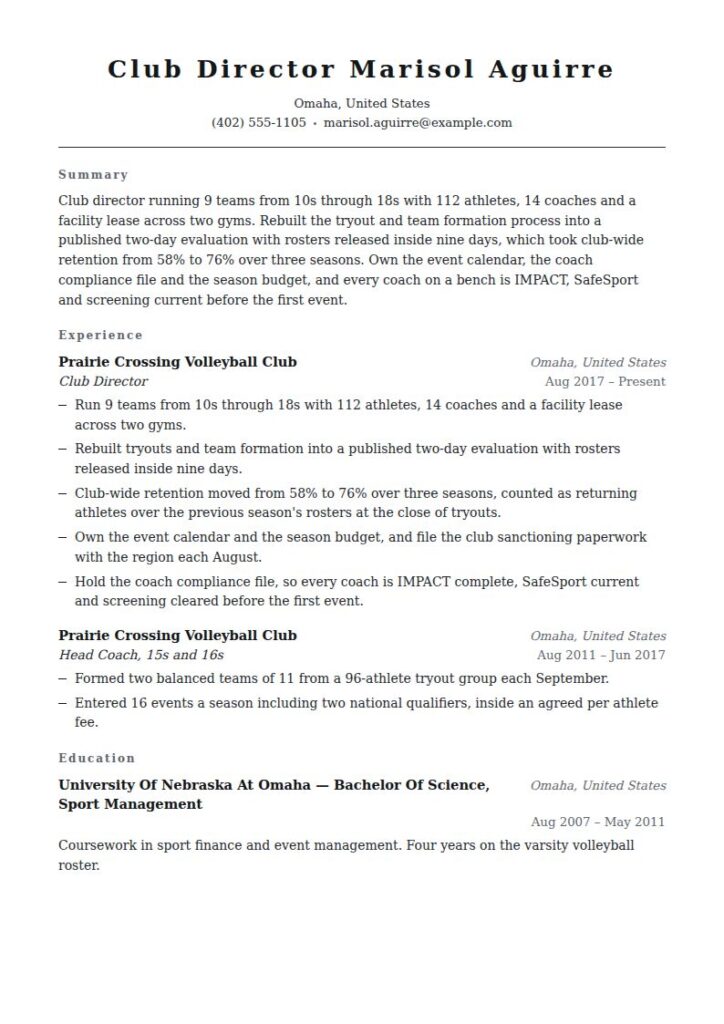
Club director running 9 teams from 10s through 18s with 112 athletes, 14 coaches and a facility lease across two gyms. Rebuilt the tryout and team formation process into a published two-day evaluation with rosters released inside nine days, which took club-wide retention from 58% to 76% over three seasons. Own the event calendar, the coach compliance file and the season budget, and every coach on a bench is IMPACT, SafeSport and screening current before the first event.
Right vs wrong: the same volleyball coach summary, twice
| ✅ Right | ❌ Wrong |
|---|---|
| Head club coach at 15s and 16s, forming two balanced teams from my own tryout group each September. | Experienced volleyball coach with a love of the game and a commitment to young athletes. |
| Build a 16-event schedule including two qualifiers, entered against published deadlines. | Responsible for scheduling and organizing team tournaments and travel. |
| Retention across my two teams moved from 63% to 81% over three years. | Built strong relationships with players and families. |
The right column is a program a director can hand over. The left column is what every other file in the folder says.
Outline your coaching experience
Club or school, age division, roster size, season length and dates. Then three to five bullets, each carrying a number from a roster, an entry record or an invoice.
| Instead of | Use |
|---|---|
| Coached club volleyball teams | Head coach, 15s and 16s, two teams of 11, September tryout through the June championship |
| Organized team tournaments | Entered 16 events a season including two national qualifiers, all against published deadlines |
| Managed team logistics | Booked 9 travel weekends, 24 room nights, inside a $2,400 per athlete season fee |
| Built team culture | Retention across my two teams went from 63% to 81% over three years, counted off consecutive rosters |
| Helped with tryouts | Ran a two-day evaluation of 96 athletes and published balanced rosters within nine days |
Head Coach, 15s and 16s, Prairie Crossing Volleyball Club, Omaha, NE, August 2019 to Present
Run the September tryout group for 15s and 16s, evaluating 96 athletes across two days and forming two balanced teams of 11 with rosters published within nine days.
Build and enter a 16-event schedule a season, including two national qualifiers, every entry made against the published deadline for the event.
Hold the season inside the $2,400 per athlete fee agreed with families in August, covering 9 travel weekends and 24 room nights, and report the position to the director monthly.
Athlete retention across the two teams moved from 63% to 81% over three seasons, counted as returning athletes over the previous year's roster.
Mentor two assistant coaches through IMPACT and the club's screening calendar.
The club year a volleyball coach actually runs
This is the block almost nobody writes, and in club volleyball it is the whole job.
Club volleyball is organized before it is coached. USA Volleyball states that "Your USA Volleyball membership will begin locally in one of 40 Regional Volleyball Associations (regions)" (usavolleyball.org, retrieved 17 September 2026). Your region sets the calendar you work to, and regions differ, so name yours rather than describing a generic season.
The age structure you place athletes into is national and published. USA Volleyball's junior player age definition for the 2026-2027 season runs nine divisions from 18 and Under down to 10 and Under, each keyed to a birth date: 18 and Under is players "born on or after July 1, 2008", 10 and Under players "born on or after July 1, 2016" (usavolleyball.org, retrieved 17 September 2026). That cutoff turns a tryout into a placement problem, because each athlete belongs to exactly one division and your teams still have to come out balanced.
The roster ceiling is published too. The USA Volleyball Girls Junior National Championship manual states that "A Team must have a minimum of one (1) head coach and six (6) players" and "A Team may have a maximum of fifteen (15) players and five (5) additional personnel on their roster" (usavolleyball.org, retrieved 17 September 2026). Those numbers are the arithmetic of every tryout. Ninety-six athletes against a fifteen-player ceiling is a decision about how many teams the club runs, and that is a budget before it is a philosophy.
Regions set their own deadlines and fees, so say which ones you worked to. One published example: USA Volleyball's Southern California region requires existing clubs to file a sanctioning form by a fixed August date and to document "secured access to a practice/training facility for the full season", charges $250 for club registration covering girls and boys under one club name plus facility insurance and $78 for each athlete and staff member, and requires club registration including completed background screenings to be finalized at least four weeks before the club's first tournament (usavolleyball.org, retrieved 17 September 2026). If your region's numbers differ, write your region's numbers.
| Month | What you own | The decision in it | Evidence line |
|---|---|---|---|
| August | Club sanctioning and coach compliance | Every coach screened and IMPACT complete before the first event | 14 coaches cleared, 0 benches empty at event one |
| September | Tryout and team formation | How many teams the club runs, and who is on each | 96 athletes evaluated over 2 days, 6 teams, rosters in 9 days |
| October | Season fee and event calendar | What families agree to pay and what they get for it | $2,400 per athlete, 16 events, 9 travel weekends |
| November to March | Entries and travel | Making every entry deadline and filling every room block | 16 entries on time, 24 room nights booked |
| April to June | Qualifiers and championships | Which teams chase a bid and which play locally | 2 qualifiers entered, 1 bid earned |
| June to July | Retention and re-signing | Who comes back, and why the rest did not | Retention 63% to 81% over three seasons |
Write your own row for every month you owned. Almost all of it sits in club records already, which is why it reads as verifiable rather than as a claim.
Retention is the number a club director is actually buying
A club's revenue is the season fee multiplied by the athletes who sign up, so the number that decides whether a coach is rehired is not the finish at a qualifier. It is how many of last year's athletes came back.
Count it one way and state the definition: returning athletes divided by the previous season's roster, taken at the close of tryouts. Give the year range and the teams it covers.
Then add the two numbers that explain it: how many athletes tried out and how many teams you formed. A retention rate on a shrinking club is a different story from one on a growing club, and a director will ask.
Tryout and formation: two-day September evaluation of 96 athletes at 15s and 16s, six stations, two evaluators per station. Two balanced teams of 11 formed, rosters published within nine days of the second session.
Schedule and budget: 16 events a season including two national qualifiers, all entries made against the published deadline. Season fee of $2,400 per athlete agreed with families in August, covering 9 travel weekends and 24 room nights. Position reported to the director monthly.
Compliance: all coaches on my benches IMPACT complete, SafeSport current and background screen cleared before the first event of the season.
Retention: returning athletes over the previous season's roster, counted at the close of tryouts, 63% to 81% across three seasons for the two teams.
Build a snapshot of your key skills
Twelve to fourteen entries in four groups: on-court, program administration, family and finance, and compliance.
On-court: Serve receive systems, Offensive systems and setter development, Blocking schemes, Practice plan writing, Match-day rotation management
Program administration: Tryout design and evaluation, Team formation and roster balance, Event entry and deadlines, Travel and room block booking, Region and national entry paperwork
Family and finance: Season fee structure, Parent meetings and written expectations, Payment plan administration, Retention tracking
Compliance: USA Volleyball membership, IMPACT, SafeSport training, Background screening, Club sanctioning paperwork
List your education and certifications
Coach education and screening status first, dated, because that is what a director has to file. Degree after.
USA Volleyball member, current season. IMPACT complete. SafeSport training current. Background screen cleared and on file.
Bachelor of Science, Sport Management, University of Nebraska at Omaha, Omaha, NE, 2012
CPR, AED and first aid, American Red Cross, current through 2027
Nebraska Department of Education substitute teaching permit, current
One nuance is worth writing exactly. USA Volleyball notes that for IMPACT, "Currently, USA Volleyball's national office does not require a renewal of this course, but the coach's region or club may decide to require a renewal or have more stringent requirements" (usavolleyball.org, retrieved 17 September 2026). If your region or club requires a renewal, write the date you last completed it, because that is the date being checked.
Choose the right layout and design
Single column, plain type at 11 or 12 point, clear section headings, no photograph and no club logo. Keep the club year table to one row per month, because portals parse resumes before a person reads them and a nested table is where that parsing drops a section.
Name the age division on every role. Give athletes evaluated, teams formed and the days between tryout and published roster. Write the number of events entered and how many were qualifiers. State the season fee and what it covered if you owned it. Define your retention number and give the years it covers. Name your region.
Do not estimate retention, a fee or an entry count. Do not name an athlete, their team placement or their college commitment. Do not describe a club year with adjectives instead of counts. Do not write "coached club volleyball" without the division. Do not list IMPACT without the completion date if your region requires renewal. Do not leave the screening status off the page.
Volleyball coach job market and outlook
Volleyball coaching sits inside one federal occupation. The Bureau of Labor Statistics publishes no separate profile for volleyball coaches: the published occupation is coaches and scouts, covering every sport and level, and the figures below describe that occupation rather than volleyball alone.
| Measure | Value |
|---|---|
| Coaches and scouts jobs, 2025 | 298,800 |
| Projected change, 2025-35 | 6%, 18,100 |
| Projected annual openings | ~36,400 |
| Typical entry-level education | Bachelor's degree |
| Median annual wage, May 2025 | $47,320 |
Source: U.S. Bureau of Labor Statistics, Occupational Outlook Handbook, Coaches and Scouts, 2025-35 projections and May 2025 wage data.
Volleyball is a very large school sport with a club program bolted onto it
In the 2024-25 National Federation of State High School Associations participation survey, girls volleyball recorded 492,799 participants, the second largest girls sport in the country behind track and field at 513,808 (NFHS, 2024-25 High School Athletics Participation Survey, retrieved 17 September 2026).
The club side runs on a separate structure, organized through USA Volleyball's 40 Regional Volleyball Associations, with its own membership, sanctioning and championship calendar (usavolleyball.org, retrieved 17 September 2026).
Set that against the employment split for coaches and scouts: 64 percent of jobs sit in educational services at a median of $46,890, 22 percent in arts, entertainment and recreation at $48,440, and 8 percent are self-employed (BLS Occupational Outlook Handbook, May 2025).
The school job is a paid autumn season inside the educational services share. The club job is the rest of the year inside the arts, entertainment and recreation share, and it is the one with a budget attached.
Where the jobs sit:
| Setting | Share of employment | Median annual wage (May 2025) |
|---|---|---|
| Educational services, state, local and private | 64% | $46,890 |
| Arts, entertainment and recreation | 22% | $48,440 |
| Self-employed | 8% | Not published |
| Religious, grantmaking and civic organizations | 2% | $43,870 |
| Local government, excluding education | 1% | $38,730 |
Source: U.S. Bureau of Labor Statistics, Occupational Outlook Handbook, Coaches and Scouts, May 2025.
What salary you can expect as a volleyball coach
The median annual wage for coaches and scouts was $47,320 as of May 2025, with the lowest 10 percent earning less than $28,790 and the highest 10 percent more than $98,860 (BLS Occupational Outlook Handbook, May 2025).
Volleyball splits that range along administrative lines rather than coaching ones. A club assistant is usually paid a per-team seasonal fee. A head coach is paid more per team and often carries two. A club director or facility manager is salaried, with a budget, a lease and staff attached, and sits far higher in the distribution.
What moves a coach across that line is the club year block. Two coaches can have identical on-court records; the one who ran a tryout for 96 athletes, formed six teams, entered 16 events on deadline and held retention through it is the one handed a program.
The school side pays differently again, usually as a stipend on a teaching contract, which is why so many volleyball careers are assembled from an autumn school season, a winter and spring club season and summer camp work. Write all three, each with its own counts.
Key takeaways for a volleyball coach resume
- Name the age division on every role; readers treat it as seniority.
- Give athletes evaluated, teams formed and days from tryout to published roster.
- Write the event schedule as a count, including qualifiers, and say entries were on deadline.
- State the season fee and what it covered if you owned it.
- Define your retention number and give the years and teams it covers.
- Name your region, because 40 of them set their own calendars.
- Date IMPACT, SafeSport and your screening status.
Build your volleyball coach resume in 15 minutes with our AI resume builder.
Related sport and fitness resume examples
- Coach resume
- Basketball coach resume
- Soccer coach resume
- Football coach resume
- Track coach resume
- Athletic trainer resume
- Referee resume
- Student athlete resume
- Sports resume
- Sport and fitness resume
- Tennis coach resume
- Fitness instructor resume
Pair it with a matching volleyball coach cover letter.
Volleyball coach resume questions, answered
How long should a volleyball coach resume be?
One page for an assistant or a first head coaching job. Two once you have owned a full club year, run an age group or directed a club. The club year block is what earns the second page.
What does USA Volleyball require of a junior club coach?
Membership, IMPACT and SafeSport training, plus a background screen. USA Volleyball states that IMPACT "is the minimum level coach education requirement for USAV in order to coach a junior club" and that "All USA Volleyball member coaches must also pass a background screen" (usavolleyball.org, retrieved 17 September 2026). Regions and clubs may add requirements, so check yours and put the dates on the page.
Should I write school volleyball and club volleyball separately?
Yes. They are different calendars, different employers and different jobs. The school season is a short autumn block on a stipend; the club season runs from a September tryout to a June championship with a budget attached. Write each with its own counts.
How do I show results without naming athletes?
Use counts across the roster. "71% of the 13s roster returned the following season" and "96 athletes evaluated over two days, six teams formed" identify nobody and read as stronger evidence than any single story. For college commitments, give the count and the season, never the name.
What if my club does not track retention?
Count it yourself off two consecutive rosters and say that is how you counted it. Returning athletes divided by the previous season's roster, taken at the close of tryouts, is a defensible definition. An estimated rate is worse than no rate, because a director can check it in five minutes.
I only have school coaching experience. Can I apply to a club?
Yes, if you write the school season as a program rather than a title. Give the roster, the match schedule, the number of teams in the program, any tryout or cut process you ran and what you handled off the court. A director wants someone who can run a calendar, and a school season is a small one.