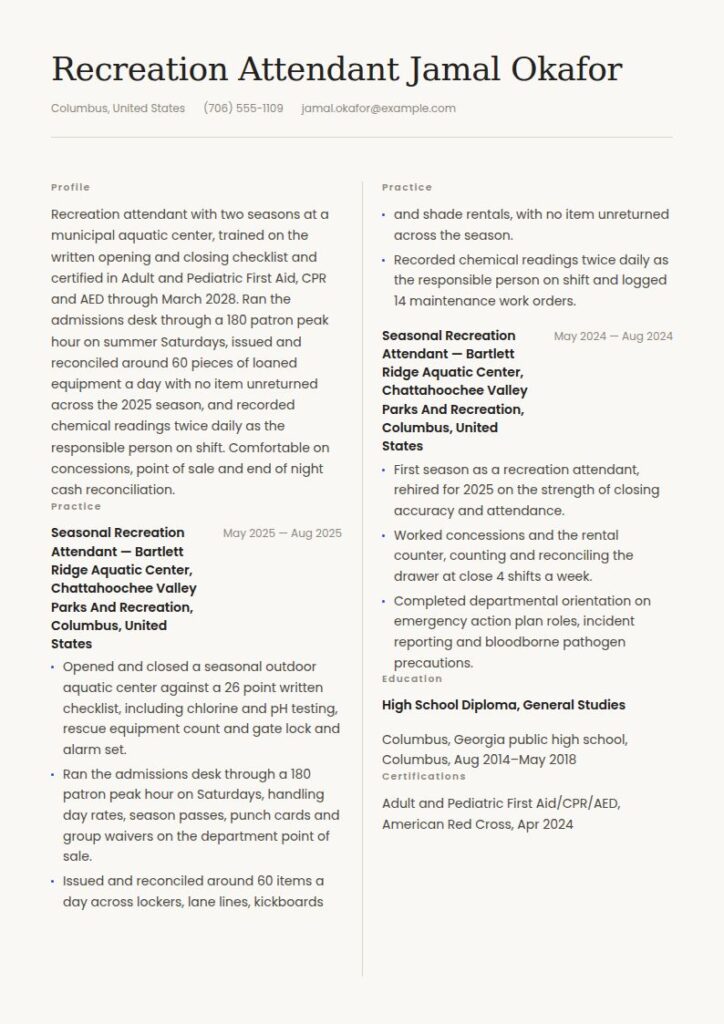
Recreation Attendant Jamal Okafor
Seasonal Recreation Attendant
[email protected] | (706) 555-1109 | Columbus, United States
Profile
Recreation attendant with two seasons at a municipal aquatic center, trained on the written opening and closing checklist and certified in Adult and Pediatric First Aid, CPR and AED through March 2028. Ran the admissions desk through a 180 patron peak hour on summer Saturdays, issued and reconciled around 60 pieces of loaned equipment a day with no item unreturned across the 2025 season, and recorded chemical readings twice daily as the responsible person on shift. Comfortable on concessions, point of sale and end of night cash reconciliation.
Work Experience
05/2025 - 08/2025, Seasonal Recreation Attendant, Bartlett Ridge Aquatic Center, Chattahoochee Valley Parks and Recreation, Columbus, United States
- Opened and closed a seasonal outdoor aquatic center against a 26 point written checklist, including chlorine and pH testing, rescue equipment count and gate lock and alarm set.
- Ran the admissions desk through a 180 patron peak hour on Saturdays, handling day rates, season passes, punch cards and group waivers on the department point of sale.
- Issued and reconciled around 60 items a day across lockers, lane lines, kickboards and shade rentals, with no item unreturned across the season.
- Recorded chemical readings twice daily as the responsible person on shift and logged 14 maintenance work orders.
05/2024 - 08/2024, Seasonal Recreation Attendant, Bartlett Ridge Aquatic Center, Chattahoochee Valley Parks and Recreation, Columbus, United States
- First season as a recreation attendant, rehired for 2025 on the strength of closing accuracy and attendance.
- Worked concessions and the rental counter, counting and reconciling the drawer at close 4 shifts a week.
- Completed departmental orientation on emergency action plan roles, incident reporting and bloodborne pathogen precautions.
Education
08/2014 - 05/2018, High School Diploma, General studies, Columbus, Georgia public high school, Columbus, United States
Enrolled in the Associate of Applied Science in Recreation and Leisure Services at Columbus Technical College from August 2019.
Skills
Opening and closing procedure, 75
Point of sale and cash reconciliation, 70
Equipment issue and reconciliation, 75
Chemical testing and recording, 60
Incident and injury reporting, 60
Waiver and registration handling, 65
Locker room and restroom sanitation, 80
Capacity and crowd management, 55
Concession service, 70
Languages
English, native
Certificates
04/2024, Adult and Pediatric First Aid/CPR/AED, American Red Cross
Two year certificate, renewed on schedule before each season.
Summary
A recreational facility attendant resume is a one page document describing the shift you run rather than the title you hold: the opening and closing checks, the admissions and point of sale volume at peak, the equipment you issue and reconcile, the logs you keep, and the certifications the shift required. This guide gives you three adaptable versions and current Bureau of Labor Statistics pay and outlook.
Recreational Facility Attendant resume examples by experience level
A recreational facility attendant resume is a one page document that describes a shift: what you check before the doors open, how many people you admit and charge at the busiest hour, what equipment leaves the counter and comes back, what you write in the log, and what you do before you lock up.
That is where most applicants lose the job. A recreation supervisor is working out whether they can leave you alone in a building at 5:45 in the morning with a key, a cash drawer, a test kit and a clipboard, and find it in good order at ten that night. Yet almost every file says “greeted patrons and maintained a clean facility.” In contrast, almost none writes the shift.
Resume guide for a recreational facility attendant resume
In short, this guide and the corresponding recreational facility attendant resume example will cover:
- First, how to write a recreational facility attendant resume, section by section
- Then, why the opening and closing routine belongs on the page as a named procedure
- Also, three adaptable summaries: seasonal, experienced and lead attendant
- How to count admissions, equipment and logs so a supervisor can check you
- Finally, what the job market looks like and what you can earn
How to write a recreational facility attendant resume
Six sections: contact header, summary, certifications with dates, facility experience, a shift detail block, and skills, with education last. One page at every level.
Certifications sit above experience because they decide whether a manager can schedule you at all. The Bureau of Labor Statistics puts it plainly: “Some employers require recreation workers to have certifications such as cardiopulmonary resuscitation (CPR) or first aid” (BLS Occupational Outlook Handbook, Recreation Workers, 27 August 2026). In particular, at a facility with water or a fitness floor, “some employers” usually means all of them.
| Section | What it is answering | Where it goes |
|---|---|---|
| Certifications and dates | Can this person be scheduled alone next Saturday? | Under the summary, with issue and expiry |
| Facility experience | What kind of building have they actually run? | Reverse chronological, facility type and size named |
| Shift detail | What happens between open and close when they are on? | Its own block, not buried inside bullets |
| Skills and systems | Do they know the register, the log and the test kit? | Grouped, with the named systems |
| Education | Does it clear the stated bar? | Last, and short |
Write your card with an issue date and an expiry date, not just a name
The American Red Cross states that its Adult First Aid/CPR/AED certificate is "valid for two years" (American Red Cross, redcross.org, retrieved 17 September 2026). Two years is short enough that a supervisor reading files in April is doing arithmetic on every one. Make it unnecessary. Write a range: "American Red Cross Adult and Pediatric First Aid/CPR/AED, issued March 2026, valid through March 2028."
Do the same with any operator credential. The National Recreation and Park Association states that "AFO certification is valid for five years" and that the Aquatic Facility Operator exam is "50 questions, open-book" with a minimum age of 18 and "no education or experience prerequisites for taking the AFO exam" (NRPA, nrpa.org, retrieved 17 September 2026). Read that last clause twice if you are early in this work: the credential that separates attendant files needs neither a degree nor a prior job.
Finally, run the finished file through the ATS resume checker first. Parks departments, county recreation authorities and university recreation centers all run hiring through an applicant system that parses your file before a person opens it.
Choosing the best resume format for a recreational facility attendant resume
Overall, reverse chronological, one page, at every stage of this career. After all, the reader wants dates, buildings and a short list of facts.
In contrast, functional and skills-first formats fail here for a reason. BLS notes that “Most recreation workers are full time, but many work part-time, irregular, or seasonal hours” (BLS Occupational Outlook Handbook, Recreation Workers, 27 August 2026). As a result, a supervisor inside that pattern reads gaps as normal and a hidden timeline as a problem. For example, writing each season as its own dated entry: “Seasonal Recreation Attendant, May 2024 to August 2024”, and again for 2025, shows the employer rehired you.
Include your contact information
| ✅ Right | ❌ Wrong |
|---|---|
| Jamal Okafor | Jamal Okafor |
| Recreational Facility Attendant, AFO certified | Hardworking team player seeking recreation role |
| Red Cross First Aid/CPR/AED through March 2028 | CPR certified |
| (706) 555-1109, [email protected], Columbus, GA | (706) 555-1109, [email protected] |
Put the expiry on the page; the supervisor checks it before writing you onto a schedule. In addition, add availability if it is useful: “available for 5:30 a.m. openings and weekend closes” is an advantage in a building staffed at both ends of the day.
Make use of a summary
In short, four lines: the facility you run, how long, the volume at peak, and the certification with its date.
Recreation attendant with two seasons at a municipal aquatic center, trained on the written opening and closing checklist and certified in Adult and Pediatric First Aid, CPR and AED through March 2028. Ran the admissions desk through a 180 patron peak hour on summer Saturdays, issued and reconciled around 60 pieces of loaned equipment a day with no item unreturned across the 2025 season, and recorded chemical readings twice daily as the responsible person on shift. Comfortable on concessions, point of sale and end of night cash reconciliation.
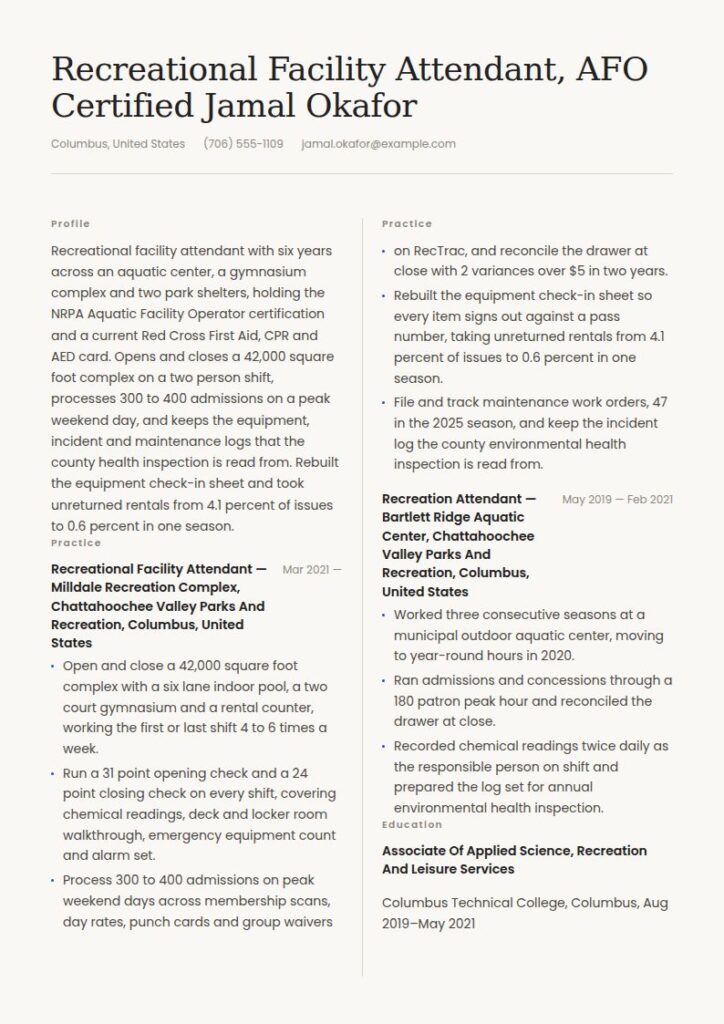
Recreational facility attendant with six years across an aquatic center, a gymnasium complex and two park shelters, holding the NRPA Aquatic Facility Operator certification and a current Red Cross First Aid, CPR and AED card. Opens and closes a 42,000 square foot complex on a two person shift, processes 300 to 400 admissions on a peak weekend day, and keeps the equipment, incident and maintenance logs that the county health inspection is read from. Rebuilt the equipment check-in sheet and took unreturned rentals from 4.1 percent of issues to 0.6 percent in one season.
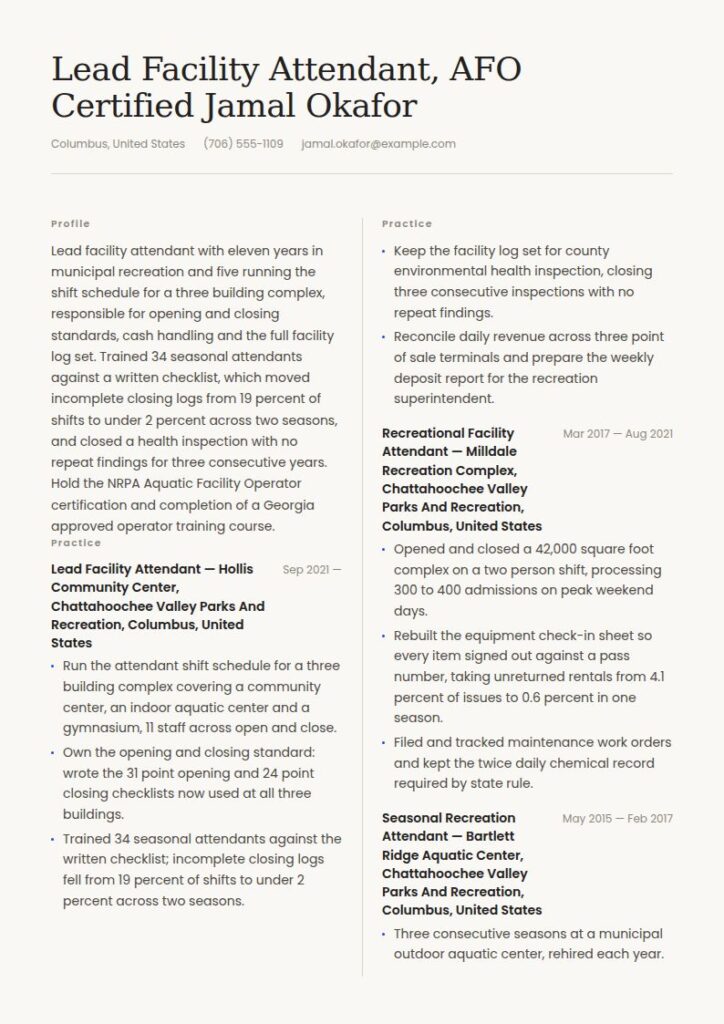
Lead facility attendant with eleven years in municipal recreation and five running the shift schedule for a three building complex, responsible for opening and closing standards, cash handling and the full facility log set. Trained 34 seasonal attendants against a written checklist, which moved incomplete closing logs from 19 percent of shifts to under 2 percent across two seasons, and closed a health inspection with no repeat findings for three consecutive years. Hold the NRPA Aquatic Facility Operator certification and completion of a Georgia approved operator training course.
Right vs wrong: the same recreational facility attendant summary, twice
| ✅ Right | ❌ Wrong |
|---|---|
| Opens and closes a 42,000 square foot complex on a two person shift. | Responsible for facility operations and maintaining a welcoming environment. |
| Processes 300 to 400 admissions on a peak weekend day. | Greets and assists patrons with a friendly attitude. |
| Took unreturned rentals from 4.1 percent of issues to 0.6 percent in one season. | Managed equipment and ensured items were returned. |
| Red Cross First Aid, CPR and AED current through March 2028. | CPR and first aid certified. |
In contrast, a manager can put the right column on a schedule. However, the left column cannot, and a supervisor working through forty applications before a season is building a schedule.
Outline your facility experience
Facility name, building type, size, dates, then three to five bullets. Ideally, therefore, every bullet carries something countable: people, items, shifts, logs or a rate.
| Instead of | Use |
|---|---|
| Greeted patrons and answered questions | Processed 300 to 400 admissions on peak weekend days, including pass scans, day rates and group waivers |
| Handled money | Ran the point of sale and closed the drawer on 4 to 6 shifts a week, with 2 variances over $5 in two years |
| Maintained a clean and safe facility | Completed the 31 point opening and 24 point closing checklist on every shift and logged both |
| Issued equipment to guests | Issued and reconciled around 60 items a day across kayaks, rackets, lane lines and gym equipment |
Recreational Facility Attendant, Milldale Recreation Complex, Chattahoochee Valley Parks and Recreation, Columbus, GA, March 2021 to Present
Open and close a 42,000 square foot complex holding a six lane indoor pool, a two court gymnasium and a rental counter, working the first or last shift 4 to 6 times a week.
Run the 31 point opening check and the 24 point closing check on every shift, including chemical readings, deck and locker room walkthrough, emergency equipment count, and alarm set.
Process 300 to 400 admissions on a peak weekend day across membership scans, day rates, punch cards and group waivers, and reconcile the drawer at close.
Issue and reconcile around 60 pieces of equipment a day; rebuilt the check-in sheet so every item signs out against a pass number, taking unreturned rentals from 4.1 percent to 0.6 percent in a season.
File and track maintenance work orders, 47 in the 2025 season, and keep the incident log the county environmental health inspection is read from.
Write the shift, not the title: what you open, count, issue, log and close
A title tells a supervisor nothing, because “attendant”, “facility aide” and “recreation assistant” mean different things in every department. The shift tells them everything. So build it in five parts, in the order the shift happens.
What you open. Name the checklist and its item count. A facility with a written opening check is a facility with an inspector, and an attendant who can describe one can take on another department’s version on day one.
What you count and charge at peak. Admissions at the busiest hour, not the daily average, because managers set staffing on peak.
What you issue and reconcile. Meanwhile, equipment is where money quietly leaves a recreation budget, and a non-return rate with a before and an after is something almost nobody else has written.
What you log. Incident reports, work orders, chemical readings, headcounts and the closing log. Inspectors read from these, yet most attendants keep them without mentioning them.
What the shift required of you. The certifications the post was staffed against, with dates.
Opening: 31 point check including chlorine and pH test, deck and locker room walkthrough, rescue equipment count, AED battery and pad check, gymnasium floor inspection, lighting and alarm disarm. Logged and initialed before doors open at 5:30 a.m.
Admissions and point of sale: 300 to 400 admissions on peak weekend days; membership scans, day passes, punch cards, group waivers and program registrations on RecTrac; drawer counted and reconciled at close, 2 variances over $5 in two years.
Equipment issued: around 60 items a day across kayaks and paddles, rackets, lane lines, gymnasium equipment and locker rentals, signed out against a pass number and reconciled at close.
Logs kept: incident and injury reports, maintenance work orders (47 in the 2025 season), twice daily chemical readings, hourly bather headcounts, and the closing log.
Closing: 24 point check including equipment reconciliation, chemical readings, chemical room secured, drawer counted, doors locked, alarm set, closing log filed.
Certifications the shift required: American Red Cross Adult and Pediatric First Aid/CPR/AED; NRPA Aquatic Facility Operator; Department approved operator training course.
Recreation attendant log and chemical lines
Above all, the log line and the chemical line are worth writing even if you never touched a feeder, because the code is public and the reader lives inside it. Georgia’s rules for public swimming pools, spas and recreational water parks require that “free available chlorine or total bromine and pH shall be tested a minimum of two times daily during the hours of operation”, that every pool “shall be maintained under the supervision and direction of a properly trained operator” holding “a current certificate showing completion of an approved operator training course”, and that the operator’s visits are documented in writing (Georgia Secretary of State, Rule 511-3-5-.22, rules.sos.ga.gov, retrieved 17 September 2026).
Check your own state’s rule before you cite anything, because the numbers change. The Centers for Disease Control and Prevention publishes the Model Aquatic Health Code as guidance and says: “The MAHC is not a federal law. Note that the MAHC is a CDC guidance document and only becomes law if voluntarily adopted by a local, state, territorial, or tribal jurisdiction” (CDC, cdc.gov, retrieved 17 September 2026). Your state or county sets testing frequency and what you must write down, so name yours by number.
Build a snapshot of your key skills
Fourteen or so entries in four groups: operations, money and systems, safety, and maintenance. Likewise, name the actual software, because an attendant who already knows theirs saves a week of training.
Operations: Opening and closing procedure, Facility walkthrough and hazard inspection, Room and court changeover, Rental and reservation handling, Capacity management
Money and systems: Point of sale and cash reconciliation, RecTrac, Membership scanning and pass administration, Program registration, Waiver collection, Daily revenue reporting
Safety: Adult and Pediatric First Aid, CPR and AED, Incident and injury reporting, Rescue equipment checks, Emergency action plan roles, Bloodborne pathogen precautions
Maintenance and water: Chemical testing and recording, Chemical handling and storage, Filter and pump room checks, Work order tracking, Locker room sanitation
List your education and certifications
Certifications first with issue and expiry, then education. The Handbook lists a high school diploma or equivalent as the typical entry-level education for recreation workers, with short-term on-the-job training (BLS, Recreation Workers, 27 August 2026), so certifications carry more weight here than a degree.
American Red Cross Adult and Pediatric First Aid/CPR/AED, issued March 2026, valid through March 2028
Aquatic Facility Operator (AFO), National Recreation and Park Association, #AFO-2041877, issued May 2024, valid through May 2029
Department approved pool operator training course, Georgia Department of Public Health recognized provider, completed April 2024
Associate of Applied Science, Recreation and Leisure Services, Columbus Technical College, Columbus, GA, 2021
High School Diploma, Columbus, GA, 2018
If you are applying for a first season with none of this, say what you have booked. After all, “Red Cross First Aid/CPR/AED scheduled 12 April” is a date a supervisor can plan around; a blank is not.
Choose the right layout and design
In practice, that means single column, plain type at 11 or 12 point, clear headings, no photograph, no icons, no rating bars, one page. Municipal and university portals parse your file into a structured record before a human reads it, and multi-column layouts and graphics are where that parsing breaks.
Write the opening and closing checks as named procedures with an item count. Give admissions volume at peak, not as a daily average. State equipment issued and the non-return rate, with a before and an after. Name the point of sale software by product name. Put issue and expiry dates on every certification. List each season as its own dated entry so a rehire is visible. Say what hours you can cover.
Do not write "maintained a clean and safe environment", which every file in the stack says. Do not describe an incident in a way that could identify a patron, a child or a member. Do not claim a lapsed certification without the expiry and the rebooking date. Do not pad to two pages. Do not use a two-column template for a government portal.
Recreational facility attendant job market and outlook
In other words, a very large occupation with modest projected growth and enormous replacement demand, which makes it easy to enter and makes staying a credential.
| Measure | Value |
|---|---|
| Recreation worker jobs, 2025 | 346,900 |
| Projected change, 2025-35 | 4 percent, 15,000 jobs |
| Projected annual openings | about 67,000 |
| Typical entry-level education | High school diploma or equivalent |
| On-the-job training | Short-term |
| Median annual wage, May 2025 | $36,560 ($17.58 per hour) |
Source: U.S. Bureau of Labor Statistics, Occupational Outlook Handbook, Recreation Workers, 2025-35 projections and May 2025 wage data.
Sixty seven thousand openings a year against fifteen thousand new jobs
BLS projects about 67,000 openings a year for recreation workers on average over the decade, against a projected increase of only 15,000 jobs in total over the same ten years (BLS Occupational Outlook Handbook, Recreation Workers, 27 August 2026).
Nearly all of that volume is churn: people leaving the occupation, and seasonal posts refilling every spring. That explains both halves of this market. A first season is easy to get, and it explains what a supervisor is shopping for, which is the opposite of churn. Anything showing you came back, finished a season, trained a replacement or held a certification through a renewal answers the problem they actually have.
Where the jobs sit:
| Setting | Share of employment | Median annual wage (May 2025) |
|---|---|---|
| Local government, excluding education and hospitals | 32 percent | $36,540 |
| Nursing and residential care facilities | 19 percent | $37,500 |
| Religious, grantmaking, civic and professional organizations | 10 percent | $36,510 |
| Other amusement and recreation industries | 10 percent | $33,810 |
| Educational services, state, local and private | 9 percent | $36,230 |
Source: U.S. Bureau of Labor Statistics, May 2025.
Instead, read that as a map of where to apply. In particular, nursing and residential care is nearly a fifth of the occupation, pays the highest published median in the group, and is the corner of this work almost nobody thinks to target.
What salary you can expect as a recreational facility attendant
The median annual wage for recreation workers was $36,560 as of May 2025, which BLS also publishes as $17.58 per hour. The lowest 10 percent earned less than $27,600 and the highest 10 percent more than $50,410 (BLS, May 2025).
That is a narrow spread, and the reason matters. Municipal recreation pay is set by a grade and step schedule, not by negotiation, so money moves when your classification moves: attendant to lead attendant, lead to facility supervisor, seasonal to year-round benefited. Employers award those steps against documentation; that is why certification dates and log work belong on the page. Similarly, industry is the second lever: published medians run from $33,810 in other amusement and recreation industries to $37,500 in nursing and residential care facilities (BLS, May 2025).
Key takeaways for a recreational facility attendant resume
- Write the shift, not the title: what you open, count, issue, log and close.
- Then put certifications above experience, with issue and expiry dates on each one.
- Also, give admissions volume at peak, and name the point of sale system.
- State equipment issued and the non-return rate, with a before and an after.
- Name the logs you keep, because inspectors read from them.
- List each season separately so a rehire is visible on the page.
- Keep it to one page, single column, and parseable by a municipal portal.
Build your recreational facility attendant resume in 15 minutes with our AI resume builder.
Related sport and fitness resume examples
- Lifeguard resume
- Fitness instructor resume
- Personal trainer resume
- Swimming coach resume
- Yoga instructor resume
- Athletic trainer resume
- Sports resume
- Coach resume
- Referee resume
- Sport and fitness resume
- Tennis coach resume
- Basketball coach resume
Pair it with a matching recreational facility attendant cover letter.
Recreational facility attendant resume questions, answered
How long should a recreational facility attendant resume be?
One page, at every level, including lead. The reader is checking four facts: certifications and their dates, the buildings you have run, the volume you handle, and whether you were asked back. A second page buries all four.
What do I put on a recreational facility attendant resume with no experience?
Write any job where you were trusted alone with a building, a register or an inventory, in the same five parts: what you opened, counted and charged, issued, logged and closed. Retail closing shifts, concession stands, school facility crews and camp work all translate. Then add the certification you hold or have booked, and the hours you can cover.
Which certification is worth getting first?
First Aid, CPR and AED, because BLS notes that "Some employers require recreation workers to have certifications such as cardiopulmonary resuscitation (CPR) or first aid" (BLS Occupational Outlook Handbook, 27 August 2026). After that, an operator credential if your facility has water: NRPA states the Aquatic Facility Operator exam has "no education or experience prerequisites" and a minimum age of 18, and that the certification "is valid for five years" (NRPA, nrpa.org, retrieved 17 September 2026).
How do I write about an incident without breaching anybody's privacy?
Describe the action and the paperwork, never the person. "Filed 12 incident reports in a season and completed the follow-up work order on each" is safe and useful. Ages, descriptions and injuries attached to an individual are not.
Does seasonal work count as real experience?
Yes, and it is the normal shape of this occupation. BLS notes that "Most recreation workers are full time, but many work part-time, irregular, or seasonal hours" (BLS Occupational Outlook Handbook, 27 August 2026). List each season separately rather than collapsing three summers into one line, because the rehire is the point.
Should I mention pool chemistry if I am not the pool operator?
Yes, if you recorded readings, because recording is a defined role in most state codes and inspections are read from the record. Georgia's rule requires chlorine or bromine and pH tested "a minimum of two times daily during the hours of operation" and written documentation of the trained operator's visits (Georgia Secretary of State, Rule 511-3-5-.22, rules.sos.ga.gov, retrieved 17 September 2026). Say what you tested, how often you logged it, and who held the operator certificate. Do not imply you held it if you did not.