Vartan Sirota Clinical Staff Pharmacist, PharmD Des Moines, 50310, United States [email protected] · (515) 555-0806
16 September 2026
Ms. Analise Vickers Director of Pharmacy Westvale Health Des Moines, United States
Application for Ambulatory Care Clinical Pharmacist, Westvale Health
Dear Ms. Vickers,
I am applying for the Ambulatory Care Clinical Pharmacist post at Westvale Health. I am licensed in Iowa and Nebraska, PGY1 trained, and I currently verify roughly 380 inpatient medication orders a shift at a 260-bed hospital while running an anticoagulation dosing service under a collaborative practice agreement. The posting asks for someone who can hold a clinic panel and a verification queue in the same week, which is what I do now.
The work I would most want to bring across is the anticoagulation service. It runs at about 40 active dosing consults a week under a collaborative practice agreement, with a documented handoff back to the prescriber at discharge rather than an open-ended pharmacy referral. Alongside it I rebuilt the controlled substance discrepancy review across 14 automated dispensing cabinets, and discrepancies unresolved at 24 hours fell from 11 a month to under 2 within three quarters. Both of those were process changes rather than one-off fixes, which is why they held.
I noticed Westvale added two clinic sites last year and that your diabetes program now schedules pharmacist visits alongside primary care. The gap I see most often from the inpatient side is the handoff in the first week after discharge, and that is the piece I would want to work on first. I also share pharmacist oversight of a USP 797 compounding area, so I can cover that rota if it is useful rather than being a single-site clinical hire.
My Iowa license is active through 2027, my Nebraska license is active, my immunization certificate is current, and I can give eight weeks of notice. Thank you for reading.
Sincerely, Vartan Sirota, PharmD
Summary
A pharmacist cover letter names the states you are licensed in, the setting and volume you work at now, and the clinical services you are already authorized to deliver. This guide gives you a full adaptable letter, how the letter changes between retail, hospital and ambulatory posts, and the rule that keeps every patient off the page.
Pharmacist cover letter examples by experience level
A pharmacist cover letter is a one-page letter that tells a pharmacy director which states you are licensed in, what setting and volume you work at now, what you are already credentialed to do, and when you could start.
Those four facts decide whether you are worth an interview, and a letter that gives them in the first paragraph is read twice. One rule comes before all of it.
Never put a patient in a pharmacist cover letter
No name, no initials, no age, no diagnosis, no prescription belonging to someone, no intervention story, no outcome, no identifying circumstance. Not a de-identified one either, because the reader cannot verify the de-identification and the stories worth telling are the ones that stay recognizable.
The intervention anecdote is the most common way a pharmacist cover letter goes wrong, because it is how pharmacists explain their value to each other in person. In writing, to a stranger, it reads as a records habit.
Write the service instead: the disease states in your collaborative practice agreement, the consult volume a week, the orders a shift, the doses administered in a season, and the rate you moved. All of that is evidence and none of it is a person.
Guide to a pharmacist cover letter
This guide and the corresponding pharmacist cover letter example will cover:
- How to structure the letter, paragraph by paragraph
- Why licensure and setting belong in the first two sentences
- What counts as evidence when you cannot describe a patient
- How the letter changes between retail, hospital and ambulatory posts
- The closing lines that get a start date into the conversation
How to write a pharmacist cover letter
| Paragraph | Its job | Length |
|---|---|---|
| Opening | The post, your license states, your current setting and volume | 2 to 3 sentences |
| Evidence | One service, one volume, one rate you moved, one period | 4 to 5 sentences |
| Fit | Something specific about their organization, and what you would take on | 3 to 4 sentences |
| Close | License status, certifications, notice period, thank you | 2 sentences |
Put licensure and setting in the first two sentences
A pharmacy director reading applications is holding a rota and a credentialing timeline. The first question is whether you can be licensed where the job is, and the second is whether you have worked at the volume the job runs at.
Answer both immediately: "I am licensed in Iowa and Nebraska and currently verify roughly 380 inpatient medication orders a shift at a 260-bed hospital." That sentence does more than a paragraph about your commitment to safe medication use.
If your license is in transfer, say so with a date rather than leaving it out. Reciprocity is routine and a dated pending line reads as organized, while silence reads as a phone call the reader has to make.
A pharmacist cover letter example you can adapt
Dear Ms. Vickers,
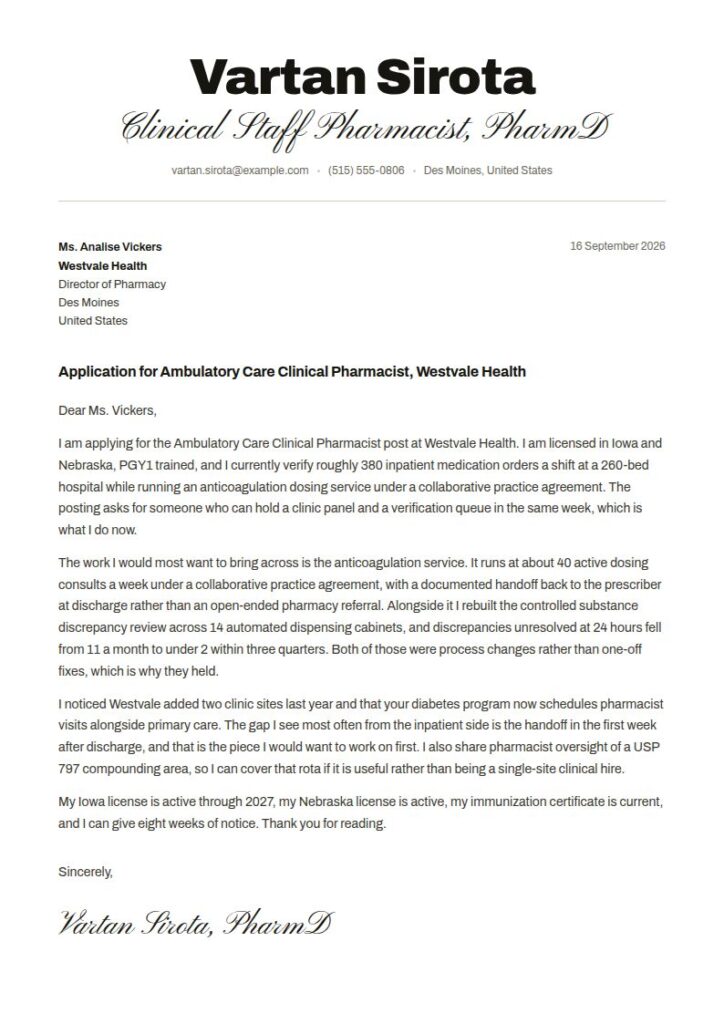
I am applying for the Ambulatory Care Clinical Pharmacist post at Westvale Health. I am licensed in Iowa and Nebraska, PGY1 trained, and I currently verify roughly 380 inpatient medication orders a shift at a 260-bed hospital while running an anticoagulation dosing service under a collaborative practice agreement. The posting asks for someone who can hold a clinic panel and a verification queue in the same week, which is what I do now.
The work I would most want to bring across is the anticoagulation service. It runs at about 40 active dosing consults a week under a collaborative practice agreement, with a documented handoff back to the prescriber at discharge rather than an open-ended pharmacy referral. Alongside it I rebuilt the controlled substance discrepancy review across 14 automated dispensing cabinets, and discrepancies unresolved at 24 hours fell from 11 a month to under 2 within three quarters. Both of those were process changes rather than one-off fixes, which is why they held.
I noticed Westvale added two clinic sites last year and that your diabetes program now schedules pharmacist visits alongside primary care. The gap I see most often from the inpatient side is the handoff in the first week after discharge, and that is the piece I would want to work on first. I also share pharmacist oversight of a USP 797 compounding area, so I can cover that rota if it is useful rather than being a single-site clinical hire.
My Iowa license is active through 2027, my Nebraska license is active, my immunization certificate is current, and I can give eight weeks of notice. Thank you for reading.
Sincerely, Vartan Sirota, PharmD
Openings that work
| Instead of | Use |
|---|---|
| I am writing to express my interest in the pharmacist position | I am applying for the Ambulatory Care Clinical Pharmacist post, licensed in Iowa and Nebraska |
| I am a detail-oriented pharmacist with a passion for patient care | I verify roughly 380 inpatient medication orders a shift at a 260-bed hospital |
| I have extensive experience in clinical pharmacy services | I run an anticoagulation dosing service under a collaborative practice agreement, about 40 consults a week |
| I would be a valuable addition to your pharmacy team | I noticed Westvale added two clinic sites last year and now schedules pharmacist visits alongside primary care |
What counts as evidence when you cannot describe a patient
Every measure below is something a pharmacy keeps anyway, which is what makes it verifiable and safe to write.
| Kind of evidence | What it looks like in a sentence |
|---|---|
| Throughput | About 420 prescriptions a day across two pharmacists and three technicians |
| Order volume | Roughly 380 inpatient medication orders verified a shift across four services |
| Service volume | About 40 active anticoagulation dosing consults a week under collaborative practice |
| Season volume | Roughly 900 immunizations administered in one fall season, including two off-site clinics |
| A rate you moved | Controlled substance discrepancies unresolved at 24 hours fell from 11 a month to under 2 |
| Program growth | Comprehensive medication reviews grew from 600 to about 3,400 a year across nine sites |
| People | Precept four PharmD students a year and own the competency file for six compounding technicians |
Retail, hospital and ambulatory letters are not the same letter
The settings hire on different evidence and they pay differently, so the letter has to pick one.
For a retail or chain post, lead with fill volume under staffing, immunization season numbers, wait time or workflow changes you made, and your availability across sites. For a hospital post, lead with bed count, orders verified a shift, the services you cover, sterile compounding and controlled substance work, and residency if you have it. For an ambulatory post, lead with the disease states in your collaborative practice agreement, visit or review volume, and board certification. In all three, name one real thing about the employer taken from their own pages.
Do not send the same letter to all three; the vocabulary gives it away in one line. Do not describe a patient, a prescription belonging to someone or an intervention story. Do not claim a service you were not credentialed for. Do not write "high volume" when you can write the number. Do not leave a pending license transfer unmentioned.
The pay gap between settings is the reason to write three letters
Pharmacist employment splits across pharmacies and drug retailers at 37 percent, hospitals at 32 percent, general merchandise retailers at 6 percent and ambulatory healthcare services at 6 percent (BLS Occupational Outlook Handbook, Pharmacists, published 27 August 2026).
The medians differ by more than the settings do in daily work: hospitals $157,290, ambulatory healthcare services $153,920, general merchandise retailers $151,370 and pharmacies and drug retailers $132,940 in May 2025, against an occupation-wide median of $140,910 (BLS, May 2025).
The Handbook also expects retail demand to be "limited" as the industry consolidates and more prescriptions are filled online or by mail, while growth comes from pharmacists being "increasingly integrated into healthcare teams" (BLS, published 27 August 2026). If you are writing across settings, the letter that moves you is the one that translates your volume into the new setting's vocabulary rather than restating it in the old one.
Length, format and sending it
One page, four paragraphs, 250 to 400 words. PDF unless the portal says otherwise, named for yourself and the post: vartan-sirota-ambulatory-pharmacist-cover-letter.pdf.
Address a person. Pharmacy leadership is usually named on a health system site or in the posting, and "Dear Hiring Manager" on an otherwise specific letter reads as one sent to twelve employers.
Keep the figures identical to your resume so the two agree. Our pharmacist resume example uses the same numbers as the letter above.
Key takeaways
- Name your license states and their status in the first two sentences.
- Give the setting and the volume you work at now, with the staffing attached.
- Pick one service, one number and one period as your evidence.
- Never describe a patient, a prescription belonging to someone or an intervention.
- Rewrite the letter for retail, hospital or ambulatory; do not send one version to all three.
- Name one real thing about the employer, taken from their own pages.
- Close with license status, certifications and a notice period.
Write your pharmacist cover letter in 10 minutes with our AI cover letter builder.
Pharmacist cover letter questions, answered
How long should a pharmacist cover letter be?
One page, four paragraphs, 250 to 400 words. If a sentence does not help a director credential you, schedule you or judge your volume, it is taking the place of one that would.
Do I need a cover letter if the application is a portal?
Attach one wherever there is a field for it. The portal collects the same structured fields from every applicant. The letter is the only place you can say which states you are licensed in, what you are credentialed for, and when you could actually start.
Can I write about a clinical catch or intervention?
No. A reader cannot verify that it has been de-identified, and the interventions worth writing about are the ones that stay recognizable. Write the service, the volume and the rate instead. A director reads "about 40 active dosing consults a week under collaborative practice" as capability; an anecdote reads as a records risk.
What do I write with no pharmacist experience yet?
Write your intern hours as a job. Name the settings, the total hours, the fill volume or bed count you worked at, what you were signed off to do, and the immunizations you administered. Then give your license date or the date you sit the NAPLEX and MPJE, and say what you want structured training in. A new licensee who states a volume, a setting and a certificate is easy to plan around.
How do I explain moving from retail to hospital?
Translate rather than apologize. Prescriptions a day becomes throughput under staffing, immunization seasons become clinical service delivery with volume, and technician supervision becomes competency assessment. Then name the gap and what you are doing about it. The Handbook expects retail demand to be limited while team-based roles grow (BLS Occupational Outlook Handbook, Pharmacists, published 27 August 2026), so a director has read the story before.