Noor Haddad Healthcare Project Manager, Clinical Systems Minneapolis, 55414, United States [email protected] · (612) 555-1138
11 September 2026
Ms. Renata Kowalczyk Director of Program Management Silver Lake Health Partners Saint Paul, United States
Application for Senior Healthcare Project Manager, Silver Lake Health Partners
Dear Ms. Kowalczyk,
I am applying for the Senior Healthcare Project Manager post at Silver Lake Health Partners. I run clinical system implementations inside a 900-bed academic hospital and hold the PMP, and my most recent project was an ambulatory EHR consolidation across 11 clinics and 620 clinicians that went live on its committed date with 4 hours of scheduled downtime and no revenue cycle hold.
The part worth describing is not the go-live, it is the week before. Two weeks out, testing surfaced a scanning defect that would have stopped specimen labeling on three units. The committed date was tied to a payer contract, so moving it was expensive and accepting the clinical risk was not an option. I took the defect to the clinical governance review, agreed a documented paper workaround with the laboratory director for the first 72 hours, and held the date. Go-live week support tickets came in at 38% of the volume forecast from the previous rollout, largely because the super-user network of 96 clinicians had already run the workaround in training.
I have also managed a rollback. During an inpatient pharmacy go-live across 3 hospitals and 740 beds, one interface failed validation overnight; we reverted it, ran on the previous interface for six days, and re-cut it the following weekend without a second downtime for clinical staff. That is what I would bring to your inpatient work, since I understand Silver Lake is moving three community hospitals onto a single instance.
My PMP is current through 2027 and I could start within four weeks of an offer. Thank you for reading.
Sincerely, Noor Haddad, PMP
Summary
A healthcare project manager cover letter names the clinical systems you have implemented, the scope of each rollout in sites and clinicians, and the date you delivered against. This guide gives you a full adaptable letter, the paragraph about downtime and rollback that almost nobody writes, and the openings that get an otherwise strong file set aside.
Healthcare Project Manager cover letter examples by experience level
A healthcare project manager cover letter is a one-page letter telling a health system which clinical systems you have put live, how big those rollouts were, and what happened on the day the date arrived. The person reading it has almost certainly lived through a go-live that went badly, and a letter written for that memory stands out on its own.
Guide to a healthcare project manager cover letter
This guide and the corresponding healthcare project manager cover letter example will cover:
- How to structure the letter, paragraph by paragraph
- Why the system and scope belong in the first paragraph
- What counts as evidence when projects are confidential
- The downtime and rollback paragraph almost nobody writes
- The openings that get a strong file set aside
How to write a healthcare project manager cover letter
| Paragraph | Its job | Length |
|---|---|---|
| Opening | The post, the systems you implement, your credential | 2 to 3 sentences |
| Evidence | One implementation, its scope, its date, what held | 4 to 5 sentences |
| Fit | Something specific about their organization | 3 to 4 sentences |
| Close | Certification, availability, thank you | 2 sentences |
Put the system and the scope in the first paragraph
A director of program management is not evaluating your philosophy of delivery. They are working out whether you have run something the size of what they are about to hand someone.
Name it: "I have run Epic ambulatory and inpatient implementations, most recently a consolidation across 11 clinics and 620 clinicians that went live on its committed date." Then add the credential, because it is a screening field: "I hold the PMP."
A healthcare project manager cover letter example you can adapt
Dear Ms. Kowalczyk,
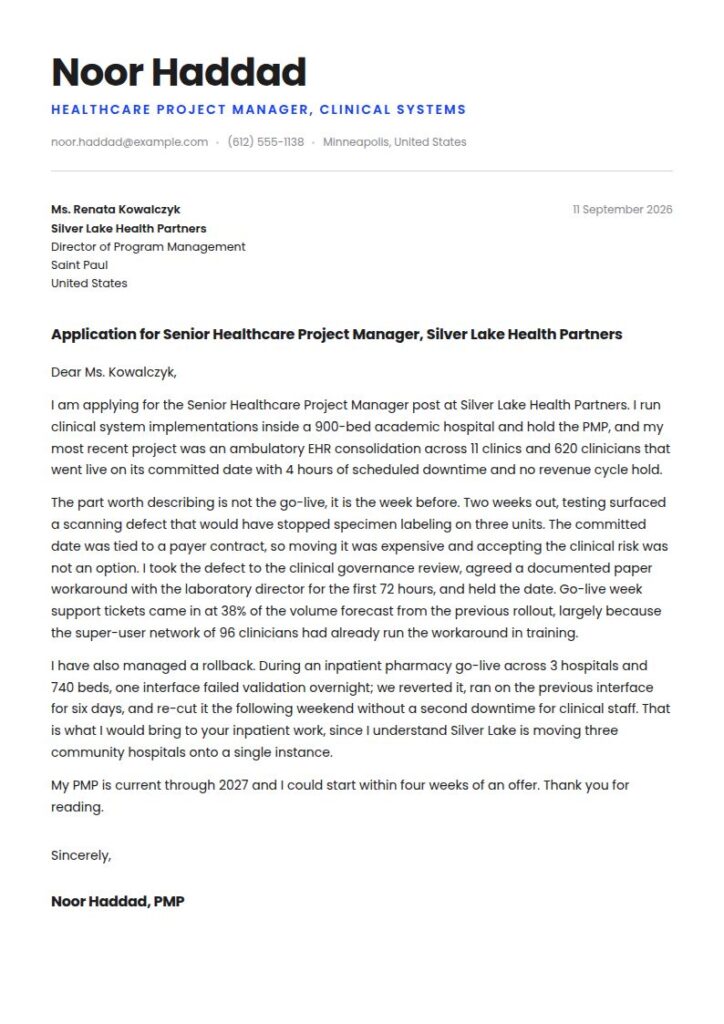
I am applying for the Senior Healthcare Project Manager post at Silver Lake Health Partners. I run clinical system implementations inside a 900-bed academic hospital and hold the PMP, and my most recent project was an ambulatory EHR consolidation across 11 clinics and 620 clinicians that went live on its committed date with 4 hours of scheduled downtime and no revenue cycle hold.
The part worth describing is not the go-live, it is the week before. Two weeks out, testing surfaced a scanning defect that would have stopped specimen labeling on three units. The committed date was tied to a payer contract, so moving it was expensive and accepting the clinical risk was not an option. I took the defect to the clinical governance review, agreed a documented paper workaround with the laboratory director for the first 72 hours, and held the date. Go-live week support tickets came in at 38% of the volume forecast from the previous rollout, largely because the super-user network of 96 clinicians had already run the workaround in training.
I have also managed a rollback. During an inpatient pharmacy go-live across 3 hospitals and 740 beds, one interface failed validation overnight; we reverted it, ran on the previous interface for six days, and re-cut it the following weekend without a second downtime for clinical staff. That is what I would bring to your inpatient work, since I understand Silver Lake is moving three community hospitals onto a single instance.
My PMP is current through 2027 and I could start within four weeks of an offer. Thank you for reading.
Sincerely, Noor Haddad, PMP
Openings that work
| Instead of | Use |
|---|---|
| I am a results-driven project manager with healthcare experience | I run clinical system implementations in a 900-bed academic hospital and hold the PMP |
| I am writing to express my interest in the project manager position | I am applying for the Senior Healthcare Project Manager post, and my last project was an 11-clinic EHR consolidation |
| I have a proven track record of delivering on time and on budget | It went live on its committed date with 4 hours of downtime and no revenue cycle hold |
| I would be a valuable addition to your organization | I understand Silver Lake is moving three community hospitals onto a single instance |
What counts as evidence when your projects are confidential
Most healthcare project work sits inside an organization that will not let you publish anything about it, and candidates respond by writing nothing specific. There is a middle position.
| Kind of evidence | What it looks like in a sentence |
|---|---|
| Scope | 11 clinics, 620 clinicians, roughly 41,000 monthly encounters |
| Date | Live 1 March on the committed date, tied to a payer contract |
| Downtime | 4 hours scheduled, 4 used, no extension |
| Recovery | Reverted one interface overnight and re-cut it without a second downtime |
None of those name a patient, a clinician or a confidential incident, and all are checkable in an interview.
The go-live paragraph: downtime, rollback and the date
This separates the letter from every other one in the folder, and the reason is structural. A healthcare project has deadlines it did not set. The Joint Commission conducts unannounced surveys, and an accredited organization must have a full unannounced survey within 36 months of its last one (The Joint Commission, Facts about the accreditation process, accessed September 2026). Medicare program reporting has fixed submission dates, and a payer contract has an effective date. An inpatient cutover happens while patients are admitted and medications are given, so there is no version of the plan where the hospital waits for you.
So the most persuasive thing you can write is not a success. It is a recovery: the interface that failed, the workaround you agreed with a clinical lead, the rollback you ran, the date you held anyway. Anyone who has managed a go-live knows the plan is judged by what happened when it broke.
Name the systems in the first paragraph, because that is the screening field. Give scope in clinics, beds, clinicians or encounters. Say whether the date held and how many downtime hours you used. Describe one recovery plainly. Name one real thing about their organization. State your PMP or CAPM and its currency.
Do not describe a hospital implementation in software release language; it reads as a letter written for a different industry. Do not name a patient, a clinician or a specific safety event. Do not claim Epic or Oracle certification without the module name. Do not say "on time and on budget" without the date and the variance.
The occupation this job is counted in is growing 24 percent
There is no Bureau of Labor Statistics Occupational Outlook Handbook profile for healthcare project managers. The occupation the role is usually classified within is medical and health services managers, which held 640,400 jobs in 2025 and is projected to grow 24 percent between 2025 and 2035, with about 62,300 openings each year over the decade (BLS Occupational Outlook Handbook, 2025 to 2035 projections). Its median annual wage was $123,860 as of May 2025 (BLS, May 2025).
Project management specialists, the generalist half of the pairing, had a median of $102,320 as of May 2025 (BLS, May 2025).
The gap between those numbers is what your letter argues about. A letter reading as project management with healthcare context competes at the lower figure; one built on downtime, clinical governance and a regulatory date competes at the higher.
Length, format and sending it
One page, four paragraphs, 250 to 400 words. PDF unless the portal says otherwise, named for you and the post: noor-haddad-healthcare-project-manager-cover-letter.pdf.
Address a person. Health system leadership is usually public, and "Dear Hiring Committee" on an otherwise specific file reads as a letter sent to twelve employers.
Use the same figures as your resume so the two agree. Our healthcare project manager resume example uses the numbers here.
Key takeaways
- Name the system and the scope in the first paragraph, with the credential beside them.
- Give one implementation with its size, committed date and whether it held.
- Write the downtime hours scheduled and the hours used.
- Describe one recovery; it beats a clean success as evidence.
- Show the regulatory clock behind the work, not sprints.
- Name one real thing about their organization.
- Address a named person; keep it to one page.
Write your healthcare project manager cover letter in 10 minutes with our AI cover letter builder.
Healthcare project manager cover letter questions, answered
How long should a healthcare project manager cover letter be?
One page, four paragraphs, 250 to 400 words. The people reading these are running projects while they hire, and length reads as noise.
Do I need a cover letter if the health system application is a portal?
Attach one wherever there is a field for it. The portal collects the same structured data from every candidate. The letter is the only place you say which systems you put live, at what scope, and what happened when a cutover went wrong.
What do I write if I am moving into healthcare project work from another industry?
Write the transferable part precisely. Regulated delivery in banking, aviation or pharmaceutical manufacturing transfers well, because the constraint has the same shape: a date set by an outside body and an activity that cannot be paused. Name the regulator and the submission you delivered against, and say plainly that clinical workflow is what you are coming to learn.
Should I mention my PMP in the cover letter as well as the resume?
Yes, once, in the opening paragraph. It is a screening field on many health system postings and costs four words. If you hold the CAPM instead, say so and give your project leadership months, since a reader will be doing that arithmetic anyway.
How do I write about a project that failed?
Write it as a recovery and keep it short. Name what broke, the decision you made, who you made it with, and the outcome for clinical staff. A candidate who describes a rollback calmly is more credible than one whose letter implies nothing has gone wrong. Do not assign blame to a named vendor or department in writing.