Callum Ashworth-Nakagawa Public Relations Specialist, APR Denver, 80202, United States [email protected] · (720) 555-0139
13 September 2026
Ms. Rosalind Achebe Communications Cascade Public Health Alliance Boulder, United States
Application for Public Relations Manager, Cascade Public Health Alliance
Dear Ms. Achebe,
I am applying for the Public Relations Manager post at Cascade Public Health Alliance. In my current role at a nine-hospital system I logged 94 unique earned placements last year, 52 of them directly pitched to a named reporter or producer and the remainder inbound enquiries, contributed bylines or wire pickup from six releases. My key message appeared in 71 percent of the pitched pieces.
The placement I would point to was a national trade feature on our rural transfer program. It started as a data request I answered for a reporter who had no story yet, took eleven weeks and three follow-ups, and ran with two of our three key messages intact and a clinician quote I had prepared her for. I am approved on the record for service line and community health topics, and anything touching clinical care, patient outcomes or litigation is drafted by me and signed by our chief medical officer or general counsel. I have run the first four hours of three issues activations to a thirty minute holding statement standard.
I have read your last two years of coverage and most of it is announcement-led, which is the pattern I recognize from before we rebuilt our ledger. The obvious opportunity is the county health data you publish quarterly: that is the kind of material a metro daily health reporter will take a call about, and it is being distributed rather than pitched. I would want to spend the first month on a beat list and a scope card for each of your clinical spokespeople.
I hold the Accredited in Public Relations credential from the Universal Accreditation Board and a crisis communication certificate from PRSA, and I am used to being on a twenty-four hour rota one week in four. Thank you for reading.
Sincerely, Callum Ashworth-Nakagawa, APR
Summary
A public relations cover letter makes two checkable claims: the coverage you personally caused, split from anything that syndicated off a wire, and the scope you held as a spokesperson. This guide gives you a full adaptable letter, openings that survive a skeptical reader, and what to write when your client list is confidential.
Public Relations cover letter examples by experience level
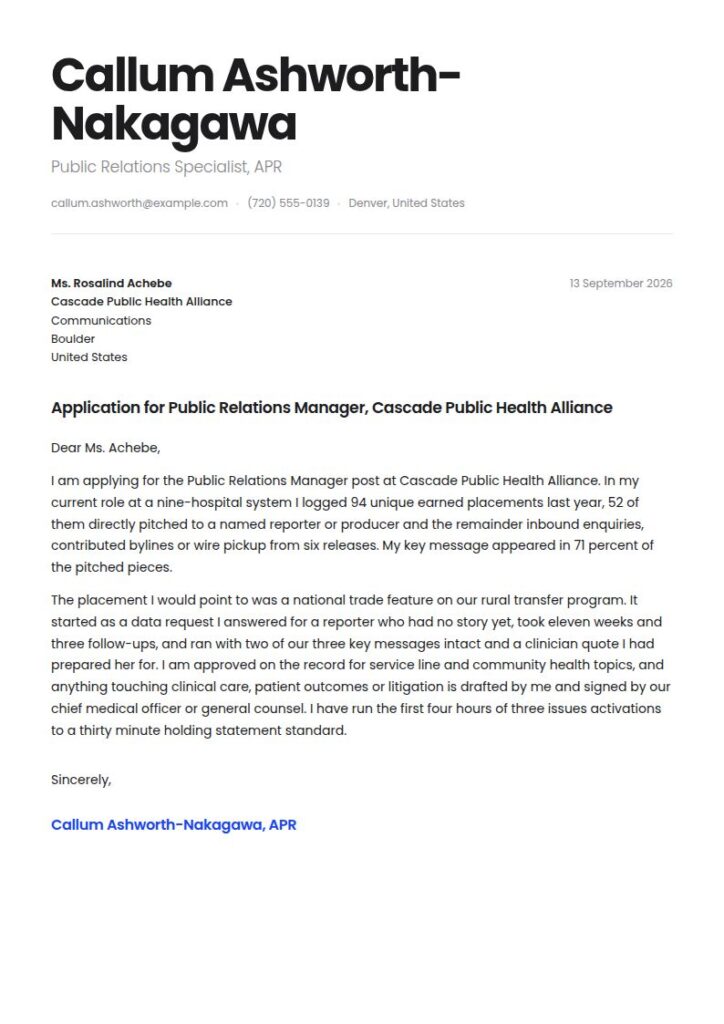
A public relations cover letter is a one-page letter making two claims a communications director can verify in a browser: what coverage you caused, and what you were allowed to say on the record.
Both claims are usually inflated in this field, which is why writing them honestly works so well. The reader has run a wire distribution and watched forty outlets republish one release. A letter that volunteers the split before anyone asks makes everything after it credible.
Guide to a public relations cover letter
This guide and the corresponding public relations cover letter example will cover:
- How to structure the letter, paragraph by paragraph
- Why the pitched and syndicated split belongs in the first paragraph
- How to state spokesperson scope without overclaiming
- What to write when your clients or matters are confidential
- The openings that survive a skeptical reader
How to write a public relations cover letter
| Paragraph | Its job | Length |
|---|---|---|
| Opening | The role, your coverage ledger in one honest sentence | 2 to 3 sentences |
| Evidence | One placement you caused, start to finish, plus your spokesperson scope | 4 to 5 sentences |
| Fit | One real observation about their coverage or their issues environment | 3 to 4 sentences |
| Close | Accreditation, rota availability, thank you | 2 sentences |
Volunteer the split before anyone asks for it
Write your headline coverage number as two figures in one sentence: what you pitched and landed, and what came from wire pickup.
"Ninety-four unique earned placements last year, fifty-two of them directly pitched to a named reporter or producer, the rest inbound or wire pickup from six releases" is a sentence almost nobody writes, and it does three things at once. It gives a real number, it proves you keep a ledger, and it signals that nothing else in the letter is padded.
Then add the quality measure: whether your key message survived into the published piece. Message pull-through is the only measure that distinguishes a placement from a mention, and offering it unprompted marks you as someone who reads their coverage rather than counting it.
A public relations cover letter example you can adapt
Dear Ms. Achebe,
I am applying for the Public Relations Manager post at Cascade Public Health Alliance. In my current role at a nine-hospital system I logged 94 unique earned placements last year, 52 of them directly pitched to a named reporter or producer and the remainder inbound enquiries, contributed bylines or wire pickup from six releases. My key message appeared in 71 percent of the pitched pieces.
The placement I would point to was a national trade feature on our rural transfer program. It started as a data request I answered for a reporter who had no story yet, took eleven weeks and three follow-ups, and ran with two of our three key messages intact and a clinician quote I had prepared her for. I am approved on the record for service line and community health topics, and anything touching clinical care, patient outcomes or litigation is drafted by me and signed by our chief medical officer or general counsel. I have run the first four hours of three issues activations to a thirty minute holding statement standard.
I have read your last two years of coverage and most of it is announcement-led, which is the pattern I recognize from before we rebuilt our ledger. The obvious opportunity is the county health data you publish quarterly: that is the kind of material a metro daily health reporter will take a call about, and it is being distributed rather than pitched. I would want to spend the first month on a beat list and a scope card for each of your clinical spokespeople.
I hold the Accredited in Public Relations credential from the Universal Accreditation Board and a crisis communication certificate from PRSA, and I am used to being on a twenty-four hour rota one week in four. Thank you for reading.
Sincerely, Callum Ashworth-Nakagawa, APR
Openings that work
| Instead of | Use |
|---|---|
| I am a strategic communicator with a proven media record | 94 unique earned placements last year, 52 of them directly pitched |
| I secured hundreds of media placements for my clients | 52 directly pitched, the rest inbound or wire pickup from six releases |
| I have served as a trusted company spokesperson | I am approved on the record for service line and community health topics |
| I am experienced in crisis communications | I ran the first four hours of three issues activations to a thirty minute holding statement standard |
Say what you were authorized to say
Spokesperson scope is granted, written down, and checkable through a reference call, so state it exactly and without decoration.
There are four honest positions, and each one is respectable. You route enquiries to someone else. You supply written statements that another person signs. You speak on the record within named topics. You are the designated spokesperson for incidents and hold an after-hours rota. Say which one you held, and name the person or office that signed above you.
Give the pitched and the syndicated figure in the same sentence. Name the outlet tier rather than writing "top tier". Describe one placement from first contact to publication, including how long it took. State your spokesperson position in one line and who countersigned. Say what your first hour in an issues activation looked like.
Do not report wire pickup as placements you secured. Do not claim a crisis you watched from the next desk. Do not name a confidential client, a patient, a complainant or a source. Do not describe yourself as a spokesperson if enquiries went past you. Do not quote an advertising equivalency figure; professional bodies have advised against it for years and it reads as a warning sign.
What counts as proof of coverage
| Kind of evidence | What it looks like in a sentence |
|---|---|
| Origin | Directly pitched to a named health reporter after an unrelated data request |
| Persistence | Eleven weeks and three follow-ups before it ran |
| Tier | A national trade feature, two top 50 metro dailies, nineteen local broadcast segments |
| Quality | Two of three key messages intact, with a prepared clinician quote |
| Authority | Approved on the record for service line topics, clinical statements countersigned |
| Discipline | Thirty minute holding statement standard, written post-incident review each time |
The persistence line is underrated. The hardest placements take months of unglamorous contact, and a candidate who reports the eleven weeks is describing a job the reader has done.
The pay jump is the authority jump
Public relations specialists had a median annual wage of $74,750 in May 2025, while public relations managers had a median of $146,910 in the same cycle (BLS Occupational Outlook Handbook, May 2025).
Specialist employment stood at 314,500 in 2025 and is projected to grow just 2 percent by 2035, with about 23,000 openings a year, while the manager tier is projected to grow 6 percent over the same period (BLS Occupational Outlook Handbook, 2025 to 2035 projections).
What is actually granted at that step is authority: the spokesperson roster, the approval chain, the after-hours rota. A letter that documents those is written for the growing, better-paid half of the occupation, which is why the second paragraph of the example above spends its space there rather than on campaign description.
Length, format and sending it
One page, four paragraphs, 300 to 400 words. PDF unless the portal says otherwise. Address a named person: communications leadership is public.
Read the employer's recent coverage first. One accurate observation about what is and is not being pitched beats a paragraph of admiration, and it cannot be reused in the next letter.
Keep every figure identical to your resume. Our public relations resume example uses the same ledger as the letter above.
Key takeaways
- Give the pitched figure and the wire pickup figure in one sentence.
- Count unique outlets, never syndicated duplicates.
- Name outlet tiers instead of writing "top tier".
- State your spokesperson position and who signed above you.
- Describe one placement from first contact to publication, with the time it took.
- Add message pull-through, the only quality measure in the ledger.
- Never use an advertising equivalency figure.
Write your public relations cover letter in 10 minutes.
Public relations cover letter questions, answered
How long should a public relations cover letter be?
One page, four paragraphs, 300 to 400 words. In a field judged on written economy, a long letter is itself evidence against you.
What do I write if my client work is confidential?
Describe the sector, the tier and the origin without naming anyone: "a national trade feature and two top 50 metro daily pieces for a private healthcare client, both directly pitched". Check your agency's policy first, because naming a confidential client is a reason not to hire you regardless of the coverage.
Should I attach coverage clippings?
Send two or three links inside the letter or the application, not a folder of PDFs. Choose placements you caused rather than the biggest logos, and say in half a sentence how each came about. A modest outlet you pitched cold is better evidence than a national name that ran your wire copy.
How do I write this letter moving from journalism into public relations?
Lead with the newsroom knowledge, because it is the transferable part: you know how an assignment editor decides what runs, what a reporter needs by when, and which pitches waste their time. Then be honest that you have not yet held spokesperson authority, and say what you have done adjacent to it.
Does mentioning the APR accreditation help?
It helps most in government, healthcare and nonprofit hiring, where formal accreditation is read as evidence of ethics and process training. Name the Universal Accreditation Board and the year. It is not a license and it will never substitute for a coverage ledger, so give it one line in the closing rather than the opening.