Local Name on Job Application: Local Given and Family Name
Local name on job application forms means your name in a local script, like Japanese or Chinese. See what to enter, what to do without one, and field order.

On this pageWhat is a local name on a job application?
- What is a local name on a job application?
- Why does a local name on job application forms appear?
- What should you enter for a local name on a job application?
- What is the difference between local given name and local family name?
- Is a local name the same as a preferred or known-as name?
- How do you fill in the name section without mistakes?
- FAQ
- Sources
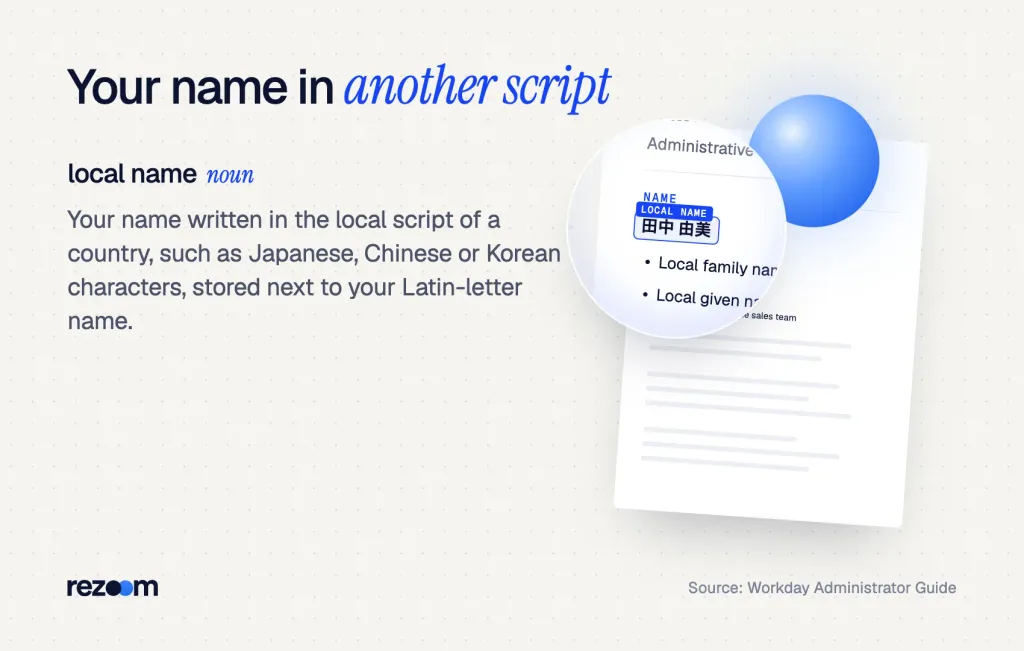
A local name on a job application is your name written in the local script of a country, such as Japanese, Chinese, Korean or Cyrillic characters. Systems like Workday show these boxes, often labeled Local Given Name and Local Family Name, for countries that use a non-Western script. If you have no name in that script, leave the boxes blank or ask the recruiter what to enter.
A local name on job application forms is your name in the local script of a country, such as Japanese kanji or Chinese characters. Fill it in only if you have a name in that script. If you don't, leave it blank or ask the recruiter.
These boxes confuse a lot of people, because they show up next to the normal name fields with almost the same labels. This guide explains what each one wants and what to type in common cases.
Our examples follow two applicants for an administrative assistant job at a global company: Yumi Tanaka, who has a Japanese name, and Dana Price, who has only an English name.
Quick answers by situation
| Your situation | What to do | Example line |
|---|---|---|
| You have a name in the local script | Type it exactly as on your national ID | Local family name: 田中 |
| You have only a Latin-letter name | Leave the local boxes blank if optional | Local given name: [blank] |
| The local boxes are required and you have no local name | Ask the recruiter, or follow the help text | "What should I enter for local name?" |
| The form says "local given name" | Enter your first or personal name in local script | Local given name: 由美 |
| The form says "local family name" | Enter your surname in local script | Local family name: 田中 |
| You go by a nickname | That goes in preferred or known-as name, not here | Preferred name: Yumi |
What is a local name on a job application?
A local name on a job application is your name written in the script or language of a country that does not use the Latin alphabet. Global HR systems store it next to your Western-script name, so a Japanese applicant might enter 田中 由美 as the local name and Yumi Tanaka as the main name.
Big HR systems store two versions of a name. Workday says "local script name components are available for countries that use a non-Western script1." So when a company hires in Japan, China, Korea or similar countries, those extra boxes can appear on the form.
Oracle's HR system works the same way. Its guide says you can define what language to use for the local name4 on a person record. Users in that country then see the local version, while everyone else sees the global one.
The labels you may see
The label changes from one employer to the next. But the meaning stays the same.
- Local name or Name (local): Your full name in the local script.
- Local given name or Local first name: Your personal name in the local script.
- Local family name or Local last name: Your surname in the local script.
- Local middle name: Rare. Leave it blank unless your ID shows one.
Workday's own data fields use the plain labels, such as Local First Name and Local Last Name3. On candidate forms, the same boxes often read "given" and "family" instead.
Known as name on job application forms means the name you go by. See what known as first name means, what to write, examples, and when to leave it blank.
Why does a local name on job application forms appear?
It appears because the employer set up its HR system for a country that writes names in a non-Western script. The country tied to the job or your profile decides which name boxes show. So a US company with an office in Tokyo may show local name boxes on a Tokyo posting, but not on a Dallas one.
You did nothing wrong if these boxes show up. They come from the employer's setup, not from your answers.
Workday says the country associated with a person's name determines which components display1. Employers can also make the local script required, so some forms won't let you skip it.
Required or optional
Look for a red asterisk next to the box. If there isn't one, the field is optional.
Workday recommends the "Local Script required2" option for countries with local script. But the same page says admins can switch to a Western script option instead. That's why the same field is required at one company and optional at another.
Why the employer wants it
In countries that write in their own script, payroll, tax and ID records use that script. So HR needs your name the way it appears on your national ID.
The W3C, which writes web standards, gives the same advice to form designers. It says forms may need to ask for a name in both scripts, using separate fields.
You probably need to ask the user to submit their name in both native script and Latin-only form, using separate fields.
W3C Internationalization, Personal names around the world
What should you enter for a local name on a job application?
If you have a name in that country's script, type it exactly as your national ID or passport shows it, with each part in its own box. If you have only a Latin-letter name, leave the local boxes blank when they're optional. If they're required, follow the help text or ask the recruiter, and never invent a translation.
There are two simple cases. Most applicants fall into one of them.
Case 1: you have a name in the local script
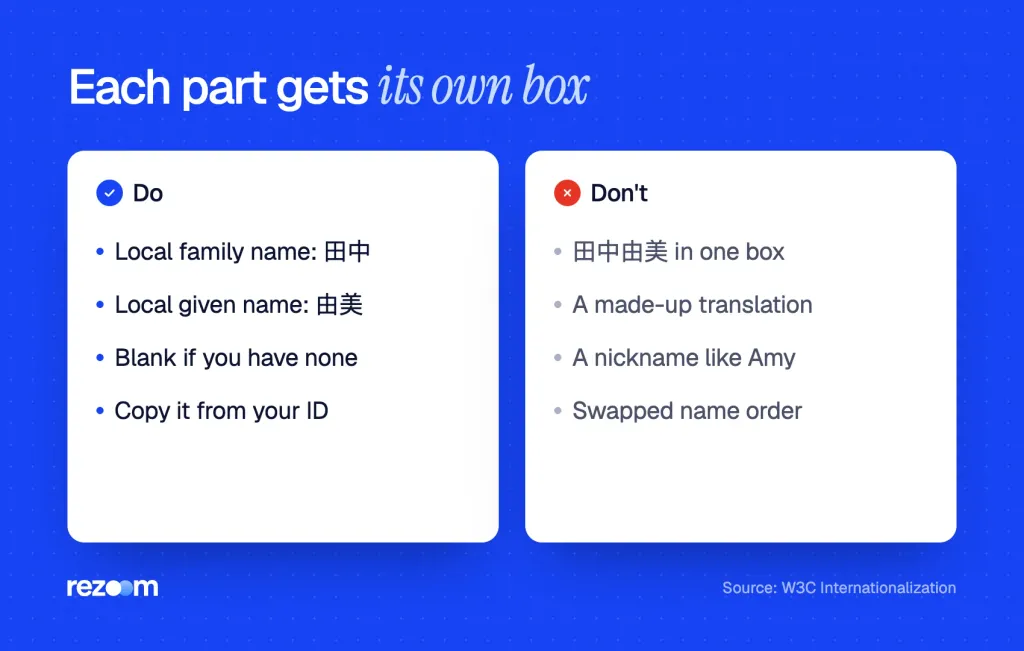
Type it the way your national ID shows it. Put your surname in the local family name box and your personal name in the local given name box.
Given name: Yumi Family name: Tanaka Local given name: 由美 Local family name: 田中 Preferred name: Yumi
Then make sure your Latin-letter name matches your passport. That version feeds background checks and visa paperwork, so spelling matters.
Case 2: you have only a Latin-letter name
Many US applicants have no name in another script. If that's you, the local name on job application forms isn't meant for you, so leave it blank when you can.
Given name: Dana
Family name: Price
Local given name: [blank]
Local family name: [blank]
Case 3: the boxes are required and you have no local name
Don't make up a translation of your name in Japanese or Chinese. A guessed spelling can end up on payroll records.
- Read the help text first: Some forms say to repeat your name in Latin letters.
- Check the job's country: If you applied to the wrong location, the boxes may vanish when you pick the right one.
- Ask the recruiter: One short email solves it.
- Note it if you have to guess: If the form forces an entry and nobody replies, repeat your Latin-letter name and mention it in the comments box.
Workday says that if you enter any name part in local or Western script, you must complete all required fields in that script. So if you type a local family name, also fill the local given name. A half-filled set often blocks the submit button.
What is the difference between local given name and local family name?
The local given name is your personal name, such as 由美 for Yumi. The local family name is your surname, such as 田中 for Tanaka. Enter each part in its own box, even if your culture writes the family name first. The form handles the display order, so don't swap or combine the parts.
Given name means first name, and family name means last name. Forms use the terms "given" and "family" because "first" and "last" don't fit every culture.
The W3C explains why. In Japan, Korea and Hungary, people order names as family name followed by given name5, and the same goes for China. So in "Mao Ze Dong," Mao is the family name, even though it comes first.
| Country or language | Usual order | Local family name | Local given name |
|---|---|---|---|
| Japan | Family, then given | 田中 (Tanaka) | 由美 (Yumi) |
| China | Family, then given | 王 (Wang) | 伟 (Wei) |
| Korea | Family, then given | 김 (Kim) | 민준 (Minjun) |
| United States | Given, then family | [blank] | [blank] |
Don't type the whole name in one box
Put only one part in each box. If you type 田中由美 in the given name box, the system thinks your personal name is four characters long, and your surname is empty.
The same rule applies to the Latin-letter fields. If you also have a middle name, it goes in its own box; our guide to the middle name on a job application covers that field.
Given name: [personal name in Latin letters, as on your passport]
Family name: [surname in Latin letters, as on your passport]
Local given name: [personal name in local script, or blank]
Local family name: [surname in local script, or blank]
Preferred name: [the name you go by, or blank]
Free ATS score, the text the software extracts and your missing keywords. No sign-up.
Is a local name the same as a preferred or known-as name?
No. A local name is your name in another script, while a preferred or known-as name is the name you go by, like Kate for Katherine or an English name you use at work. A few employers use "local name" loosely for the name you go by where you live, so read the help text if you're unsure.
People often confuse these fields because they sit side by side. This table sorts them out.
| Field | What it asks | Example |
|---|---|---|
| Legal given and family name | Your name in Latin letters, as on your ID | Yumi Tanaka |
| Local given and family name | Your name in the local script | 田中 由美 |
| Preferred name | The name you want recruiters to use | Yumi |
| Known as name | A nickname or everyday name | Amy |
| Previous name | A name you used before | Yumi Sato |
The main name fields should be your legal name on a job application, because background checks use it. A nickname belongs in the known as name on a job application field.
When "local name" means the name you use
Some forms use "local name" in a looser sense: the name you use in the country where you live. For example, a person with a Chinese name might use "Jenny" at work. If the help text points that way, enter your everyday name there and keep your legal name in the main boxes.
Legal name on a job application: which fields need it, what "do you have previously used legal names" means, and how to answer the former legal name question.
How do you fill in the name section without mistakes?
Fill in your legal name in Latin letters first, exactly as your passport or ID shows it. Then add your local-script name only if you have one, part by part. Add a preferred name if you use one, check that autofill didn't scramble the boxes, and keep the same name on your resume.
Resume autofill often drops names into the wrong boxes. So review every name field before you click Next.
- Enter your legal nameType your given and family name in Latin letters as your passport or ID shows them.
- Decide on the local nameFill the local boxes only if you have a name in that script; otherwise leave them blank or ask.
- Fill each part separatelyPut the surname in the family name box and the personal name in the given name box.
- Add a preferred nameUse the preferred or known-as box for the name you go by at work.
What to say if they push back
Sometimes a recruiter asks about a blank or unusual entry. Keep each reply to one line.
- "Your local name is blank." Say: "I don't have a name in that script, so I left it empty."
- "Can you add your name in Japanese?" Say: "My passport is in English only, so Dana Price is my full legal name."
- "The local name doesn't match your passport." Say: "My passport shows the Latin version. My national ID shows the local one."
- "Which name should we use on emails?" Say: "Please use my preferred name, Yumi."
Recruiter: "Your application is missing a local name. It's required for this office."
"I don't have a name in Japanese script. My legal name is Dana Price."
Recruiter: "Got it. Can you enter your name in English letters there?"
"Sure, I'll update it now and send you a quick note when it's done."
Do
- Type your local name exactly as your national ID shows it.
- Put each part in its own box.
- Leave optional local boxes blank if you have no local name.
- Ask the recruiter when a required box doesn't fit you.
Don’t
- Invent a translation of your name in another script.
- Type your whole name into the given name box.
- Put a nickname in the local name field.
- Swap your family and given names to match the display order.
If you see local name boxes on a US job, check the location on your profile and the posting. A wrong country can pull in another country's name format. Fix the location first, then the extra boxes often disappear.
Check before you submit
Before you submit the name section
Make your admin application stand out
Global office jobs often use these long Workday forms. Browse our administrative resume examples to see how strong applicants show scheduling, records and office tools.
Yumi used this administrative assistant resume example to list her bilingual support and travel planning as clear wins.
Administrative assistant resume example
See how to show calendar work, office software and language skills on one clean page.
If the posting asks for a letter, our administrative cover letter examples show how to sign off with the same name as your resume. Then run your file through the ATS resume checker to confirm your name and contact details parse cleanly.
Free ATS score and your missing keywords. No sign-up.
Frequently asked questions
What does local name mean on a job application?
It means your name written in the local script of a country, such as Japanese, Chinese, Korean or Cyrillic characters. It sits next to your name in Latin letters.
What is a local given name?
It's your personal name, or first name, in the local script. For Yumi Tanaka, the local given name is 由美.
What is a local family name?
It's your surname, or last name, in the local script. For Yumi Tanaka, the local family name is 田中.
What if I don't have a local name?
Leave the local boxes blank if they're optional. If they're required, follow the help text or ask the recruiter, and don't invent a translation.
Is a local name the same as a nickname?
No. A nickname belongs in the preferred or known-as name field. The local name field asks for your name in another script.
Should my local name match my ID?
Yes. Type it the way your national ID or passport shows it, so payroll and tax records match.
Sources
We opened and read each page below. The small numbers in the text point here. Pages that carry no publication date show n.d.
- Workdayn.d.
Workday offers local script name components for countries with a non-Western script, the name's country decides which components display, and starting a name in one script means completing all required fields in that script.
- Workdayn.d.
Workday recommends the Local Script required option for countries with local script, and admins can enable Western script instead.
- ServiceNow (Workday HR spoke documentation)n.d.
Workday name data includes Local First Name and Local Last Name fields.
- Oraclen.d.
Oracle HR lets each person record set a local-name language, shown to users in that country.
- W3C Internationalizationn.d.
Japan, Korea, Hungary and China put the family name first, and forms may need separate native-script and Latin fields.
Mohammad has spent more than ten years designing consumer products and leads product at Rezoom, deciding what gets built and what gets left out. His guides cover the whole job search, from resume sections and cover letters to interview answers and career moves.
Goodi, M. (2026, November 23). Local Name on Job Application: Local Given and Family Name. Rezoom. https://rezoom.io/local-name-on-job-application/