Wellness Coordinator Hadassah Greenfield CHES
Wellness Coordinator
[email protected] | (614) 555-2144 | Columbus, United States
Profile
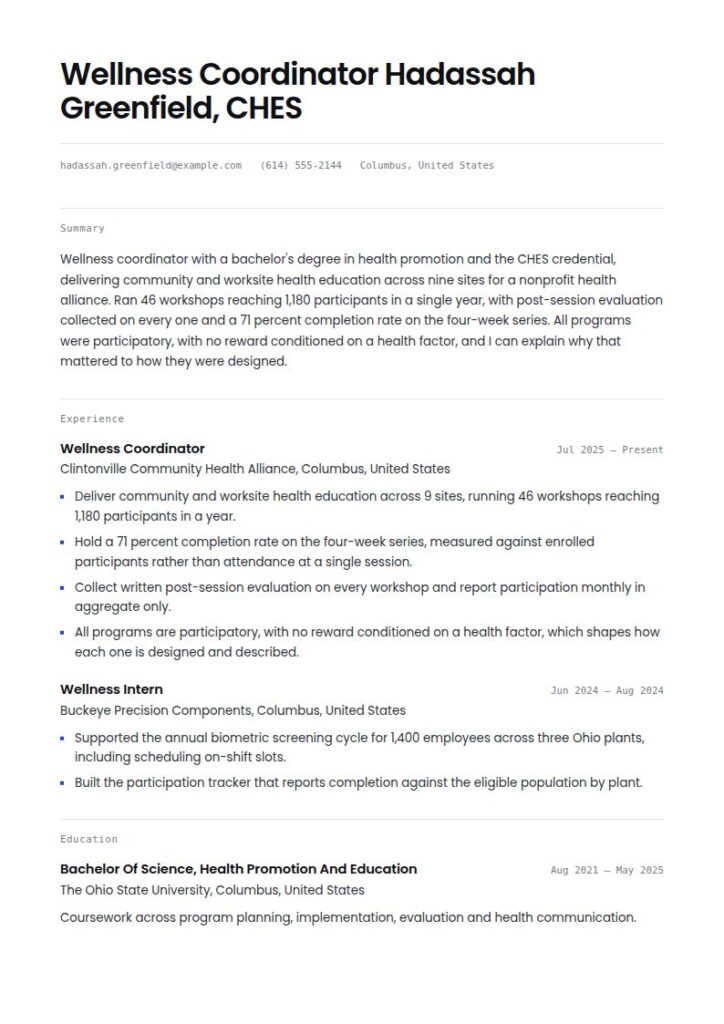
Wellness coordinator with a bachelor's degree in health promotion and the CHES credential, delivering community and worksite health education across nine sites for a nonprofit health alliance. Ran 46 workshops reaching 1,180 participants in a single year, with post-session evaluation collected on every one and a 71 percent completion rate on the four-week series. All programs were participatory, with no reward conditioned on a health factor, and I can explain why that mattered to how they were designed.
Work Experience
07/2025 - Present, Wellness Coordinator, Clintonville Community Health Alliance, Columbus, United States
- Deliver community and worksite health education across 9 sites, running 46 workshops reaching 1,180 participants in a year.
- Hold a 71 percent completion rate on the four-week series, measured against enrolled participants rather than attendance at a single session.
- Collect written post-session evaluation on every workshop and report participation monthly in aggregate only.
- All programs are participatory, with no reward conditioned on a health factor, which shapes how each one is designed and described.
06/2024 - 08/2024, Wellness Intern, Buckeye Precision Components, Columbus, United States
- Supported the annual biometric screening cycle for 1,400 employees across three Ohio plants, including scheduling on-shift slots.
- Built the participation tracker that reports completion against the eligible population by plant.
Education
08/2021 - 05/2025, Bachelor of Science, Health Promotion and Education, The Ohio State University, Columbus, United States
Coursework across program planning, implementation, evaluation and health communication.
Skills
Workshop design and delivery, 75
Participation reporting against eligible population, 70
Pre and post evaluation design, 65
Participatory program design, 70
Multi-site scheduling, 70
Aggregate reporting and data handling, 75
Languages
English, native
Hebrew, intermediate
Certificates
10/2025, Certified Health Education Specialist (CHES), National Commission for Health Education Credentialing, CHES-30418
Examination of 165 multiple-choice questions taken in 3 hours, covering the Eight Areas of Responsibility for Health Education Specialists (NCHEC).
04/2025, Adult CPR, AED and First Aid, American Red Cross
Summary
A wellness manager resume names the programs you ran, the population each one covered, and which of them were participatory and which were health-contingent under federal rules. This guide gives you three adaptable versions, the compliance vocabulary that separates a manager from a coordinator, and current Bureau of Labor Statistics pay for the closest published occupation.
Wellness Manager resume examples by experience level
In short, a wellness manager resume is a one to two page document naming the programs you ran, the population each covered, the budget behind them, and the legal shape each program took.
That last item is what most applicants leave out, and it is the fastest way to tell a manager from an activities coordinator. For example, a program that ties a reward to a health factor is a regulated object with five federal requirements attached. By contrast, a program that does not is a different object with almost none. Somebody who has managed a portfolio knows which of theirs was which, and says so.
Resume guide for a wellness manager resume
For this reason, this guide and the corresponding wellness manager resume example will cover:
- First, how to write a wellness manager resume, section by section
- Then, why the participatory and health-contingent split belongs on the page
- Also, three adaptable summaries: coordinator, program manager and department lead
- In addition, what the reward caps and the reasonable alternative standard are, and how to evidence them
- Finally, what the job market looks like and what you can expect to earn
How to write a wellness manager resume
Overall, six sections: contact header, summary, program portfolio, work experience, education and credentials, and skills. In general, one page for the first five years, two once you own a budget and a team.
The program portfolio goes above the experience, because it is what a reader is assembling in their head anyway: the population you have served, the number of programs you have run at once, and whether any of them carried a reward.
| Section | What it is answering | Where it goes |
|---|---|---|
| Program portfolio | How many programs, what population, what budget, what legal shape? | Directly under the summary |
| Work experience | What changed for the population, and how do you know? | Reverse chronological, with numbers |
| Credentials | Is there a named certification behind the health content? | Its own block, after experience |
| Skills | Which vendors, platforms and data sources have they actually worked in? | Last, grouped |
Write the population and the participation rate in the same line
A wellness program is judged on reach first, and reach is a fraction. The numerator is participants. The denominator is the eligible population, and it is the number applicants forget.
"Ran biometric screening for 1,400 employees across three plants; completion moved from 38 percent to 61 percent over three annual cycles" is a sentence a benefits director can use. "Coordinated annual biometric screening events" is not.
Put the denominator in every reach claim you make. If you do not know it, the program was not yours to manage.
Run the finished file through the ATS resume checker first. Wellness roles sit inside human resources and benefits teams, and those teams parse applications into a system before anyone opens them.
Choosing the best resume format for a wellness manager resume
As for format, use reverse chronological, with a program portfolio block above the experience. Move to two pages once you have a budget, a team and more than one employer's worth of programs.
Functional formats fail here. After all, the reader is checking continuity: which employer, which population size, which years, and what you were allowed to decide. As a result, a format that hides the sequence reads as a sequence worth hiding.
Watch the job title. In practice, employers advertise the same work as wellness manager, wellbeing manager, health promotion manager and population health program manager. That is why you should mirror the posting's title in your header and keep your actual one in the experience entry.
Include your contact information
| ✅ Right | ❌ Wrong |
|---|---|
| Hadassah Greenfield, MPH, CHES | Hadassah Greenfield |
| Wellness Program Manager, 1,400-employee manufacturer | Wellness and Health Promotion Professional |
| Certified Health Education Specialist, NCHEC #CHES-30418 | Certified health educator |
| (614) 555-2144, [email protected], Columbus, OH | (614) 555-2144, [email protected] |
The second line does what a job title alone cannot: it gives the population size, which is the number a hiring manager uses to decide whether your experience scales to their headcount. The Bureau of Labor Statistics notes that employers may require or prefer certification for health education specialists, the closest published occupation to this one (BLS Occupational Outlook Handbook, published 27 August 2026), so a credential belongs in the header with its number rather than on page two.
Make use of a summary
For the summary, use four lines: the population you serve, the number and type of programs, one measured outcome, and the credential.
Wellness coordinator with a bachelor's degree in health promotion and the CHES credential, delivering community and worksite health education across nine sites for a nonprofit health alliance. Ran 46 workshops reaching 1,180 participants in a single year, with post-session evaluation collected on every one and a 71 percent completion rate on the four-week series. All programs were participatory, with no reward conditioned on a health factor, and I can explain why that mattered to how they were designed.
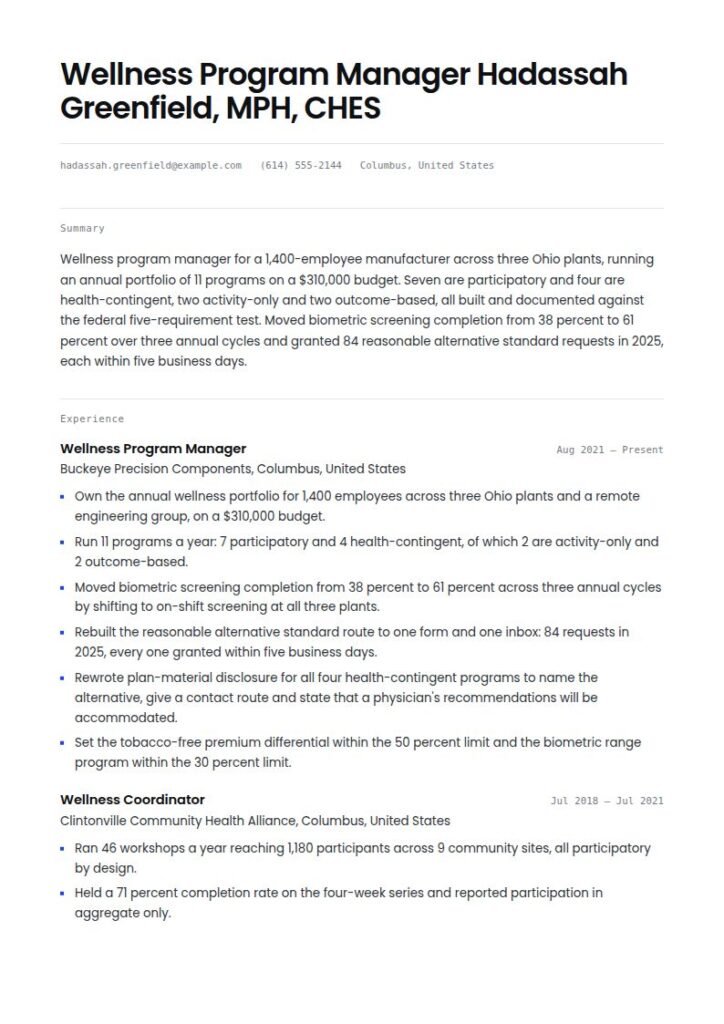
Wellness program manager for a 1,400-employee manufacturer across three Ohio plants, running an annual portfolio of 11 programs on a $310,000 budget. Seven are participatory and four are health-contingent, two activity-only and two outcome-based, all built and documented against the federal five-requirement test. Moved biometric screening completion from 38 percent to 61 percent over three annual cycles and granted 84 reasonable alternative standard requests in 2025, each within five business days.
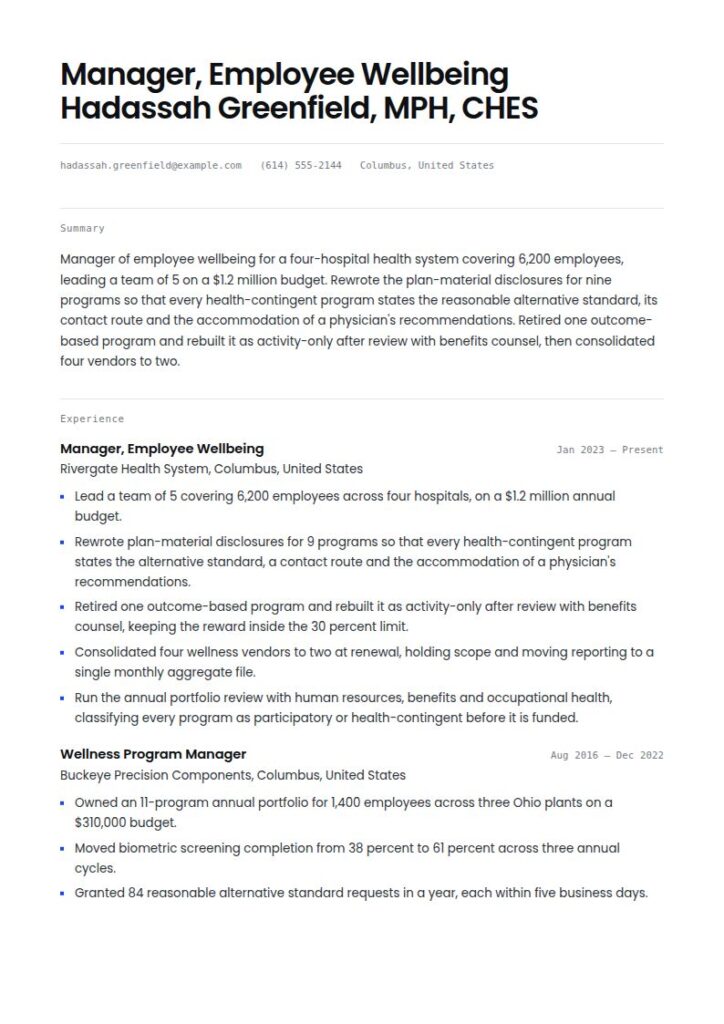
Manager of employee wellbeing for a four-hospital health system covering 6,200 employees, leading a team of 5 on a $1.2 million budget. Rewrote the plan-material disclosures for nine programs so that every health-contingent program states the reasonable alternative standard, its contact route and the accommodation of a physician's recommendations. Retired one outcome-based program and rebuilt it as activity-only after review with benefits counsel, then consolidated four vendors to two.
Right vs wrong: the same wellness manager summary, twice
| ✅ Right | ❌ Wrong |
|---|---|
| Wellness program manager for a 1,400-employee manufacturer across three Ohio plants. | Wellness professional with experience in corporate wellbeing. |
| Eleven programs a year on a $310,000 budget: seven participatory, four health-contingent. | Manage a variety of wellness initiatives and employee engagement activities. |
| Biometric screening completion moved from 38 percent to 61 percent over three cycles. | Proven success in driving employee participation and engagement. |
The right column can be checked. Then a benefits director reads it and knows your headcount, your budget, the legal shape of your portfolio and the direction of your numbers. The left column, on the other hand, could describe a vendor's sales associate.
Outline your wellness program experience
Employer, population size, scope and dates. Then three to five bullets, each naming a program, a population and a number.
| Instead of | Use |
|---|---|
| Coordinated wellness initiatives for employees | Ran an 11-program annual portfolio for 1,400 employees across three plants on a $310,000 budget |
| Increased participation in wellness programs | Moved biometric screening completion from 38 percent to 61 percent across three annual cycles |
| Ensured programs met compliance requirements | Documented all four health-contingent programs against the five federal requirements, including the annual qualification opportunity |
| Managed relationships with wellness vendors | Consolidated four vendors to two at renewal, holding scope and moving reporting to a single monthly file |
| Supported employees with health concerns | Processed 84 reasonable alternative standard requests in 2025, all granted within five business days |
Wellness Program Manager, Buckeye Precision Components, Columbus, OH, August 2021 to Present
Own the annual wellness portfolio for 1,400 employees across three Ohio plants and a remote engineering group, on a $310,000 budget.
Run 11 programs a year: 7 participatory, including on-site classes, a walking challenge with no reward and free flu vaccination, and 4 health-contingent, of which 2 are activity-only and 2 outcome-based.
Moved biometric screening completion from 38 percent to 61 percent over three annual cycles by shifting to on-shift screening at all three plants rather than a single day at headquarters.
Rebuilt the reasonable alternative standard route so requests arrive through one form and one inbox; 84 requests in 2025, every one granted within five business days.
Rewrote the plan-material disclosure for all four health-contingent programs so it names the alternative, gives a contact route and states that a physician's recommendations will be accommodated.
Say which programs were participatory and which were health-contingent
In fact, this is the section that turns a list of activities into a managed program, and almost nobody writes it.
Federal rules divide workplace wellness programs in two. A participatory program conditions no reward on a health factor, or offers no reward at all. A health-contingent program does, and splits again into activity-only programs, which require doing something, and outcome-based programs, which require achieving or maintaining a result. The Departments of Labor, Health and Human Services and the Treasury set out that structure in their FAQs about Affordable Care Act and HIPAA Implementation Part 74, dated 26 August 2026, with the regulations at 26 CFR 54.9802-1(f), 29 CFR 2590.702(f) and 45 CFR 146.121(f).
Why the wellness program split matters
It matters on a resume because the second category carries five requirements and the first does not.
| Requirement for a health-contingent program | What it means in practice |
|---|---|
| At least one chance a year to qualify | The program cannot be a single locked window with no re-entry |
| Reward capped at 30 percent of the cost of employee-only coverage | Rising to 50 percent for programs designed to prevent or reduce tobacco use |
| Reasonable design | The program must reasonably promote health or prevent disease |
| Reasonable alternative standard | The full reward has to stay available to all similarly situated individuals by another route |
| Disclosure in plan materials | The availability of the alternative, a contact route, and a statement that a physician's recommendations will be accommodated |
Source: Departments of Labor, Health and Human Services and the Treasury, FAQs about Affordable Care Act and HIPAA Implementation Part 74, 26 August 2026, and 26 CFR 54.9802-1(f), 29 CFR 2590.702(f) and 45 CFR 146.121(f).
Therefore, write the portfolio the way the rules divide it.
Annual portfolio, 1,400 employees across three plants, $310,000 budget, 11 programs
Participatory, 7 programs: on-site classes and seminars, a no-reward walking challenge, free on-site flu vaccination, an employee assistance program awareness series, reimbursement for a gym membership regardless of use, a diabetes prevention referral pathway, and a mental health first aid course.
Health-contingent, activity-only, 2 programs: a walking program rewarding a step target and a completed coaching series, each with a written alternative for participants for whom the activity is medically inadvisable.
Health-contingent, outcome-based, 2 programs: a tobacco-free premium differential set at the 50 percent limit, and a biometric range program set within the 30 percent limit, both with an alternative standard reachable through one form.
Compliance: all four health-contingent programs documented against the five federal requirements; disclosure language reviewed annually with benefits counsel.
Three things follow from writing it this way, and each, in turn, is a hiring signal.
Hiring signals in a wellness portfolio
You are stating the cap you worked inside. A reward capped at 30 percent of the cost of employee-only coverage, or 50 percent for a tobacco program, is a number you had to calculate from a real premium rather than inherit.
You are showing that the alternative existed and worked. The reasonable alternative standard is where programs most often fail in practice, because the route to it is buried or unassigned. A count of requests and a turnaround is the cleanest evidence that the route was real.
You are showing you know what the disclosure has to say. It has to state that the alternative is available, give contact information, and say that a physician's recommendations will be accommodated. Naming those three elements shows you have read the rule.
Name the credential and describe the exam, not the acronym
If your health content sits behind a certification, describe what it covers rather than leaving the acronym to do the work. The Certified Health Education Specialist examination administered by the National Commission for Health Education Credentialing is 165 multiple-choice questions, 150 of them scored and 15 pilot items, taken in 3 hours, and it covers the Eight Areas of Responsibility for Health Education Specialists (NCHEC, retrieved 17 September 2026).
One line does it: "Certified Health Education Specialist, NCHEC, #CHES-30418, examination covering the Eight Areas of Responsibility." A benefits director who has never met the credential now knows it is an examined one. Do not write a certification as "in progress" without saying when you sit the exam.
Build a snapshot of your key skills
For skills, list ten to fourteen entries in groups: program design, compliance, data, and the systems your employer runs.
Program design and delivery: Annual program planning against a budget, Health-contingent program design, Incentive design within federal reward limits, Health coaching program oversight, Multi-site delivery across shifts
Compliance and governance: Participatory and health-contingent classification, Reasonable alternative standard administration, Plan-material disclosure drafting, Vendor contracting and renewal, Working with benefits counsel and plan documents
Data and evaluation: Aggregate participation reporting, Eligible-population denominators, Pre and post evaluation design, Claims-adjacent reporting from the plan administrator, Survey design and reporting
Systems: Benefits administration platform reporting, Wellness vendor portals, Human resources information system extracts, Spreadsheet modeling of reward values
However, keep individual health information out of all of those lines. A wellness manager writes in aggregates.
List your education and certifications
Degree first, then the certification with its number and date, then short courses that are genuinely relevant.
Master of Public Health, Health Behavior and Health Promotion, The Ohio State University, Columbus, OH, 2021
Bachelor of Science, Health Promotion and Education, The Ohio State University, Columbus, OH, 2018
Certified Health Education Specialist, National Commission for Health Education Credentialing, #CHES-30418, 2018. Examination of 165 multiple-choice questions covering the Eight Areas of Responsibility for Health Education Specialists.
Mental Health First Aid, instructor certification, 2023. Adult CPR, AED and first aid, American Red Cross, 2026.
For education, BLS lists a bachelor's degree as the typical entry-level education for health education specialists, the closest published occupation to wellness management (BLS Occupational Outlook Handbook, published 27 August 2026). Similarly, a master's is common at the manager level and worth putting first if you hold one.
Choose the right layout and design
Single column, 11 or 12 point, no photograph, no graphics. Send a PDF named for yourself and the role: hadassah-greenfield-wellness-manager-resume.pdf.
The program portfolio is the block most likely to break in an applicant system if you build it as a multi-column table. Either way, keep it as labeled lines under a heading.
Put the eligible population next to every participation number. Split the portfolio into participatory and health-contingent, and the second into activity-only and outcome-based. Name which reward cap applied to which program. Give a count and a turnaround for reasonable alternative standard requests. Say what the disclosure language contains. Name your budget and the number of programs you owned at once.
Do not describe programs as initiatives, offerings or touchpoints; those words hide whether a reward was attached. Do not quote a participation percentage without its denominator. Do not describe any individual employee's health or outcome, even anonymously. Do not claim ownership of a program you scheduled but did not design or budget. Do not list a vendor's product name as a skill.
Wellness manager job market and outlook
The Bureau of Labor Statistics publishes no Occupational Outlook Handbook profile for wellness managers, so the closest published occupation is health education specialists, and that is the one to cite.
| Measure | Value |
|---|---|
| Health education specialist jobs, 2025 | 70,400 |
| Projected change, 2025-35 | 6 percent, 3,900 new jobs |
| Projected average annual openings | About 6,900 |
| Typical entry-level education | Bachelor's degree |
| Median annual wage, May 2025 | $64,070 |
Source: BLS Occupational Outlook Handbook, health education specialists, May 2025 wage data with 2025 to 2035 projections, published 27 August 2026.
Specifically, here is where those jobs sit, by share of employment: government excluding education and hospitals 24 percent, ambulatory healthcare services 18 percent, hospitals 16 percent, educational services 14 percent, social assistance 7 percent (BLS Occupational Outlook Handbook, published 27 August 2026).
Even so, none of those lines counts a corporate wellness manager inside a manufacturer or an insurer, which is the argument for putting population size and budget on the page: those two numbers travel across settings in a way a job title does not.
The industry line is worth $32,810 a year
Inside one occupation, the setting decides most of the pay. Health education specialists had a median annual wage of $83,040 in hospitals, $69,740 in government excluding education and hospitals, $62,370 in educational services, $60,500 in ambulatory healthcare services, and $50,230 in social assistance, against an occupation median of $64,070 (BLS Occupational Outlook Handbook, May 2025 wage data, published 27 August 2026).
That is a spread of $32,810 a year between the top and bottom industry lines, inside a single occupation with 70,400 jobs and about 6,900 openings a year (same source and cycle).
For a resume, this has one consequence. The setting you are aiming at should be legible from your first three lines, because a hospital wellbeing team and a community health nonprofit read the same page differently and pay it differently. If you are moving up that range, the page has to carry the scale: population covered, budget owned, programs run at once, and the compliance work you already do.
What salary you can expect as a wellness manager
For pay, the median annual wage for health education specialists, the closest published occupation, was $64,070 as of May 2025, against 70,400 jobs and about 6,900 openings a year through 2035 (BLS Occupational Outlook Handbook, published 27 August 2026).
Still, most of the movement inside that number is the setting, not the negotiation. For instance, hospitals paid a median of $83,040 and social assistance $50,230 in the same cycle, a gap of $32,810, with government at $69,740, educational services at $62,370 and ambulatory healthcare services at $60,500 (same source and cycle).
What a resume can move is which band a reader places you in before the salary conversation opens. Three things do that work: the population size, because a manager of a 6,200-employee program is not competing with a coordinator of 300; the budget, because owning spend is the difference between recommending a vendor and choosing one; and the compliance scope, because an employer whose health-contingent programs are already documented against the five federal requirements is buying a lower-risk hire.
If a benefits team rather than a health organization is hiring you, the benefits function rather than the health education occupation usually sets the band. Consequently, naming the plan work you have done is what puts you in that conversation.
Key takeaways for a wellness manager resume
- To start, put the eligible population beside every participation number.
- Next, split the portfolio: participatory, health-contingent activity-only, health-contingent outcome-based.
- Also name which reward cap applied, the 30 percent limit or the 50 percent tobacco limit.
- Evidence the reasonable alternative standard with a count and a turnaround.
- Say what the plan-material disclosure contains, in three elements.
- Give the budget and the number of programs you owned at once.
- Write in aggregates, never about one employee's health.
Build your wellness manager resume in 15 minutes with our AI resume builder.
Related beauty and wellness resume examples
- Hair stylist resume
- Nail technician resume
- Massage therapist resume
- Aesthetician resume
- Spa manager resume
- Salon receptionist resume
- Beauty and wellness resume
- Cosmetology resume
- Salon manager resume
- Beautician resume
- Esthetician resume
- Makeup artist resume
Pair it with a matching wellness manager cover letter.
Wellness manager resume questions, answered
How long should a wellness manager resume be?
One page for the first five years, two once you own a budget, a team or a multi-site portfolio. The portfolio block earns page two only if every line on it carries a population, a count or a dollar figure.
What is the difference between a participatory and a health-contingent wellness program?
A participatory program conditions no reward on a health factor, or offers no reward at all. A health-contingent program does, and splits into activity-only programs that require doing something and outcome-based programs that require achieving a result. Health-contingent programs carry five federal requirements, including the reward cap and the reasonable alternative standard (Departments of Labor, Health and Human Services and the Treasury, FAQs about Affordable Care Act and HIPAA Implementation Part 74, 26 August 2026).
Do I need a certification to be a wellness manager?
There is no single required license. BLS notes that employers may require or prefer certification for health education specialists, the closest published occupation (BLS Occupational Outlook Handbook, published 27 August 2026). The CHES examination from NCHEC is 165 multiple-choice questions in 3 hours covering the Eight Areas of Responsibility (NCHEC, retrieved 17 September 2026).
What do I put on a wellness manager resume with no manager title yet?
Write the coordinator work as program work: the population, the number of sessions, the completion rate against a denominator, and whether the programs were participatory. Then add the piece almost no coordinator writes down, which is which part of the annual cycle you have already handled end to end.
How do I show results when the health outcomes take years?
Use what is measurable inside a year: reach against the eligible population, completion of a series rather than attendance at one session, the direction of participation across annual cycles, and vendor cost per participant. Give the before, the after and the period. Long-horizon claims about cost or risk reduction need an evaluation design behind them.
Should I put individual employee health information on a resume?
Never, in any form, including anonymized anecdotes. Work in aggregates and in program terms. A resume that describes a recognizable participant tells a benefits director you would do the same internally.