Assistant Salon Manager and Licensed Cosmetologist Ephraim Solberg-Nwosu
Assistant Salon Manager
[email protected] | (608) 555-2162 | Madison, United States
Profile
Licensed cosmetologist and assistant salon manager for a 9 station salon in Madison, running the rota, the retail order and the weekly commission calculation for 7 commission stylists and 2 assistants paid hourly plus tips. Rebuilt the commission worksheet so stylists could see their own tier position mid-period rather than on payday, which ended the recurring end-of-month disputes. Work a chair two days a week and keep only the tips my own clients give me for my own services.
Work Experience
03/2024 - Present, Assistant Salon Manager, Fernwood Row Salon, Madison, United States
- Run the rota, the retail order and the weekly commission calculation for a 9 station salon: 7 commission stylists and 2 assistants paid hourly plus tips.
- Rebuilt the commission worksheet so stylists can see their own tier position mid-period rather than on payday, which ended the recurring end-of-month disputes.
- Collect and file the written tip credit notice before the first tipped pay period for every hourly hire.
- Work a chair two days a week and retain only tips from my own clients for services I personally provide.
- Keep the license expiry calendar and the implement and sanitation logs; one establishment inspection with no corrective action in 2025.
08/2021 - 03/2024, Cosmetologist, Fernwood Row Salon, Madison, United States
- Full scope cosmetology station: cutting, color, blow dry services and waxing, 5 days a week.
- Trained two new assistants on backbar, dispensary and sanitation routine.
Education
09/2020 - 07/2021, Cosmetology Program, Cosmetology, Isthmus Academy of Cosmetology, Madison, United States
Board-approved cosmetology program. Wisconsin cosmetology license #CS-204417 issued 2021.
Skills
Commission calculation and worksheets, 75
Rota and coverage planning, 80
Tipped and hourly payroll entry, 65
Retail ordering and backbar inventory, 75
Sanitation and implement logs, 85
Booking and point of sale administration, 80
Languages
English, native
Norwegian, intermediate
Certificates
08/2021, Cosmetology License, Wisconsin Department of Safety and Professional Services, CS-204417
Wisconsin cosmetology license, current.
01/2026, CPR and First Aid, American Red Cross
Summary
A salon manager resume is a one to two page document naming the pay model you administered, the number of chairs on each model, and the federal tipped-wage rules you worked inside while doing it. This guide gives you three adaptable versions, the compliance block most applicants leave out, and the published figures that bracket a job the Handbook does not publish.
Salon Manager resume examples by experience level
A salon manager resume is a one to two page document naming the pay model you ran, the number of chairs that sat on each model, and the wage rules you stayed inside while running it.
Most salon manager resumes are a list of duties: scheduling, ordering, hiring, guest recovery. The reader is usually the owner, and the owner already knows the duties. What a duty list cannot tell them is whether you have held a commission ladder, a rent roll and a tipped payroll in one building at once and come out without a wage claim.
One thing to state plainly at the start. The Bureau of Labor Statistics publishes no Occupational Outlook Handbook profile for salon managers. Checked on 17 September 2026, the Handbook's Personal Care and Service group page lists profiles for barbers, hairstylists and cosmetologists, manicurists and pedicurists, skincare specialists and others, and none for salon managers. So the market and salary sections here bracket the job between published occupations below it and above it, and say so every time.
Resume guide for a salon manager resume
This guide and the corresponding salon manager resume example will cover:
- How to write a salon manager resume, section by section
- The pay model block that belongs near the top of the page
- Three adaptable summaries: assistant manager, salon manager and group manager
- What federal tipped-wage rules ask of a manager, including the exception written for managers who still work a chair
- What published data can and cannot tell you about what the job pays
How to write a salon manager resume
Six sections: contact header, summary, the salon and its pay model, management experience, compliance and licensure, and skills. One page until you have run a full salon, two once you carry more than one.
The pay model comes before the experience bullets because it is the context everything else is read against. "Salon manager, six years" means little until the reader knows whether that was sixteen employees on commission or sixteen tenants on rent. Those are two jobs with one title.
| Section | What it is answering | Where it goes |
|---|---|---|
| Salon and pay model | What kind of business did you actually run? | Directly under the summary |
| Management experience | What did you change, and what did it do? | Reverse chronological, with numbers |
| Compliance and licensure | Which rules did you own, and what is your record? | Its own section, never a bullet |
| Education and certifications | Do you hold a license, and what board issued it? | Below experience, with the number |
Name the model before you name the title
Write the shape of the business in the first line under your name, the way you would describe it to another manager: "Salon Manager, 19 stations, 11 commission, 5 booth rent, 3 hourly plus tips, 7 days."
That one line answers four questions an owner would otherwise ask in a first call: the size of the operation, whether you managed employees or tenants or both, that you know the difference, and that you can describe a business in numbers rather than adjectives.
Run the finished file through the ATS resume checker before you send it. Salon groups and franchise operators route management applications through a parser before a person opens them.
Choosing the best resume format for a salon manager resume
Reverse chronological. One page until you have run a full salon, two once you have run more than one location or carried a build out.
A functional format hides the two things an owner reads for: how long you stayed, and how big each operation was. Results here take two or three seasons to appear, so a short tenure is not automatically a problem. An unexplained one is.
Include your contact information
| ✅ Right | ❌ Wrong |
|---|---|
| Ephraim Solberg-Nwosu | Ephraim Solberg-Nwosu |
| Salon Manager, 19 stations, commission and booth rent | Beauty industry leader and team builder |
| Wisconsin cosmetology license #CS-204417 | Licensed and experienced |
| (608) 555-2162, [email protected], Madison, WI | (608) 555-2162, [email protected] |
Put the license number in the header if you hold one. Owners check it, and a manager who is also a licensed cosmetologist reads differently: you can cover a call-out, judge a service, and answer to the same board as the people you supervise.
Make use of a summary
Four lines: the size of the salon, the pay models you administered, one result with a number and a period, and the compliance record behind it.
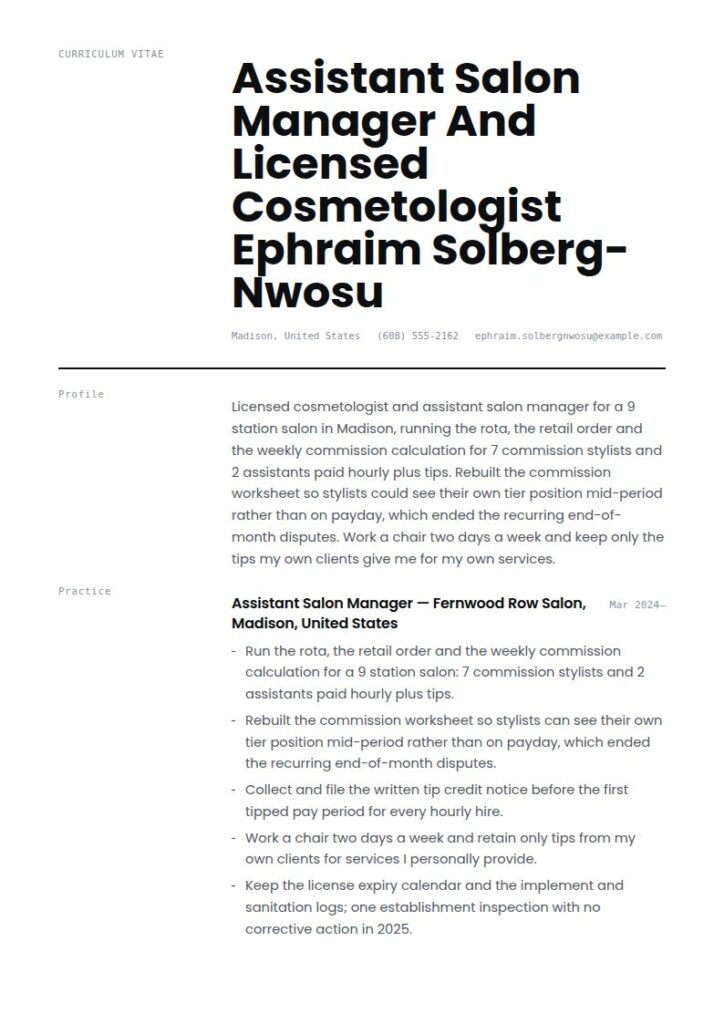
Licensed cosmetologist and assistant salon manager for a 9 station salon in Madison, running the rota, the retail order and the weekly commission calculation for 7 commission stylists and 2 assistants paid hourly plus tips. Rebuilt the commission worksheet so stylists could see their own tier position mid-period rather than on payday, which ended the recurring end-of-month disputes. Work a chair two days a week and keep only the tips my own clients give me for my own services.
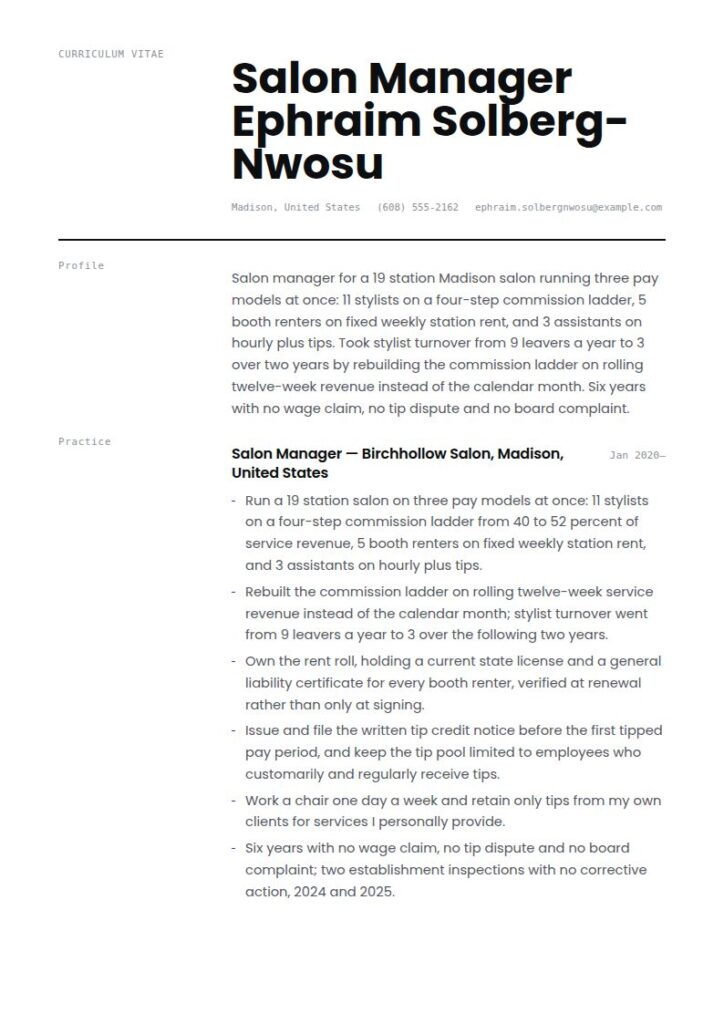
Salon manager for a 19 station Madison salon running three pay models at once: 11 stylists on a four-step commission ladder, 5 booth renters on fixed weekly station rent, and 3 assistants on hourly plus tips. Took stylist turnover from 9 leavers a year to 3 over two years by rebuilding the commission ladder on rolling twelve-week revenue instead of the calendar month. Six years with no wage claim, no tip dispute and no board complaint.
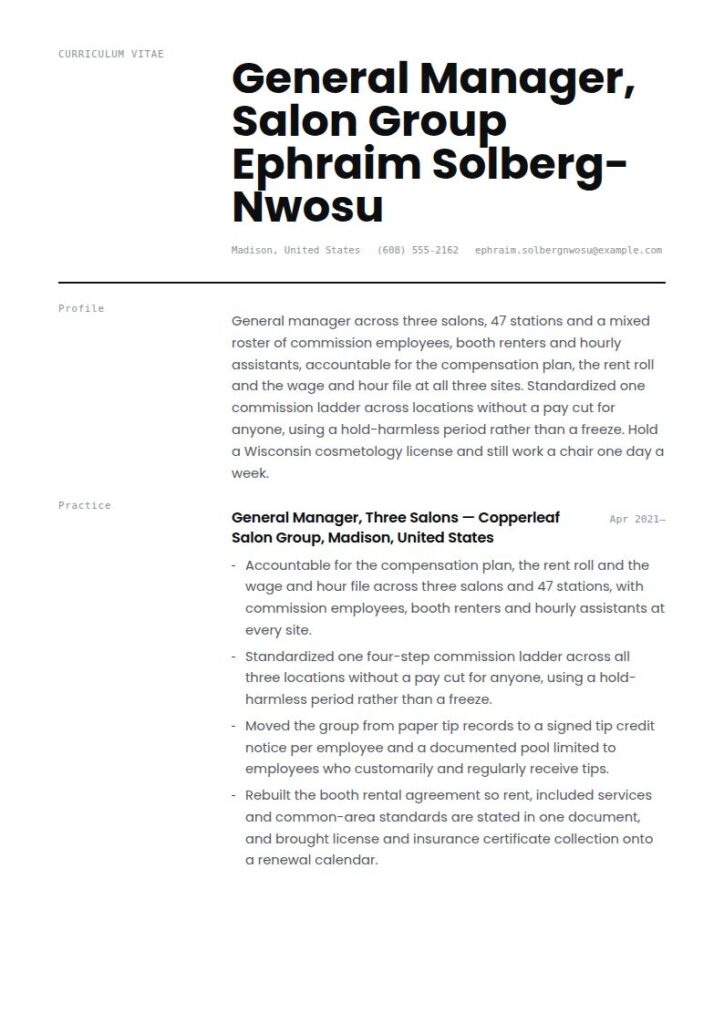
General manager across three salons, 47 stations and a mixed roster of commission employees, booth renters and hourly assistants, accountable for the compensation plan, the rent roll and the wage and hour file at all three sites. Standardized one commission ladder across locations without a pay cut for anyone, using a hold-harmless period rather than a freeze. Hold a Wisconsin cosmetology license and still work a chair one day a week.
Right vs wrong: the same salon manager summary, twice
| ✅ Right | ❌ Wrong |
|---|---|
| 19 stations: 11 commission, 5 booth rent, 3 hourly plus tips. | Managed a busy salon with a large team of talented professionals. |
| Turnover from 9 leavers a year to 3 over two years after rebuilding the commission ladder. | Improved staff retention and team morale. |
| Six years with no wage claim, no tip dispute and no board complaint. | Ensured full compliance with all applicable regulations. |
The right column describes a business an owner can picture. The left column describes a feeling, and the reader is about to hand someone the payroll.
Outline your salon management experience
Salon, city, station count, pay models, dates. Then three to five bullets, each with a number and a period.
| Instead of | Use |
|---|---|
| Managed a team of stylists | Managed 19 stations across three pay models: 11 commission, 5 booth rent, 3 hourly plus tips |
| Improved staff retention | Took stylist turnover from 9 leavers a year to 3 over two years after rebuilding the commission ladder |
| Handled payroll and scheduling | Ran the weekly commission calculation and a 5 station rent roll, with signed tip credit notices before the first tipped pay period |
| Ensured compliance | Kept implement and license records to the written sequence; two establishment inspections with no corrective action, 2024 and 2025 |
| Grew the business | Added a fourth commission tier at 52 percent, which moved three senior stylists off a rental offer from a competing salon |
Salon Manager, Birchhollow Salon, Madison, WI, January 2020 to Present
Run a 19 station salon on three pay models at once: 11 stylists on a four-step commission ladder, 5 booth renters on fixed weekly station rent, and 3 assistants on hourly plus tips.
Rebuilt the commission ladder on rolling twelve-week service revenue instead of the calendar month, so a stylist returning from leave did not fall two tiers in a single pay period; turnover went from 9 leavers a year to 3 over the following two years.
Own the rent roll: a current state license and a general liability certificate on file for every booth renter, verified at renewal rather than only at signing.
Show the pay model you ran and the tip rules you stayed inside
This is the section that separates a salon manager from a salon supervisor, and almost nobody writes it.
A salon manager is hired to operate a compensation system. Three exist, they behave differently, and most salons run more than one at once.
| Model | How the provider is paid | What the manager actually administers |
|---|---|---|
| Commission | A share of the service revenue they produce, usually on a sliding ladder | Tier thresholds, the recalculation period, service pricing, the retail split, what happens after leave |
| Booth or station rent | A fixed rent for a station; the renter sets prices and buys their own product | The rent roll, license and insurance certificates, what rent includes, common-area standards |
| Hourly plus tips | An hourly wage, with tips paid directly by clients | Wage rates, overtime, the tip credit if one is taken, the written notice, the pool |
Say which models you ran, for how many chairs, and for how long. Then say what you changed and what happened.
A commission ladder is the piece most managers are asked to redesign, and the decisions inside it are specific. Tier thresholds decide who stays. The recalculation period decides how it feels, because a ladder recalculated on the calendar month punishes anyone who takes a week off and a rolling window does not. None of that survives in a bullet that says "managed payroll."
The wage rules are the part an owner is quietly checking
Federal tipped-wage rules sit under the Fair Labor Standards Act. A tipped employee is one who customarily and regularly receives more than $30 a month in tips. Where an employer takes a tip credit, the required cash wage is at least $2.13 an hour and the maximum federal tip credit is $5.12 an hour, against the $7.25 federal minimum wage used in that calculation (U.S. Department of Labor, Wage and Hour Division, Fact Sheet #15, retrieved 17 September 2026).
Before taking that credit, the employer has to tell the employee five specific things: the direct cash wage being paid, the tip credit being claimed, that the credit cannot exceed the tips actually received, the tip pooling arrangement, and that the credit does not apply unless the notice is given (same source). That notice either exists in the file or it does not, and producing it is a manager's job.
Pools have two shapes. Where the employer takes a tip credit, a mandatory pool may include only employees who customarily and regularly receive tips. Where the employer pays the full minimum wage directly and takes no credit, the pool may include non-tipped workers as well, provided everyone earns at least the federal minimum wage. In neither case may the employer participate (same source).
Many states set a cash wage higher than $2.13 and some allow no tip credit at all, so name your own state's rule from your own state's labor agency rather than repeating a federal number as though it were local.
The exception that is about you
Managers and supervisors are prohibited from keeping any portion of employees' tips, with one exception: they may retain tips they personally receive from customers for services they directly provided (U.S. Department of Labor, Wage and Hour Division, Fact Sheet #15, retrieved 17 September 2026).
A salon manager who still works a chair is exactly the person that sentence was written about. It grants one thing and forbids everything around it. Tips your own clients hand you for your own services are yours. A share of the pool because you covered a Saturday is not. A cut for booking someone else's guest is not. A percentage for supervising is not.
If you work a chair, put the boundary on the page. It is short, it is checkable, and it tells an owner that the person about to run their payroll has read the rule rather than heard about it.
Pay models administered: 11 commission stations on a four-step ladder from 40 to 52 percent of service revenue; 5 booth rental stations at a fixed weekly rent; 3 assistants on hourly plus tips.
Commission: ladder rebuilt on rolling twelve-week service revenue rather than the calendar month, with mid-period tier position visible to each stylist.
Rent: rent roll held with a current state license and a general liability certificate for every renter, verified at renewal.
Tipped payroll: written tip credit notice issued and signed before the first tipped pay period; pool limited to employees who customarily and regularly receive tips; no employer or manager participation.
Manager exception: work a chair one day a week and retain only tips from my own clients for services I personally provide.
Record: six years with no wage claim, no tip dispute and no board complaint.
Build a snapshot of your key skills
Twelve to fourteen entries in four groups: compensation, people, compliance, systems.
Compensation: Commission ladder design, Booth rental agreements and rent roll, Tipped and hourly payroll, Tip credit notices and pool administration, Service and retail pricing
People: Hiring and licensure verification, Rota planning, New stylist ramp plans, Performance conversations
Compliance: Wage and hour record keeping, State board establishment requirements, Sanitation logs, License expiry tracking, Insurance certificates
Systems: Booking and point of sale administration, Payroll software, Inventory and backbar ordering, Reporting by station and service category
List your education and certifications
License first with the board and number, then any business qualification, then the certifications an owner will ask about.
Cosmetology License, Wisconsin Department of Safety and Professional Services, #CS-204417, current
Associate of Applied Science, Business Management, Madison Area Technical College, Madison, WI, 2014
Isthmus Academy of Cosmetology, Madison, WI, cosmetology program, 2008 to 2009
Certifications: CPR and first aid, American Red Cross (2026). Payroll software administration, vendor certified (2023). Bloodborne pathogens training, annual.
If you came into management from behind the chair, date it. Owners read a licensed manager as someone who can cover a no-show and be believed by the floor.
Choose the right layout and design
Single column, plain type at 11 or 12 point, clear headings, no photograph. Put the station count and pay models immediately under the summary, which on a single column page is where the eye lands first.
Give the station count and the split across pay models for every salon you ran. Name what you changed about a commission ladder and what happened to turnover afterwards. Write the tip credit notice, the pool rule and the manager exception as things you administered. Put your license number and its board in the header if you hold one. Give inspection and claim history as dated facts.
Do not write "managed a team" when you can write the station count and the models. Do not quote a state tipped cash wage you have not checked against your own state labor agency this year. Do not describe booth renters as staff; they are tenants, and an owner will notice. Do not claim a Bureau of Labor Statistics median for salon managers, because none is published.
Salon manager job market and outlook
With no Handbook profile for the occupation, the honest approach is to bracket the job between two occupations that are published, and to label it as bracketing.
| Bracketing occupation, BLS published | Median annual wage, May 2025 |
|---|---|
| Barbers, hairstylists and cosmetologists | $35,880 |
| Personal care and service occupations, group | $36,410 |
| General and operations managers, retail trade | $75,860 |
| General and operations managers, all industries | $105,770 |
Source: U.S. Bureau of Labor Statistics, Occupational Outlook Handbook, May 2025 wage data, published 27 August 2026.
The floor you manage is large and turns over constantly. Barbers, hairstylists and cosmetologists held 670,800 jobs in 2025, with projected growth of 7 percent through 2035, 48,400 new jobs and about 80,300 openings a year (BLS Occupational Outlook Handbook, 2025 to 2035 projections, published 27 August 2026).
The management side is a different shape. General and operations managers sit inside a top executives group that held 3,890,600 jobs in 2025, projected to grow 5 percent and add 190,600 jobs, with about 304,100 openings a year. Typical entry-level education for the group is a bachelor's degree, with five years or more of related work experience (same source).
You manage an occupation with 80,300 openings a year
Barbers, hairstylists and cosmetologists had about 80,300 average annual openings against 670,800 jobs, with 7 percent projected growth through 2035 (BLS Occupational Outlook Handbook, May 2025 data and 2025 to 2035 projections, published 27 August 2026).
That ratio is a salon manager's people problem in one line, and 48 percent of the same workforce is self-employed, so a leaver can go to a rented station rather than to another employer (same source).
Which is why a turnover result belongs next to the mechanism that produced it. "Reduced turnover" is a claim. "Turnover from 9 leavers a year to 3 after rebuilding the commission ladder on a rolling twelve-week window" is something an owner can try in their own building.
What salary you can expect as a salon manager
There is no published median for this job, and a page presenting one as a Bureau of Labor Statistics figure is presenting something the Handbook does not contain.
The published data gives you a range with two honest ends. The floor is the occupation you supervise: $35,880 a year for barbers, hairstylists and cosmetologists in May 2025. The ceiling, for most salons, is general and operations managers in retail trade at $75,860 in the same release (BLS Occupational Outlook Handbook, published 27 August 2026).
Use the retail trade line rather than the $105,770 all-industry median. Retail trade is the lowest published industry figure in that occupation and the closest to a salon in size, hours and margin. The same release puts general and operations managers in professional, scientific and technical services at $151,040, and nobody should walk into a salon interview with that number in their head.
What moves your own pay is the pay model again. A flat salary in an all-rental salon buys full stations and a compliant building. A bonus on service revenue in a commission salon buys a ladder that works. Ask which job it is before you discuss a number.
Key takeaways for a salon manager resume
- Name the pay models and the number of stations on each, in the first line under your name.
- Say what you changed about a commission ladder and what happened to turnover afterwards.
- Write the tip credit notice, the pool rule and the manager exception as work you administered.
- If you work a chair, state the boundary: your own clients, your own services, nothing else.
- Treat booth renters as tenants on the page, with licenses and insurance certificates on file.
- Put your license number and its issuing board in the header if you hold one.
- Say plainly that BLS publishes no salon manager profile, and bracket the job instead.
Build your salon manager resume in 15 minutes with our AI resume builder.
Related beauty and wellness resume examples
- Hair stylist resume
- Cosmetologist resume
- Cosmetology resume
- Beautician resume
- Nail technician resume
- Aesthetician resume
- Esthetician resume
- Massage therapist resume
- Spa manager resume
- Salon receptionist resume
- Makeup artist resume
- Beauty and wellness resume
Pair it with a matching salon manager cover letter.
Salon manager resume questions, answered
How long should a salon manager resume be?
One page until you have run a full salon, two once you have run more than one location, carried a build out, or standardized a compensation plan across sites. The pay model block and the compliance block earn their space; a third page does not.
Where does salary data for salon managers come from?
Not from a Handbook profile, because there is none. Bracket the job instead: barbers, hairstylists and cosmetologists at a $35,880 median and general and operations managers in retail trade at $75,860, both May 2025, published 27 August 2026. Say on the page that you are bracketing; an owner who knows the data respects that more than a confident number they cannot find.
Can a salon manager keep tips?
Only their own. Managers and supervisors may not keep any portion of employees' tips, with one exception: they may retain tips they personally receive from customers for services they directly provided (U.S. Department of Labor, Wage and Hour Division, Fact Sheet #15, retrieved 17 September 2026). A manager who works a chair keeps what their own clients give them for their own services, and nothing from a pool.
Do I need a cosmetology license to manage a salon?
Requirements for the management role differ by state, and your own state board is the only place to settle it. Holding a license changes how the resume reads: you can cover a station, judge a service and be held to the board's rules yourself. If you hold one, put the number and the board in the header. If not, be specific about which license types you supervise and how you verify them.
What if I managed booth renters rather than employees?
Write it as what it is, which is closer to property management than supervision: stations, rent, what the rent includes, how you verified licenses and insurance, and your vacancy history. Very few applicants describe that accurately, so doing it is an advantage.