Konstantin Falkenrath Chief Financial Officer, CPA Minneapolis, 55408, United States [email protected] · (612) 555-0311
11 September 2026
Mr. Sigurd Holmqvist Chief Executive Officer Cobblefield Industries Saint Paul, United States
Application for Chief Financial Officer, Cobblefield Industries
Dear Mr. Holmqvist,
I am writing about the chief financial officer role at Cobblefield Industries. I am currently chief financial officer of a $620 million packaging group that has been an SEC registrant since 2024, carrying a $310 million capital structure of a term loan, a revolver and a convertible note across a lender group of 11. Your announcement of an intention to move to a public listing in the next two years is the piece of work I finished most recently, and it is the reason I am writing rather than waiting.
The registration took 14 months. The hard part was not the offering document; it was two restated comparative years, a segment reporting basis that had to be rebuilt around how the business is actually run, and a material weakness in revenue cut-off that I inherited in 2022 at two acquired units and closed in the following cycle. I refinanced the term loan in 2023 before any of that became public, extending maturity by three years and replacing two maintenance covenants with one, which removed the quarterly cliff that would otherwise have sat under the whole process.
Since registration I certify each quarterly and annual report alongside the chief executive, supported by a sub-certification process I designed across nine reporting units. I chair the disclosure committee, serve an audit committee of four with a private session with the external auditor at every meeting, and present the going concern and covenant analysis myself rather than delegating it. Before this I spent four years as chief financial officer of a sponsor-owned industrial group, so I have also run the version of this job where the reporting goes to four lenders and a sponsor rather than to a market.
What I would want to understand first is how far the current reporting basis is from what a registrant needs, and whether the board has decided between a listing and a sale, because the two mandates diverge in about month three. Thank you for your time.
Sincerely, Konstantin Falkenrath, CPA
Summary
A CFO cover letter is a one page letter that matches your capital history to the company's. It names the structure you carry now, the lenders, investors or sponsor you face, the reporting obligations your company's status creates, and what you personally certify. This guide gives you a full adaptable letter, the openings that work, and the financing detail that must stay off the page.
CFO cover letter examples by experience level
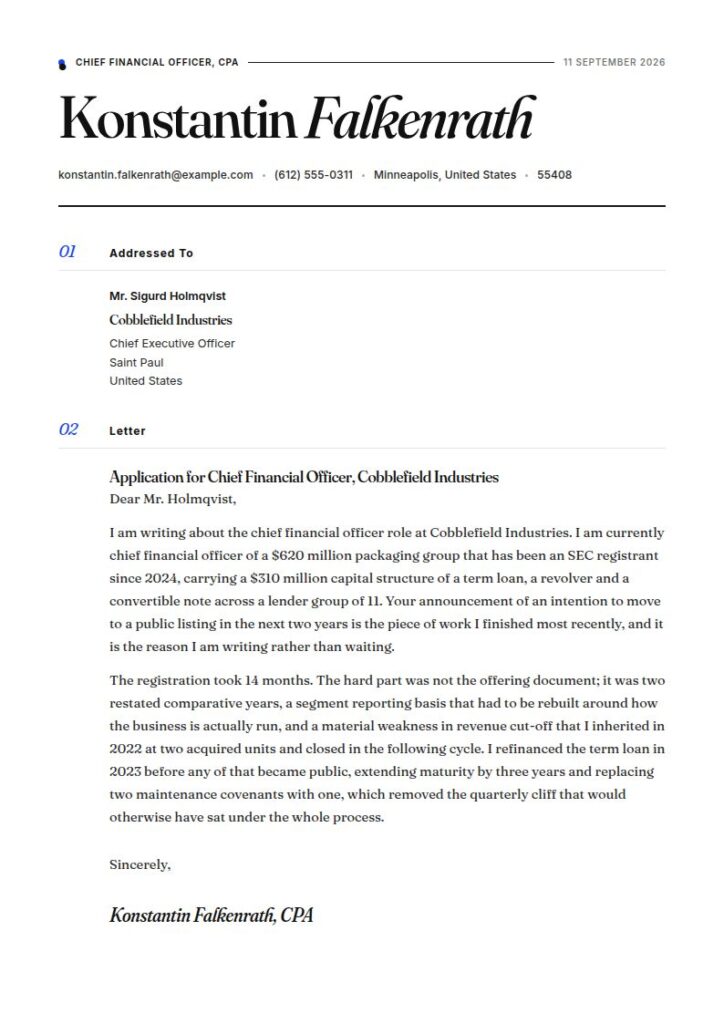
In short, a CFO cover letter is a one page letter that answers a question the resume can only imply: have you financed a company that looks like this one, in front of counterparties that look like these?
In practice, chief financial officer searches are unusually specific. A board is not hiring generic finance leadership; it is hiring somebody who has been through the particular thing that is about to happen. For example, a refinancing, a sale, a registration, a covenant reset, a first institutional round, an integration, or three years of quiet reporting after a bad period. The letter, then, is where you say which of those you have done.
Guide to a CFO cover letter
Specifically, this guide and the corresponding CFO cover letter example will cover:
- How to open on capital rather than on finance leadership
- First, how to structure the letter, paragraph by paragraph
- Then, a full adaptable letter you can rework
- Also, openings that work, and the four that readers skim
- Finally, what financing detail must stay off the page
How to write a CFO cover letter
| Paragraph | Its job | Length |
|---|---|---|
| Opening | The role, your current capital structure and status in one line, and the event they are facing | 3 to 4 sentences |
| Evidence | One financing event: what it was, who was on the other side, what changed | 5 to 6 sentences |
| Obligations | What you sign, what you serve, and the control record | 3 to 4 sentences |
| Close | What you would want to understand first, and a thank you | 2 sentences |
Four paragraphs, one page, 300 to 450 words. Nothing about the close calendar, nothing about the team structure, nothing about systems unless the role is explicitly a systems mandate. Those belong in the interview and, before that, on a finance director resume if that is closer to the job being filled.
Open on the right-hand side of the balance sheet
Almost every chief financial officer letter opens the same way, with a sentence about delivering financial leadership and driving value. It tells the reader nothing, because every applicant writes it.
The opening that works names a structure and a status: "I am chief financial officer of a $620 million packaging group that has been an SEC registrant since 2024, carrying a $310 million structure of a term loan, a revolver and a convertible." In one sentence a board chair knows the size, the ownership, the obligations and the instruments, and can decide within seconds whether to keep reading.
Then connect it to their situation in the same paragraph: "The covenant reset you are facing is a version of what we did in 2023, ahead of registration." Nothing else in the letter will do as much work.
A CFO cover letter example you can adapt
Dear Mr. Holmqvist,
I am writing about the chief financial officer role at Cobblefield Industries. I am currently chief financial officer of a $620 million packaging group that has been an SEC registrant since 2024, carrying a $310 million capital structure of a term loan, a revolver and a convertible note across a lender group of 11. Your announcement of an intention to move to a public listing in the next two years is the piece of work I finished most recently, and it is the reason I am writing rather than waiting.
The registration took 14 months. The hard part was not the offering document; it was two restated comparative years, a segment reporting basis that had to be rebuilt around how the business is actually run, and a material weakness in revenue cut-off that I inherited in 2022 at two acquired units and closed in the following cycle. I refinanced the term loan in 2023 before any of that became public, extending maturity by three years and replacing two maintenance covenants with one, which removed the quarterly cliff that would otherwise have sat under the whole process.
Since registration I certify each quarterly and annual report alongside the chief executive, supported by a sub-certification process I designed across nine reporting units. I chair the disclosure committee, serve an audit committee of four with a private session with the external auditor at every meeting, and present the going concern and covenant analysis myself rather than delegating it. Before this I spent four years as chief financial officer of a sponsor-owned industrial group, so I have also run the version of this job where the reporting goes to four lenders and a sponsor rather than to a market.
What I would want to understand first is how far the current reporting basis is from what a registrant needs, and whether the board has decided between a listing and a sale, because the two mandates diverge in about month three. Thank you for your time.
Sincerely, Konstantin Falkenrath, CPA
Openings that work
| Instead of | Use |
|---|---|
| I am writing to express my interest in the CFO position | I am writing about the chief financial officer role at Cobblefield Industries |
| I am a strategic finance leader with a proven track record | I am chief financial officer of a $620 million group that has been an SEC registrant since 2024 |
| I have extensive experience in financial management and reporting | I carry a $310 million structure of a term loan, a revolver and a convertible across 11 lenders |
| I would welcome the opportunity to add value to your organization | Your announced intention to list is the piece of work I finished most recently |
The right column is verifiable. In fact, the left column is what the other nine letters in the folder say, and it is the reason a reader gives most of them eight seconds.
Say what you sign
One paragraph, and it is the part of the letter most candidates never write.
A chief financial officer is a co-signer, and for a registrant that is a legal fact rather than a way of speaking. The principal executive officer and the principal financial officer must each certify the annual and quarterly reports, covering among other things that the officer has reviewed the report, that to their knowledge it "does not contain any untrue statement of a material fact", and that the statements "fairly present in all material respects the financial condition and results of operations" of the issuer (15 U.S.C. 7241). In addition, the rule that implements it states that the certification may not be signed on the officer's behalf "pursuant to a power of attorney or other form of confirming authority" (17 CFR 240.13a-14).
At a private company the signatures are different but no less real: a quarterly compliance certificate, a borrowing base certificate, a management representation letter to the auditor. Name the ones you sign. It is one sentence and it places you more precisely than a paragraph of description.
Open with the size, status and capital structure of the company you run now. Name the event they are facing and the nearest one you have completed. Give one financing event with the counterparties and the year. Say what you personally certify or sign. Name the control record, including anything inherited and closed. Close with the question you would want answered first.
Do not open with "strategic finance leader" or any variant of it. Do not put pricing, spreads, fees or covenant headroom on a private facility into a letter. Do not name a lender, bidder, investor or rating outcome that is not public. Do not claim a refinancing, listing or sale you supported as one you led. Do not describe the close calendar or the team structure; neither is what the letter is for. Do not exceed one page.
What must stay off the page
The letter is the riskier of the two documents, because narrative pulls detail with it.
Off the page: any transaction that has not closed, unannounced results, pricing and covenant terms on a private facility, a credit paper or anything drawn from one, a private valuation or multiple, a rating discussion that has not been published, the identity of a lender or investor who has not announced themselves, and customer names or contract values. For a registrant, rules govern these rather than discretion, and a letter circulates further than you expect.
Also off the page: any named individual. For instance, a predecessor who left a problem behind, an auditor who disagreed with you, a director. Above all, describe the condition and the outcome, never the person.
What the published pay data can and cannot see
There is no federal occupational profile for the title "chief financial officer". The work brackets two published occupations: financial managers, with a median annual wage of $166,570 in May 2025, employment of 879,700 in 2025, 10 percent projected growth to 2035 and about 65,600 openings a year; and chief executives, with a median of $213,990 and employment of 291,600 (BLS Occupational Outlook Handbook, May 2025 wage data and 2025 to 2035 projections).
Within financial managers, industry is the largest published lever: medians of $174,170 in professional, scientific and technical services, $172,340 in management of companies and enterprises, $169,980 in finance and insurance, $164,400 in manufacturing and $139,810 in government (BLS, May 2025).
None of it sees the part a chief financial officer negotiates hardest. The federal wage survey collects straight-time gross pay and explicitly excludes year-end bonuses, profit-sharing payments, stock bonuses and severance pay (BLS, Occupational Employment and Wage Statistics survey documentation, accessed 13 September 2026). For a sponsor-backed or newly listed company that is often the largest component of the package. The published data covers base and regular incentive together and stops, and no federal source publishes an equity or long term incentive figure for the role, so never put a compensation expectation in a letter on the strength of a number you cannot source.
Length, format and sending it
One page, four paragraphs, 300 to 450 words. PDF, named for yourself and the role: konstantin-falkenrath-cobblefield-cfo-letter.pdf. Address a named person: the chief executive, the board chair, the audit committee chair or the search partner, all of whom are usually findable.
Use the same figures as your resume. A board chair who finds two different structure sizes across two documents from the same candidate will not ask which is right; they will stop. Our CFO resume example uses the figures in this letter.
Key takeaways
- First, open on capital structure and reporting status, not on finance leadership.
- Next, name the event the company is facing and the nearest one you have completed.
- After that, give one financing event with counterparties, terms you may disclose, and the year.
- Say what you personally certify or sign.
- Give the control record, including anything inherited and closed.
- Close with the question you would want answered first.
- Finally, one page to a named person, with figures that match your resume.
Write your CFO cover letter in 10 minutes with our AI cover letter builder.
CFO cover letter questions, answered
Should a CFO cover letter mention the finance team?
Only in passing, and only if the role is explicitly a rebuild. The letter has room for one story and it should be a capital or obligation story, because that is what distinguishes candidates at this level. Team structure, close timing and systems are strong material for the interview and for the resume, but in a letter they compete with the thing that gets you the interview.
I am moving from finance director to CFO. How do I write the letter?
Lead with the pieces of the chief financial officer job you already hold, which is usually more than candidates claim: a lender relationship, a covenant certificate you sign, an audit committee you attend, a capital appraisal a board approved, a diligence process you ran. Then name plainly what you have not held, such as raising equity or facing a rating agency. A stated gap is manageable; an implied one is what the first interview question is about.
How much can I say about a company that has not announced a transaction?
Nothing. Not the type, not the size, not the stage, not the fact that one exists. If the reason you are on the market is an imminent sale or listing, describe your motivation in another way, such as a completed mandate or a change of ownership already public. A letter is copied and forwarded, and a candidate who leaks a live process in writing has answered the only question a board really cares about.
Does a chief financial officer applying to a private company still talk about certification?
Yes, using the private equivalents. The management representation letter, the quarterly compliance certificate and the borrowing base certificate are all signed by a person and all carry consequences. Naming them shows you understand the job as a set of personal obligations rather than a set of deliverables, which is the distinction a board is testing for.
Who should the letter be addressed to?
The chief executive for most corporate roles, the board chair or audit committee chair where the board is running the process, and the search partner where a firm has been engaged. If the posting names nobody, the audit committee chair is a defensible choice for a registrant and the chief executive for everyone else. Avoid "Dear Hiring Committee" on a document that is otherwise specific.