Omar Haddad Event Operations Coordinator Kansas City, 64111, United States [email protected] · (816) 555-0211
17 September 2026
Ms. Corinne Vasilenko Event Operations Heartland Sports Commission Kansas City, United States
Application for Event Operations Manager, Heartland Sports Commission
Dear Ms. Vasilenko,
I am applying for the Event Operations Manager post with the Heartland Sports Commission. For the last three years I have run 72 home dates a season at Crosstown Field, a 7,400-capacity venue, plus six non-baseball events a year, and I am available nights, weekends and holidays across a full season.
What I own there is the run of show from load-in to load-out. I hold a six-hour load-in and a ninety-minute load-out across the season, distribute the written timeline to every department the day before, and direct sixty event-day staff at peak across gates, ushering, guest services and clean team. I also coordinate four concessions partners and a contracted medical provider, and I run four field configuration changes a year between baseball, soccer and concert setups, each inside a fourteen-hour window.
The part I would want you to ask about is the weather. Last season we ran three lightning suspensions, and the worst of them moved 6,800 people to shelter in eleven minutes with no reported injury. That time came from rehearsing the plan in preseason with the gate leads rather than from anything that happened on the night, which is the habit I would bring to a nine-venue portfolio.
I hold current CPR, AED and first aid certification and state-approved alcohol server training, and I have been a registered high school sports official since 2018. I can start within four weeks. Thank you for your time.
Sincerely, Omar Haddad
Summary
A sports cover letter names the events you have worked, the part of the run of show you owned, the staff and crowd you handled, and one event that went wrong. This guide gives you a full adaptable letter, openings that work, how the letter changes across coaching, officiating and operations, and the availability line that decides most shortlists.
Sports cover letter examples by experience level
A sports cover letter is a one page letter that tells whoever is building an event-day roster how many events you have worked, what you owned inside them, and what happened the time one went wrong.
The reader is usually short of people for specific dates. An operations director, an assignor or an athletics administrator is not looking for enthusiasm; they are looking at a calendar with holes in it. A letter written for the calendar is remembered.
Guide to a sports cover letter
This guide and the corresponding sports cover letter example will cover:
- How to structure the letter, paragraph by paragraph
- Why the event count and your availability belong in the first paragraph
- How to write the event that went wrong, which is the paragraph that gets read twice
- How the letter changes across coaching, officiating and operations
- Openings that work, and the ones every reader in this sector has seen
How to write a sports cover letter
| Paragraph | Its job | Length |
|---|---|---|
| Opening | The role, your event volume, and the dates you can cover | 2 to 3 sentences |
| Evidence | One event you owned, with the run of show, staff and crowd numbers | 4 to 5 sentences |
| Recovery | One event that went wrong, what you did, how long it took | 3 to 4 sentences |
| Close | Credentials with dates, availability, thank you | 2 sentences |
Write the calendar into your first paragraph
Sports hiring is a scheduling problem before it is a talent problem. The person reading has a season on a wall and gaps in it, and the first thing they need from you is whether you can stand in one.
So open with volume and availability together: "I have worked 72 home dates a season for the last three years at a 7,400-capacity venue, and I am available nights, weekends and holidays through the season."
Everything else in the letter is evidence for that sentence. A letter that opens with how much you love the sport spends its best line on the one fact every other applicant also has.
A sports cover letter example you can adapt
Dear Ms. Vasilenko,
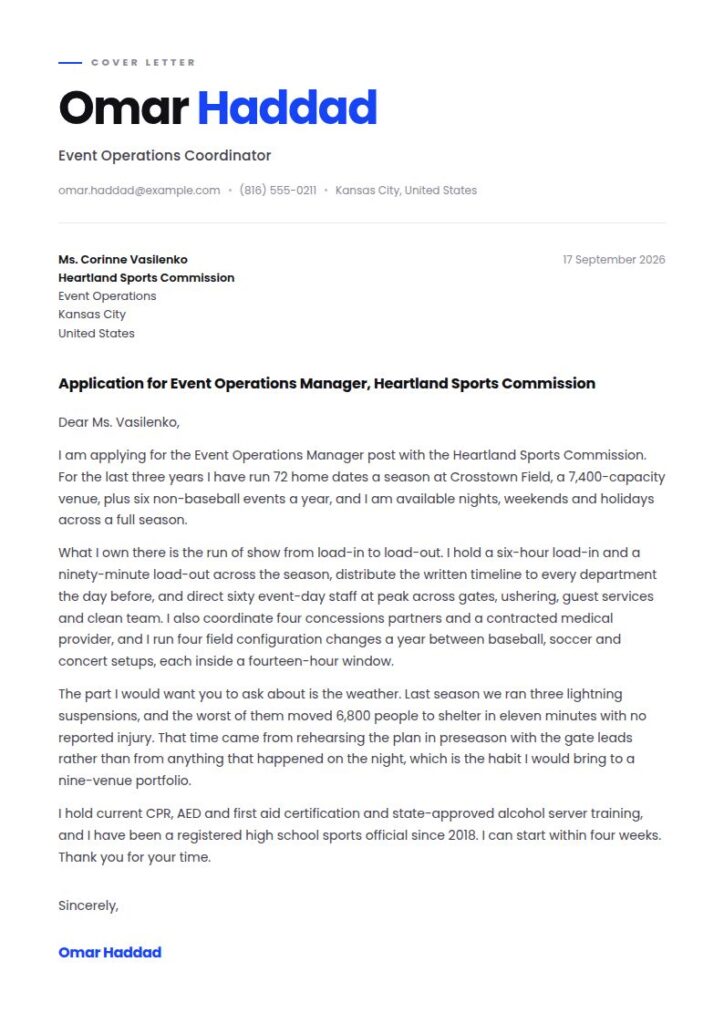
I am applying for the Event Operations Manager post with the Heartland Sports Commission. For the last three years I have run 72 home dates a season at Crosstown Field, a 7,400-capacity venue, plus six non-baseball events a year, and I am available nights, weekends and holidays across a full season.
What I own there is the run of show from load-in to load-out. I hold a six-hour load-in and a ninety-minute load-out across the season, distribute the written timeline to every department the day before, and direct sixty event-day staff at peak across gates, ushering, guest services and clean team. I also coordinate four concessions partners and a contracted medical provider, and I run four field configuration changes a year between baseball, soccer and concert setups, each inside a fourteen-hour window.
The part I would want you to ask about is the weather. Last season we ran three lightning suspensions, and the worst of them moved 6,800 people to shelter in eleven minutes with no reported injury. That time came from rehearsing the plan in preseason with the gate leads rather than from anything that happened on the night, which is the habit I would bring to a nine-venue portfolio.
I hold current CPR, AED and first aid certification and state-approved alcohol server training, and I have been a registered high school sports official since 2018. I can start within four weeks. Thank you for your time.
Sincerely, Omar Haddad
Openings that work
| Instead of | Use |
|---|---|
| I have always had a passion for sports | I have run 72 home dates a season for three years at a 7,400-capacity venue |
| I am writing to express my interest in this position | I am applying for the Event Operations Manager post, and I am available nights, weekends and holidays |
| I work well under pressure | I ran three lightning suspensions last season, the worst moving 6,800 people to shelter in eleven minutes |
| I am a strong team player | I direct sixty event-day staff at peak across gates, ushering, guest services and clean team |
The event that went wrong
This is the paragraph that gets read twice, and most applicants leave it out because it feels like admitting failure. It is the opposite. Every reader in this sector has stood in a control room while something broke, and they are hiring for what you did next.
| What went wrong | What the sentence needs |
|---|---|
| Weather suspension | People moved, time taken, where they went, injuries |
| Gate backing up | Queue time before and after, what you changed mid-event |
| Medical incident | Response time, who you coordinated, what changed afterward |
| Timing or scoreboard failure | The manual procedure, whether it had been rehearsed |
| Vendor or official no-show | Who you called, how long the gap lasted, what covered it |
Keep it non-identifying. Describe the procedure and the numbers, never the person involved, never a patron, an athlete or an official by name or description.
Three published sports occupations, three different markets
Coaches and scouts held 298,800 jobs in 2025 with about 36,400 openings projected each year on average over the decade; umpires, referees and other sports officials held 18,200 jobs with about 4,300; athletes and sports competitors held 22,900 with about 2,200 (BLS Occupational Outlook Handbook, last modified 27 August 2026).
Median annual wages in May 2025 were $47,320 for coaches and scouts, $40,710 for officials and $66,710 for athletes and sports competitors (BLS, May 2025).
For a letter that is a useful reality check. Almost all of the paid work in this sector is on the coaching, officiating and staffing side, and it is won on availability and record rather than on affinity for the game.
How the letter changes by job family
The structure holds across the sector; the numbers in it change.
Coaching: season length, athlete numbers, assistants supervised, and the certification or mandatory courses your state requires, which BLS notes public high school coaches may need (BLS Occupational Outlook Handbook, Coaches and Scouts, last modified 27 August 2026). Officiating: assignments completed by level and sport, and the registration behind them, since BLS reports that high school officials typically register with a state or local agency and pass a rules exam (BLS Occupational Outlook Handbook, Umpires, Referees, and Other Sports Officials, last modified 27 August 2026). Operations, facilities and game-day staff: events a season, run of show, load-in and load-out windows, staff directed and crowd handled.
Open with your event volume and your availability in the same sentence. Name the part of the run of show you owned. Give load-in and load-out as real times. Say how many staff you directed at peak. Spend a paragraph on one event that went wrong. List credentials with their currency dates at the close.
Do not open with how long you have loved the sport. Do not claim a coaching certification or an officiating registration you do not currently hold, because both sit on a register somebody can check. Do not describe an incident in a way that identifies a patron, an athlete or an official. Do not leave availability out of a letter for seasonal or event work; it is the first thing the reader needs. Do not send a two-page letter into a hiring window that lasts a fortnight.
Length, format and sending it
One page, four paragraphs, 250 to 400 words. PDF unless the portal says otherwise, named for yourself and the post: omar-haddad-event-operations-manager-cover-letter.pdf. Address a person: operations and athletics staff directories are public on most team, venue and university sites. Use the same numbers as your resume so the two agree. Our sports resume example is written with the figures used here.
Key takeaways
- Put your event count and your availability in the first sentence.
- Name the part of the run of show you owned, not the department you sat in.
- Give load-in and load-out as real windows with real times.
- Say how many event-day staff you directed at peak.
- Spend a paragraph on the event that went wrong and what you did.
- Keep every incident description non-identifying.
- Close with credentials and their currency dates.
Write your sports cover letter in 10 minutes with our AI cover letter builder.
Sports cover letter questions, answered
How long should a sports cover letter be?
One page, four paragraphs, 250 to 400 words. Hiring in this sector happens in short windows before a season, and length is not read as effort.
Do I need a cover letter for a seasonal game-day job?
Attach one if there is a field for it. The form collects the same availability grid from everyone. The letter is where you say how many dates you worked last season, whether you were rehired, and what you handled at the gate.
How do I write about an incident without naming anyone?
Describe the procedure and the numbers. People moved, minutes taken, who you coordinated with, what changed afterward. Never a name, a description, a jersey number or a detail that would identify a patron, an athlete or an official.
Should I mention that I played the sport?
Only in a clause, and only if it is relevant. A season of playing tells an operations director very little; a season of working the gate tells them a great deal. If you played at a level that explains your understanding of the run of show, one sentence is enough.
What do I write with no paid sports experience yet?
Write volunteer and student roles as events. A tournament you helped run, a school event you set up and broke down, a club fixture you worked the gate for. Give the date count, the people, the setup window and anything that went wrong. Then state your availability plainly, because in this sector that alone gets some letters read.