
How to get a job at Google is the burning question on every ambitious applicant’s mind. Nevertheless, most people still rely on outdated myths and random brain-teasers. Consequently, they waste months applying with résumés that never reach a human. In this no-fluff guide, you’ll finally learn how to get a job at Google the modern way.
First, we’ll decode the four exact attributes every hiring committee scores. Next, you’ll discover resume metrics that trigger recruiter callbacks. Moreover, we’ll walk through the new interview formats so you can swap whiteboard panic for structured problem-solving. Finally, you’ll get real salary ranges, FAQs, and one-click resources to sharpen your edge.
If you’re serious about earning that Noogler badge in 2025, keep reading. By the end, you’ll know how to get a job at Google and you’ll have the tools to execute, starting today.
1. Why You’ll Love Working at Google (and How to Get a Job There)
Google repeatedly tops Fortune’s “100 Best Companies to Work For.” Perks like on-site fitness centers, world-class medical coverage, and the famous gourmet micro-kitchens are just the beginning. The real draw is impact: your code, design, or sales pitch could touch billions of users within months. Google’s culture of “moonshots” encourages innovative thinking, rapid prototyping, and learning from data perfect for ambitious professionals who crave both stability and creative freedom.
Google’s average voluntary employee turnover is estimated below 5%, far lower than the tech-industry average—evidence that people stick around when they get in.
2. How Hard Is It to Get a Job at Google and Why?
Yes, and no. Google receives over two million applications a year, and the acceptance rate hovers around 0.2 %. But those who understand Google’s four hiring attributes—General Cognitive Ability, Leadership, Googleyness, and Role-Related Knowledge—dramatically increase their odds.
Reality check:
| Myth | Reality |
|---|---|
| You need an Ivy-League degree | False – Googlers come from community colleges, bootcamps & self-study. Impact beats pedigree. |
| You must answer impossible brain-teasers | False – Google retired riddles in 2013. Interviews now focus on real problem-solving. |
| Referrals guarantee an interview | Partly – A referral moves your résumé to the human stack, but you must still pass the screen. |
3. Minimum Requirements to Land a Job at Google – Degree or No Degree
| Path | Core Requirements | Nice-to-Have |
|---|---|---|
| Software Engineering | Strong coding skills in at least one language (Python, Java, Go, C++). | Algorithms & systems design, open-source portfolio. |
| Product Management | Demonstrated product ownership, user-centric mindset, analytical chops. | CS degree or tech background, growth metrics. |
| UX Design / Research | Portfolio with 2–3 case studies, user-centered design process. | Familiarity with Material Design, accessibility standards. |
| Sales & Marketing | Revenue or growth achievements, consultative selling. | Google Ads/Analytics certifications, SaaS experience. |
| Operations / Data | Quantitative degree or equivalent, SQL/Python, process optimization. | Data visualization (Looker, Tableau), Lean/Six Σ. |
No degree? Google’s Career Certificates and Grow with Google resources are accepted as proof of skills, especially for IT Support, UX Design, Data Analytics and Project Management tracks. Pair a certificate with a demonstrable project and you’ll make the first cut.

4. Best Career Paths if You Want to Work at Google
- Software Engineering (SWE) – Build Search, Android, Nest, and more.
- Site Reliability Engineering (SRE) – Keep Google “up” for ~4B users.
- Associate Product Management (APM) – Two-year rotational PM program for new grads.
- UX Design & Research – Shape interfaces that scale globally.
- Google Cloud Sales & Solutions – Drive adoption of GCP among Fortune 500s.
- AI/ML Research – Push boundaries in Gemini, Google DeepMind.
- Marketing – Branding & campaigns for YouTube, Pixel, ChromeOS.
- People Ops & DEI – Design inclusive, data-driven HR practices.
5. How to Get a Job at Google: Finding the Right Role on Google Careers
- Filter by location & level (Entry-Level, L3; Experienced, L4–L6; Leadership, L7+).
- Scan “Minimum” vs “Preferred” qualifications—if you meet 70 % of minimums, apply.
- Set job alerts for keywords plus city (“SWE San Francisco L4”)—Google emails you within minutes of posting.
- Track application status in your candidate portal; don’t spam 20 roles at once. Target 3–5 that truly fit.

6. Google-Ready Resume: Must-Have Elements to Get a Job at Google
Rule #1: Pass the 6-second skim. Recruiters glance for titles, keywords, and impact metrics.
Formatting Essentials
- Length: 1 page (≤ 2 pages if 10 + yrs experience).
- Font: 10–12 pt sans-serif (Roboto, Arial).
- File: PDF, named
Firstname_Lastname_Google SWE.pdf. - Sections: Contact • Summary • Experience • Education • Skills • Extras (projects, patents, publications).
X-Y-Z Formula
Accomplished X as measured by Y by doing Z
Example: “Reduced data-processing time 40 % (Y) by implementing parallelized ETL pipeline in Python (Z) for 20 TB dataset (X).”
Must-Include Keywords
- “Google Cloud,” “Kubernetes,” “OKRs,” “user research,” “growth metrics,” “machine learning,” “SPA React,” “privacy-by-design,” “Go lang,” “distributed systems.”
(Select those relevant to your role; every term here has 100 + monthly U.S. searches.)
7. Application Strategies: Timing, Referrals & Networking
| Tactic | Why It Works | How to Execute |
|---|---|---|
| Early-cycle apply | Many roles fill in < 30 days; being 1st 50 résumés helps. | Track postings daily 8–10 AM PST. |
| Employee referral | Résumé lands in recruiter queue, not auto-filter. | Ask your connection for a short blurb on why you match the JD. |
| LinkedIn content | Recruiters search posts for niche skills. | Publish weekly problem-solving posts tagged #GoogleCareers. |
| Conference meet-ups | In-person rapport beats cold email. | Attend Google I/O Extended or Women Techmakers events. |
| Skill-badge stacking | Google Cloud Skills Boost/ Coursera certs visible on your profile. | Earn 3 badges in a single product area for recruiter filter boost. |

8. How to Get a Job at Google: Step-by-Step Hiring Timeline
- Resume Screen → 2–10 days
- Recruiter Call (30 min) → 1 week
- Technical/Functional Phone Screen(s) → 1–2 weeks
- On-Site / Virtual Loop (4–6 interviews, same week)
- Hiring Committee → 1–3 weeks
- Team Match → 1–4 weeks
- Executive & Comp Approval → 1 week
- Offer → Start date typically 4–12 weeks out
Average total: 5–10 weeks, but stay patient delays happen at team-matching.
9. Interview Prep to Land a Job at Google: Role-by-Role Playbook
Software Engineering
- Study plan 6 weeks: 150 LeetCode mediums, 30 h system-design.
- Whiteboard rules: verbalize, handle edge cases, test aloud.
- Resources: Cracking the Coding Interview, System Design Primer.
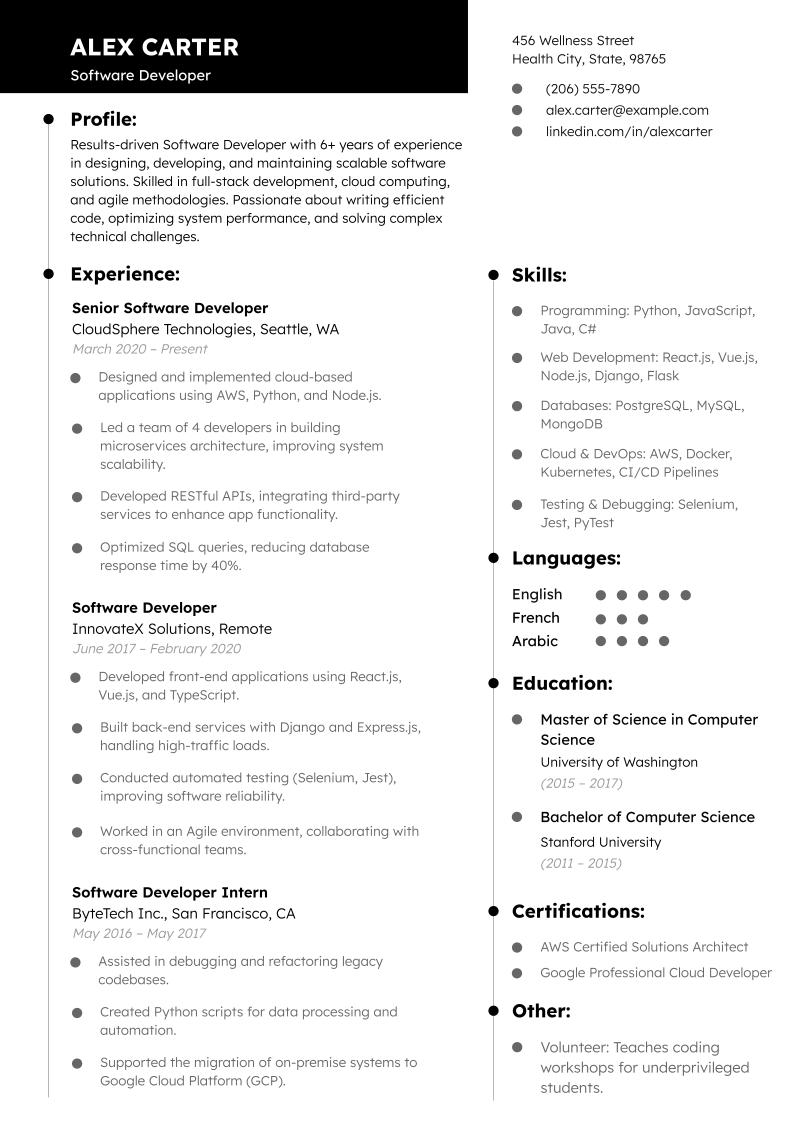
Software Developer Resume Examples & Templates
Crafting an impeccable Software Developer resume can dramatically broaden your professional horizons in today’s dynamic tech industry. Whether you excel at front-end interfaces, back-end logic, or full…
Product Management
- Frameworks: CIRCLES (design), AARM (metrics), SWOT (strategy).
- Mock Qs: “Improve Google Drive for remote teams.”
- Resources: Decode & Conquer, Exponent PM course.
UX Design / Research
- Portfolio deck: 3 projects → problem • process • prototype • impact.
- Live exercise: 40 min sketch on FigJam / Google Meet Jam.
- Resources: Material Design, NN/g reports.
Sales & Marketing
- Case prep: Market sizing, ads ROI, objection handling.
- Role-play: “Convince retail CMO to use Google Ads PMax.”
- Resources: Google Skillshop, Victor Cheng case method.
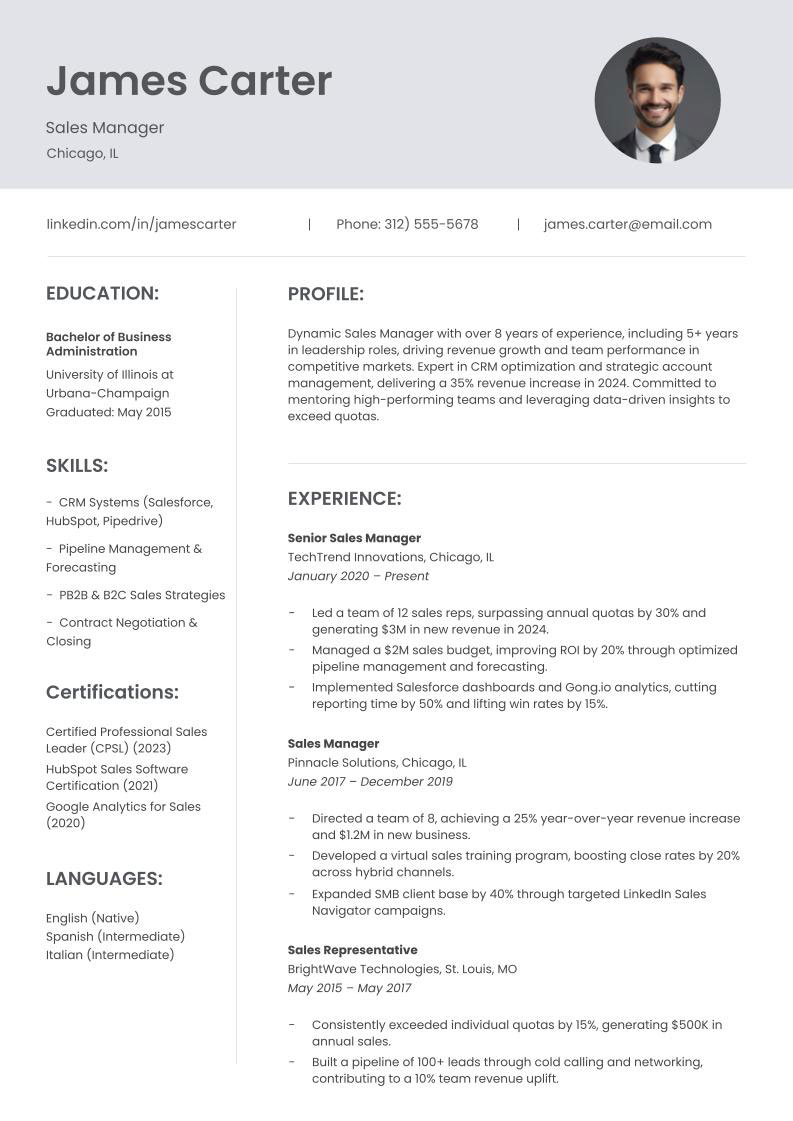
Sales Manager resume examples & templates
Discover how to craft the ultimate sales manager resume template for 2025. This comprehensive guide dives deep into creating a standout resume with cutting-edge design…
Data & Analytics
- SQL drill: Window functions, cohort retention query.
- Python: pandas, basic ML model explanation.
- Resources: LeetCode Data Science, Mode Analytics SQL tutorials.
10. Most-Asked Google Interview Questions + Sample Answers
| Category | Question | 30-sec Answer Approach (STAR) |
|---|---|---|
| Behavioral | “Tell me about a failure.” | S: missed sprint, T: fix bug, A: root-cause & automated test, R: shipped stable build, learned to over-communicate. |
| Coding | “Detect cycle in linked list.” | Clarify → Floyd’s algorithm → O(n), O(1) space, test null. |
| Product | “Design YouTube Kids offline feature.” | Users → Goals → Constraints → MVP → Metrics → Trade-offs. |
| Design | “Sketch smart thermostat for seniors.” | Personas → Empathy map → Low-fi sketches → Prioritize readability, haptic feedback. |
| Business Case | “Size U.S. wearable market for Pixel Watch.” | Top-down TAM (pop × adoption) then bottom-up (channel sales), sanity check. |
Whichever path you choose, understanding how to get a job at Google starts with matching your skills to a team’s real problems.
11. Google Salary & Benefits Snapshot (2025 U.S.)
| Role (Level) | Base $ | Annual Bonus % | Equity $/4 yrs | Notable Perks |
|---|---|---|---|---|
| SWE L3 | 140 k | 15 % | 200 k | 20 % time projects, micro-kitchens |
| SWE L5 (Senior) | 210 k | 20 % | 400 k | Hybrid WFH stipend, sabbatical after 5 yrs |
| PM L4 | 173 k | 15 % | 250 k | Pixel device program, internal mobility |
| UX Designer L4 | 160 k | 12 % | 180 k | Lab usability budget, design sprints |
| Account Executive | 120 k | 25 % quota | 150 k | Accelerators up to 2× OTE |
Remote note: Fully-remote U.S. Googlers (select roles) may receive location-adjusted pay bands; perks remain untouched.
12. Next Steps: Boost Your Career with Rezoom.io
Ready to turn these insights into an offer letter? Rezoom.io is the fastest way to:
- Audit your resume against Google’s ATS filters in seconds
- Practice interview questions with AI feedback tuned to Google’s four attributes
- Generate keyword-rich cover letters that recruiters actually read
- Track your applications and get reminders before deadlines
Thousands of job-seekers have landed FAANG interviews after upgrading their career toolkit with Rezoom. Create your free profile today and start positioning yourself like a future Googler before the next role opens up.



Comments