

Summary
Estimates of how many listings are ghost jobs range from roughly one in seven to nearly half, because each study measures something different: employer behaviour, listing characteristics, or what HR staff admit in surveys. The defensible floor is about one in five. More useful than any percentage is a two-minute check — open the company's own careers page and see whether the role is still there.
Search for how many listings are ghost jobs and you will find a number. You will also find a different one on the next page, and a third that contradicts both.
Forbes covered a 2026 study putting ghost jobs at roughly one in seven listings. Greenhouse’s own platform data says 18 to 22 percent. ResumeUp.AI’s analysis of LinkedIn put it at 27.4 percent. Some sites run headlines claiming 47 percent.
The instinct is to pick the scariest figure. The more useful move is to understand why they disagree — because that explains what is actually happening to your applications, and it points at a check you can run in two minutes that beats every estimate.
What are ghost jobs?
Ghost jobs are listings that stay public while the employer has no active intention of filling the role soon. Some are deliberate pipeline building; others are simply stale postings nobody removed. From the applicant's side the outcome is identical — the application goes nowhere.
Several different behaviours sit inside the category, and they look identical from the outside:
Pipeline building. The company collects résumés for a role it expects to open later. Real intent, wrong timeline.
Signalling growth. An open req makes a company look like it is expanding, which matters to investors, boards and “fastest-growing employer” lists.
Compliance postings. An internal candidate is already chosen, but policy requires an open search.
Stale listings. The role was filled and nobody closed the posting. There is a structural version of this too: when a company closes a req in Greenhouse, Workday or Lever, its own careers page updates immediately, while LinkedIn and Indeed receive the feed update 24 to 72 hours later — or never, if the integration has broken. A listing marked “Just Posted” on an aggregator can already be dead at the source.
That last one matters for how you read this whole topic. Not every ghost job is deception. Some of it is plumbing. The effect on your time is the same either way, which is why the fix is verification rather than outrage.
What percentage of job postings are fake?
Estimates range from about 14% to 27%, with outlier claims near 47%. The defensible floor is roughly one in five: Greenhouse's platform data puts it at 18–22%, and Glassdoor's language-model analysis put it at up to 21%. Studies disagree because they measure different things.
Here is the disagreement laid out, because seeing the methods side by side is more useful than any single headline.
| Source | Estimate | What it actually measured |
|---|---|---|
| Forbes-covered 2026 study | ~1 in 7 | Listing analysis |
| Greenhouse platform data | 18–22% | Employer posting behaviour on its own platform |
| Glassdoor LLM analysis | up to 21% | Language-model classification of listings |
| ResumeUp.AI | 27.4% | Characteristics of active LinkedIn postings |
| Clarify Capital | ~1 in 3 employers | What employers admit in a survey |
| LiveCareer (918 HR staff) | 45% post them regularly | What HR professionals admit about themselves |
| MyPerfectResume | 81% of recruiters | Whether their employer has ever done it |
Read down the right-hand column and the contradiction dissolves. “18–22% of postings” and “45% of HR professionals” are not competing answers — they are answers to different questions. A minority of listings can be ghost jobs while a majority of HR teams have posted one, in the same way that a small share of drivers speeding at any moment is compatible with most drivers having sped.
The survey figures also carry a bias worth naming: they measure what people will admit, which is a floor, not a count.
Ignore the headline percentage
The number you need is not the market average — it is whether the specific posting in front of you is live. A 20% base rate tells you nothing about the job you are about to spend forty minutes applying to. The verification steps below take two minutes and answer the only question that affects you.
The statistic that explains it better than any percentage
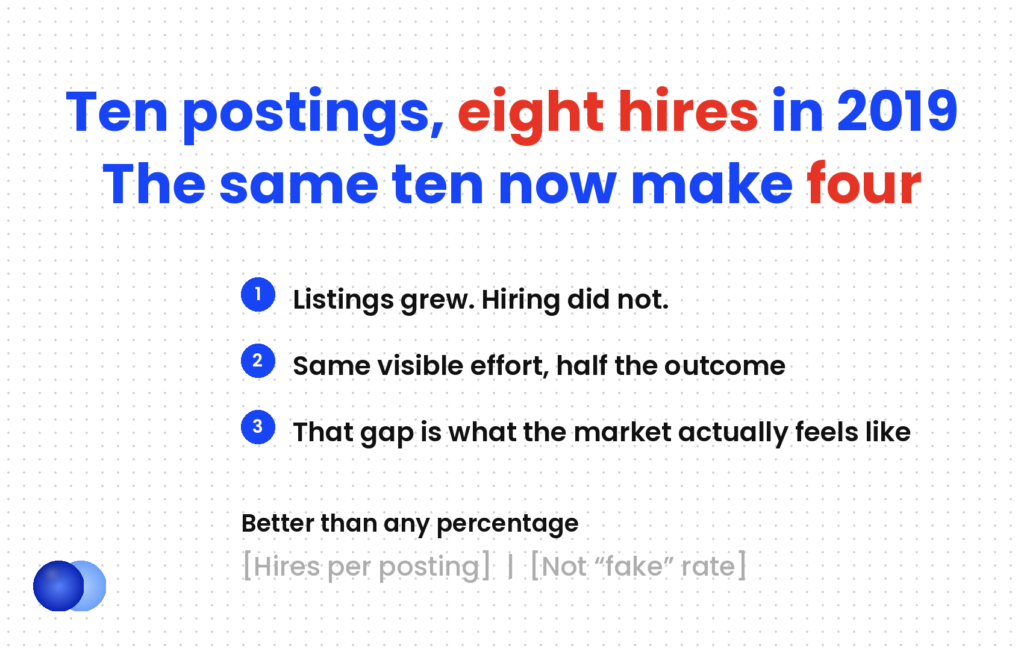
Hires per posting have halved since 2019, from roughly eight per ten postings to four per ten, according to Columbia Law Review research. The volume of listings grew while the volume of hiring did not, which is why the market feels far worse than the unemployment rate suggests.
That ratio is the quiet number underneath the whole ghost-job argument, and it is more informative than any percentage of “fake” listings.
It reframes the experience. If you are applying steadily and hearing very little, you are not necessarily doing anything wrong and you are not necessarily unqualified. You are operating in a market where the same visible effort produces about half the hiring outcome it did in 2019.
Greenhouse also found roughly 70% of companies on its platform posted at least one ghost job in a single quarter, and for about 15% of clients the practice was routine — with half of that group’s listings going unfilled. The problem is concentrated. Most employers do it occasionally; a minority does it constantly.
How do you spot a fake job posting?
Check the posting age against the roughly 41-day average time to fill, look for the same role reappearing on a cycle, and read for missing specifics — no named team, no scope for the first six months, no salary range. Then verify at the source.
Three signals are worth reading before you invest any time:
Age. The average US posting fills in about 41 days. A listing that has been live for more than 30 days with no visible activity deserves suspicion; one that has been up for three months is very unlikely to be urgent.
Repetition. Search the exact job title plus the company name. If the same role has resurfaced every quarter for a year, it is a pipeline listing regardless of what the description says.
Vagueness. Genuine postings written by someone who needs the role filled contain specifics: the team, the manager or reporting line, what the first six months involve, a salary range. Generic scope with no deliverables usually indicates low urgency or a listing nobody owns.
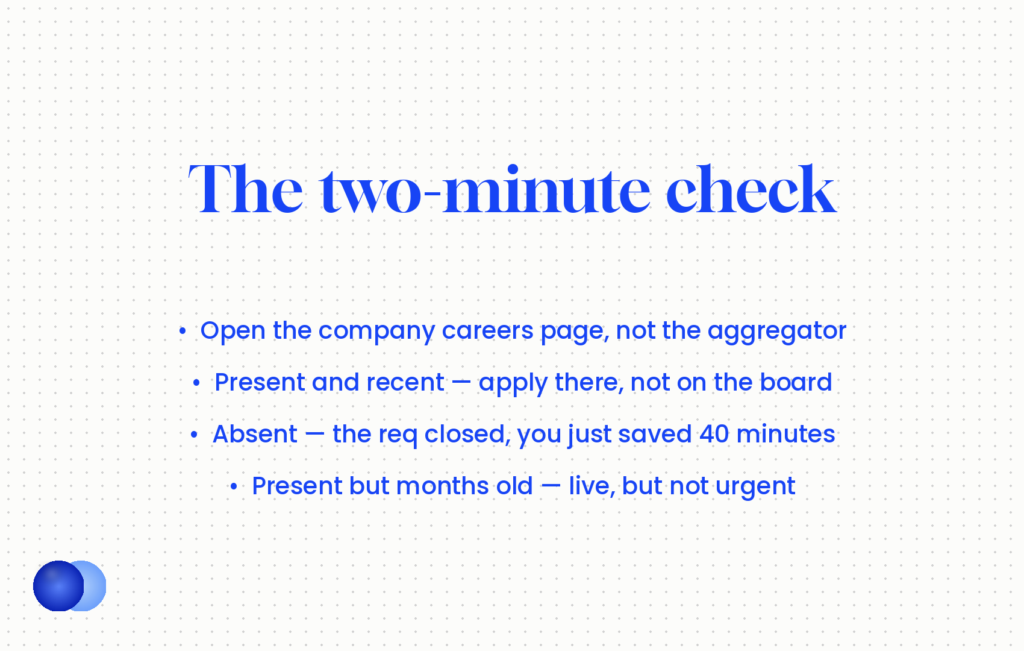
Open the company's own careers page — not LinkedIn, not Indeed — and search the job title there.
Present, with a recent date: the role is live at the source. Apply through that page rather than the aggregator.
Absent: the req was closed and the aggregator has stale data. You just saved yourself forty minutes.
Present but months old: live but not urgent. Apply if it fits, but do not build your week around it.
This one check resolves the aggregator lag problem, the stale-listing problem and most of the deliberate-ghost problem at once.
Two secondary checks are worth running when a role really matters to you. Look at whether the team is actually growing — a company that genuinely needs a fifth data analyst usually hired the fourth one recently, and that is visible on LinkedIn. And check for a verification badge where the platform offers one; LinkedIn now tags more than half its listings as verified, and Greenhouse clients can display a badge on confirmed openings.
Keep a short list of companies you would genuinely join, check their careers pages directly, and apply the same week a role appears. Freshness beats volume by a wide margin in a market with this much stale inventory.
Respond to a ghost-job market by applying to more things. Greenhouse found 38% of job seekers now mass-apply, which raised recruiter workload 26% in a single quarter — making every real application harder to see, including yours.
Does applying to more jobs help?
No — it makes the problem worse in both directions. Mass applying raises recruiter workload, which slows responses to everyone, and it spreads your effort so thin that each application is generic. Fewer, verified, well-targeted applications outperform volume in a market this noisy.
The instinctive response to a market containing ghost jobs is to send more applications, on the theory that volume compensates for waste. It does the opposite, for two reasons.
The first is arithmetic on the employer side. When 38% of job seekers mass-apply, recruiter workload rises — Greenhouse measured a 26% increase in a single quarter — and the screening gets harsher and slower for everybody, including the candidates who were a genuine fit.
The second is quality on your side. Applications compete on specificity: whether your wording matches the posting, whether your experience is legible in the first seven seconds a person spends on it. That is exactly the thing volume destroys. Running your file through an AI resume checker against each verified posting takes ten minutes and moves the number that actually filters you — which is a better use of an hour than eight more applications into unverified listings.
Greenhouse also reported that 72% of job seekers say the application process is difficult to sustain. Ghost jobs make that worse in a specific way: effort that produces no response at all gives you nothing to learn from. Verification is worth doing partly because it protects your time, and partly because it means the silence you do get is at least real information.

Nearly 70% of companies on the platform posted at least one ghost job in a single quarter. For about 15% of clients it was routine — and half of that group's listings went unfilled.
Is posting a ghost job illegal?
Mostly not. In most of the United States, posting a role you do not intend to fill is not itself unlawful, which is why the practice persists. Ontario's law taking effect in January 2026 requires employers to disclose whether a role is actively being recruited for, and similar proposals exist at the US federal level.
The absence of consequence is the whole mechanism. Posting costs almost nothing, syndicates to every board in one click, and carries no penalty when the role never existed. Platforms have started responding with verification badges, which is a market answer rather than a legal one.
Ontario’s disclosure requirement, effective January 2026, is the first substantial legal move: employers must tell applicants where they stand rather than leaving postings and candidates in indefinite limbo. Whether that model spreads is an open question, and it is worth watching if you are job searching in a jurisdiction considering something similar.
Until then, the practical position is unchanged: you cannot control the supply of ghost jobs, only how much of your time reaches them.
Where this fits with everything else about applying
Verification is the step before every other step. A perfect application to a dead listing scores zero, so confirm the role is live at the source first, then spend the effort on parsing, wording and preparation.
There is a natural order to this, and ghost jobs sit at the front of it.
Verify the posting is real. Then make sure your file can actually be read and that its language matches the posting — which is what an AI resume checker measures, and where most applications quietly fail. If the screen that follows is automated, an AI video interview and an AI recruiter phone interview each score different things and reward different preparation.
Every stage after verification rewards specificity: real projects, real numbers, the employer’s own vocabulary for work you genuinely did. That holds whether the reader is a parser, a voice agent, or a person. But none of it counts if the listing was never live, which is why two minutes on the company’s careers page is the highest-return habit in a job search right now.
Once you have a verified role worth pursuing, the resume examples library shows how a strong page one is structured by role, and interview preparation is where a real opening finally turns into a conversation.
Frequently asked questions
What are ghost jobs?
Ghost jobs are listings that remain public while the employer has no active intention of filling the role soon. They include pipeline building, growth signalling, compliance postings for pre-selected internal candidates, and stale listings nobody removed.
What percentage of job postings are ghost jobs?
Estimates range from roughly one in seven to about 27%, with outlier claims near 47%. Greenhouse's platform data puts it at 18–22% and Glassdoor's analysis at up to 21%, so roughly one in five is the defensible figure.
Why do the ghost job statistics disagree so much?
Because they measure different things. Platform data measures posting behaviour, listing analyses measure characteristics, and surveys measure what HR staff will admit. "18–22% of postings" and "45% of HR professionals" are answers to different questions, not contradictions.
How can I tell if a job posting is fake?
Open the company's own careers page and search the title there. If the role is absent, the aggregator listing is stale. Also check the posting age against the roughly 41-day average time to fill, and whether the same role reappears every few months.
Why do companies post ghost jobs?
Pipeline building for future openings, signalling growth to investors and rankings, compliance requirements when an internal candidate is already selected, and simple neglect. In most of the US there is no legal penalty, so nothing forces the practice to stop.
Is it illegal to post a job you don't intend to fill?
In most of the United States, no. Ontario's law taking effect in January 2026 requires employers to disclose whether a role is actively being recruited for, and similar federal proposals exist in the US but have not passed.
Should I still apply if I suspect a ghost job?
Only if the role genuinely fits and the effort is low. A tailored application to an unverified listing is the worst use of your time; a verified role that fits you is worth forty minutes of tailoring.
Does applying to more jobs help in a market with ghost jobs?
No. Greenhouse found 38% of job seekers now mass-apply, raising recruiter workload 26% in a single quarter, which slows responses for everyone. Fewer verified, well-targeted applications outperform volume.



Comments