Naomi Feldman High-Dosage Mathematics Tutor, CRLA Level 2 Philadelphia, 19104, United States [email protected] · (215) 555-0184
11 September 2026
Ms. Adaeze Okonjo Programme Director Riverline Scholars Philadelphia, United States
Application for High-Dosage Mathematics Tutor, Riverline Scholars
Dear Ms. Okonjo,
I am applying for the High-Dosage Mathematics Tutor position with the Riverline Scholars programme. I have spent four years doing exactly this work in Title I middle schools: groups of three, four sessions a week, during the school day, across a full academic year.
At Keystone I carry a fixed caseload of 36 students in Grades 6 to 8. The sessions are planned weekly with the two Grade 7 mathematics teachers and follow the classroom's Illustrative Mathematics unit sequence rather than running a separate curriculum alongside it, which is the change that made the difference. Over the last two academic years my caseload averaged 8 points of NWEA MAP growth above the district median. The number I am more proud of is attendance: 91% against a programme average of 78%, which came from a five-minute check-in routine and calling families myself rather than routing it through the school office.
I read that Riverline is expanding from four schools to nine this year. Holding group size and attendance through that kind of growth is the hard part, and it is where most programmes lose their effect. I have been through one expansion already and would want to work on the scheduling side of it, since in-day placement is what everything else depends on.
I hold CRLA Level 2 training, my Pennsylvania child protection clearances are current, and I can start with the autumn term. Thank you for your time.
Sincerely, Naomi Feldman
Summary
A tutor cover letter says which of the six kinds of tutoring you do, at what group size and frequency, and what moved. This guide gives you a full adaptable letter, what changes between a school programme, a learning centre and private clients, and why dosage is the language that gets you hired.
Tutor cover letter examples by experience level
A tutor cover letter is a one-page letter that says which kind of tutoring you do, at what dosage, and what changed for the students you did it with.
Almost every tutoring letter in a folder says the writer enjoys helping students learn. That is not a differentiator, it is the entry condition. What separates one applicant from twenty is whether they can describe the conditions they worked under precisely enough for a coordinator to picture the sessions.
Guide to a tutor cover letter
This guide and the corresponding tutor cover letter example will cover:
- How to structure the letter, paragraph by paragraph
- Why dosage is the language this field hires in
- What changes between a school programme, a learning centre and private clients
- What counts as a result when you have no test data
- Length, format and sending it
How to write a tutor cover letter
| Paragraph | Its job | Length |
|---|---|---|
| Opening | The role, the kind of tutoring, the subject and level | 2 to 3 sentences |
| Evidence | Group size, frequency, duration, caseload, and one outcome | 4 to 5 sentences |
| Fit | Something specific about their programme, and what you would work on | 3 sentences |
| Close | Training, clearances, availability, thank you | 2 sentences |
Dosage is the vocabulary that gets you hired
A meta-analysis of 96 randomised trials put the average tutoring effect at 0.37 standard deviations, with teacher tutors at 0.50, paraprofessionals at 0.40 and volunteers at 0.21 (Nickow, Oreopoulos and Quan, NBER Working Paper 27476, July 2020).
A 2026 meta-analysis of 263 trials found that the effect falls sharply as programmes grow: 0.51 for programmes under 100 students, down to 0.16 at 1,000 or more, because group sizes rise and dosage falls (Kraft, Schueler and Falken, Review of Educational Research, June 2026).
Anyone coordinating a tutoring programme knows this, and it is the problem they spend their week on. A letter that says "groups of three, four sessions a week, during the school day, across a full academic year" is speaking to that problem directly. A letter that says "extensive tutoring experience" is not.
A tutor cover letter example you can adapt
Dear Ms. Okonjo,
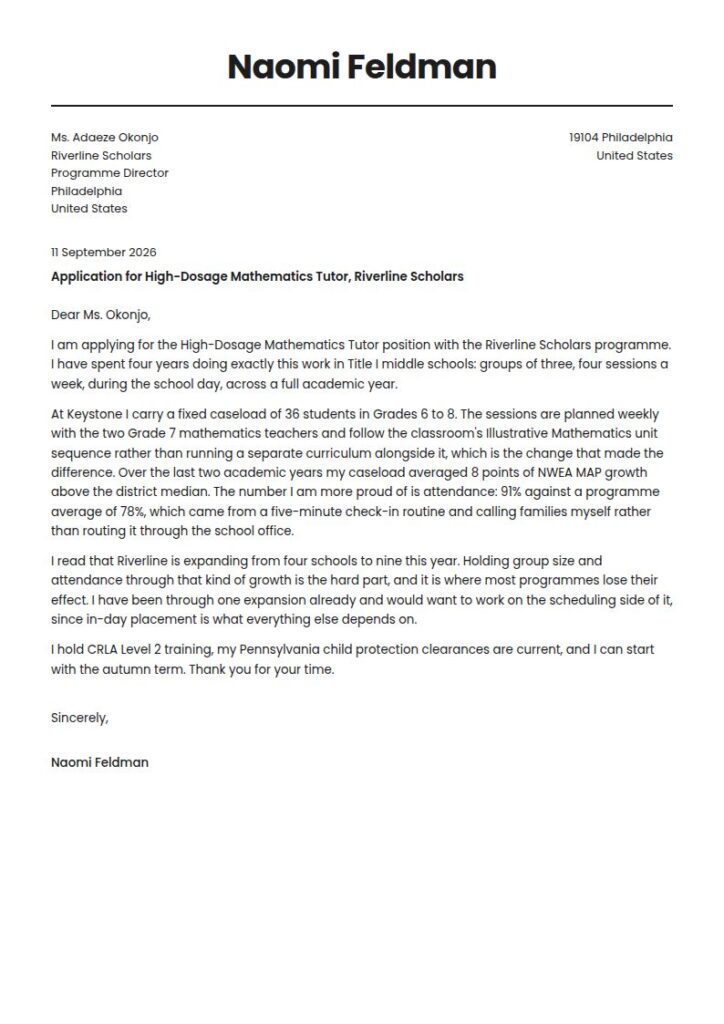
I am applying for the High-Dosage Mathematics Tutor position with the Riverline Scholars programme. I have spent four years doing exactly this work in Title I middle schools: groups of three, four sessions a week, during the school day, across a full academic year.
At Keystone I carry a fixed caseload of 36 students in Grades 6 to 8. The sessions are planned weekly with the two Grade 7 mathematics teachers and follow the classroom's Illustrative Mathematics unit sequence rather than running a separate curriculum alongside it, which is the change that made the difference. Over the last two academic years my caseload averaged 8 points of NWEA MAP growth above the district median. The number I am more proud of is attendance: 91% against a programme average of 78%, which came from a five-minute check-in routine and calling families myself rather than routing it through the school office.
I read that Riverline is expanding from four schools to nine this year. Holding group size and attendance through that kind of growth is the hard part, and it is where most programmes lose their effect. I have been through one expansion already and would want to work on the scheduling side of it, since in-day placement is what everything else depends on.
I hold CRLA Level 2 training, my Pennsylvania child protection clearances are current, and I can start with the autumn term. Thank you for your time.
Sincerely, Naomi Feldman
Openings that work
| Instead of | Use |
|---|---|
| I have a passion for helping students succeed academically | I have spent four years in high-dosage tutoring: groups of three, four sessions a week, in-day |
| I am writing to apply for the tutoring position | I am applying for the High-Dosage Mathematics Tutor position with Riverline Scholars |
| I have tutored students of all ages in many subjects | I carry a fixed caseload of 36 students in Grades 6 to 8 mathematics |
| I am reliable, patient and hard-working | Session attendance held at 91% against a programme average of 78% |
What counts as a result
| Kind of evidence | What it looks like in a sentence |
|---|---|
| Growth on a shared assessment | The caseload averaged 8 points of MAP growth above the district median |
| Attendance | Session attendance held at 91% against a programme average of 78% |
| Retention | 78% repeat-appointment rate against a centre average of 61% |
| Tier movement | 12 students entered as Tier 3; all 12 exited to Tier 2 by spring |
| Test preparation | 8-week SAT courses for cohorts of six; average section gain 74 points across three cohorts |
| Grades | All three students in the group moved up a course grade band across the year |
School programme, learning centre, or private clients
For a school-based or high-dosage post, lead with dosage and the paraprofessional route you meet, and mention alignment to the classroom curriculum, because coordinators are judged on whether tutoring reinforces instruction rather than competing with it. For a learning centre or agency, lead with throughput and retention: students per week, repeat bookings, parent communication. For private clients, lead with outcomes and referrals, and say plainly which subjects and levels you take. For a college learning centre, lead with your CRLA level and the hours behind it.
Do not name a student or a family anywhere, including in a quoted testimonial. Do not claim a score gain you did not see documented. Do not send a private rate card to an employer. Do not write "various subjects and all ages", which tells a scheduler nothing. Do not describe your love of teaching in the opening; it costs you the two sentences that matter most.
The money behind school tutoring has changed, and the letters should too
More than 40% of districts, and two thirds of the largest systems, planned to spend federal pandemic relief money on tutoring, an estimated $3.6 billion nationally (FutureEd, Georgetown University, April 2022). The obligation deadline for that money was 30 September 2024.
What replaced it is uneven: 23 states offer grant or formula funding districts can direct toward high-impact tutoring, 5 require it for particular student groups, and one has folded it into ongoing formula funding (National Student Support Accelerator, April 2025).
Household demand, meanwhile, held steady: 19% of parents said their child was receiving tutoring in October 2025, with another 24% looking (EdChoice, November 2025).
The practical consequence for your letter: a school programme coordinator is now defending a budget line every year, so evidence of measurable growth is not a nice extra, it is what keeps their programme alive. Give them a number they can put in a report.
Length, format and sending it
One page, four paragraphs, 250 to 350 words. PDF unless the portal says otherwise, named for yourself and the role: naomi-feldman-high-dosage-math-tutor-cover-letter.pdf.
Keep the same dosage and outcome figures as your resume so the documents agree. Our tutor resume example uses the numbers in this letter.
Key takeaways
- Name which of the six kinds of tutoring you do, in the first sentence.
- Give group size, sessions per week and weeks sustained.
- Use the assessment the employer already uses, by name.
- Include attendance or retention; those are the operational numbers coordinators live on.
- Say what you would work on in their programme, not what you admire about it.
- State clearances and training with dates.
- Never name a student, and never claim a gain you did not see documented.
Write your tutor cover letter in 10 minutes.
Tutor cover letter questions, answered
How long should a tutor cover letter be?
One page, four paragraphs, 250 to 350 words. Many tutoring applications go through a coordinator screening dozens of files for a start date a fortnight away, so the first two sentences do most of the work.
Do I need a cover letter for an online tutoring platform?
Usually not, since most platforms screen with a subject test and a trial lesson instead. Where there is a free-text field, use it for the same content in shorter form: subjects, levels, formats, hours delivered, rating and repeat-booking rate.
What do I write with no paid tutoring experience?
Write the unpaid work with full dosage detail. A volunteer group of three, twice a week, for 28 weeks, is a stronger claim than a year of casual help, and it is the shape of the work providers hire for. Add any training you have completed, and if you are applying to a school-based role, name the paraprofessional route you meet.
Should I mention my own test scores?
For test preparation work, yes, and prominently. BLS notes that test preparation tutors "usually need to have scored highly on the standardized tests for which they help students prepare" (Occupational Outlook Handbook, August 2026). For other tutoring, leave them out; they are not what is being assessed.
How do I write about a student I helped without identifying them?
Describe the group and the change, never the person. "Twelve students entered as Tier 3 and all twelve exited to Tier 2 by spring" describes your work. A story with a name, a grade and a teacher in it describes a child, in a document that will be forwarded around an office.