Priya Raghunathan Teaching Professional, Trackman Certified Scottsdale, 85254, United States [email protected] · (480) 555-1111
17 September 2026
Mr. Callum Ferriday Director of Instruction Ocotillo Wells Golf Club Chandler, United States
Application for Teaching Professional, Ocotillo Wells Golf Club
Dear Mr. Ferriday,
I am applying for the Teaching Professional post at Ocotillo Wells Golf Club. I currently teach around 720 lesson hours a year at a private club in Scottsdale, and of the 34 students who completed a full season of scheduled lessons last year, 26 lowered their Handicap Index, an average reduction of 3.4 taken from their own GHIN records at season open and close.
The way I get there is the part I would bring with me. Every student gets a Trackman baseline at intake and review sessions at week six and week twelve, and a written report after each session with club speed, ball speed, smash factor, carry and carry side. Reporting the lateral number alongside the distance number changes what students practice: in a twelve week driver block with 15 mid handicap players, average carry side dispersion narrowed from 31 to 19 yards while average carry barely moved, and those were the players whose scores came down.
I saw that Ocotillo Wells has added a second teaching bay and runs a junior program on Saturday mornings. I rebuilt a junior pathway around measured benchmarks rather than age groups at my current club, taking enrollment from 24 to 61 across three seasons, and I would want to do the same here. I can run both bays unsupervised, including calibration.
I am Trackman certified, hold Titleist Performance Institute Level 1, and can start in time for the winter schedule. Thank you for your time.
Sincerely, Priya Raghunathan
Summary
A golf instructor cover letter gives a director of instruction one measured result, names the device that measured it, and says what you would run at their facility. This guide gives you a full adaptable letter, how to quote handicap index movement without overstating it, and the openings that get a file read.
Golf Instructor cover letter examples by experience level
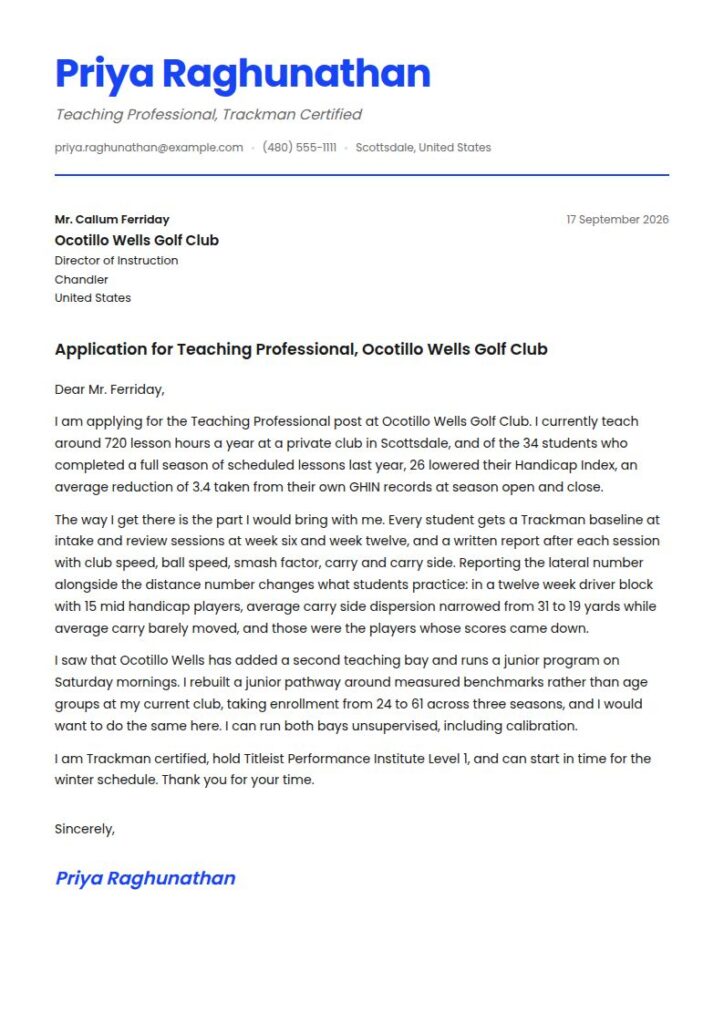
A golf instructor cover letter gives a director of instruction one measured result, names the instrument that produced it, and says what you would run at their facility.
Directors hire in a short window before a season, from a stack of letters that all say the same thing. The one opening with a number they could verify is remembered by the second paragraph.
Guide to a golf instructor cover letter
This guide and the golf instructor cover letter example below will cover:
- How to structure the letter, paragraph by paragraph
- Why one measured result beats a list of everything you teach
- How to quote handicap index movement without overstating it
- What changes between a private club, a public facility and an academy
- The openings that get a file read
How to write a golf instructor cover letter
| Paragraph | Its job | Length |
|---|---|---|
| Opening | The post, your teaching volume, one measured result | 2 to 3 sentences |
| Evidence | The cohort, the baseline, the device, the period, the change | 4 to 5 sentences |
| Fit | Something specific about their facility, and what you would run | 3 to 4 sentences |
| Close | Certification and availability | 2 sentences |
One number, fully specified, beats five half numbers
The instinct is to list everything: beginners, juniors, short game, on course, club fitting, simulator work. A director reads that as an applicant who has not decided what they are good at.
Give one result instead, with everything needed to test it: how many students, over what period, measured how. "Of the 34 students who completed a full season of scheduled lessons last year, 26 lowered their Handicap Index, an average reduction of 3.4, taken from their own GHIN records at season open and close."
That names the cohort, the period, the measure and the source. It is also conservative: the USGA states that a Handicap Index averages "your 8 best Score Differentials out of your most recent 20, which means 12 of your last 20 scores are not used in the calculation" (USGA, usga.org, retrieved 17 September 2026). Any movement you report has already discarded the student's worst rounds.
A golf instructor cover letter example you can adapt
Dear Mr. Ferriday,
I am applying for the Teaching Professional post at Ocotillo Wells Golf Club. I currently teach around 720 lesson hours a year at a private club in Scottsdale, and of the 34 students who completed a full season of scheduled lessons last year, 26 lowered their Handicap Index, an average reduction of 3.4 taken from their own GHIN records at season open and close.
The way I get there is the part I would bring with me. Every student gets a Trackman baseline at intake and review sessions at week six and week twelve, and a written report after each session with club speed, ball speed, smash factor, carry and carry side. Reporting the lateral number alongside the distance number changes what students practice: in a twelve week driver block with 15 mid handicap players, average carry side dispersion narrowed from 31 to 19 yards while average carry barely moved, and those were the players whose scores came down.
I saw that Ocotillo Wells has added a second teaching bay and runs a junior program on Saturday mornings. I rebuilt a junior pathway around measured benchmarks rather than age groups at my current club, taking enrollment from 24 to 61 across three seasons, and I would want to do the same here. I can run both bays unsupervised, including calibration.
I am Trackman certified, hold Titleist Performance Institute Level 1, and can start in time for the winter schedule. Thank you for your time.
Sincerely, Priya Raghunathan
Openings that work
| Instead of | Use |
|---|---|
| I have a lifelong love of the game and a desire to share it | I teach around 720 lesson hours a year at a private club in Scottsdale |
| I am an experienced instructor who works with golfers of all levels | Of 34 students completing a full season, 26 lowered their Handicap Index |
| I use the latest technology to improve my students' swings | Every student gets a Trackman baseline at intake and review at week six and week twelve |
| I would love the opportunity to join your team | I saw that Ocotillo Wells has added a second teaching bay |
Each row replaces something about you with something measured about a student.
What counts as evidence for a golf instructor
| Kind of evidence | What it looks like in a sentence |
|---|---|
| Outcome | 26 of 34 season students lowered their Handicap Index, average reduction 3.4 |
| Dispersion | Carry side dispersion from 31 to 19 yards across 15 players in twelve weeks |
| Efficiency | Average 7 iron smash factor from 1.19 to 1.28 across 22 adult beginners |
| Program | Junior pathway enrollment from 24 to 61 across three seasons |
| Retention | Rebooking within 90 days of a first paid lesson at 71 percent |
Use the manufacturer's own definitions when you quote a metric. Trackman defines smash factor as "The ratio between the measured ball speed and measured club speed" and carry as "The straight-line distance between where the golf ball was launched from and where it crosses a point that has the same elevation" (Trackman, trackmangolf.com, retrieved 17 September 2026). Say too whether a number came from the bay or from the course; they are not interchangeable and a director will ask.
Private club, public facility, academy
For a private club, lead with retention and the reporting a member receives, because members compare notes. For a public facility, lead with beginner throughput and clinic volume, because that is where the revenue is. For an academy, lead with the measurement protocol and whether you can train other instructors on it. Name the launch monitor by product and say you can run it unsupervised.
Do not name a student or describe a junior by age, school or team. Do not claim an index drop over a window shorter than the index can move in. Do not list every format you have ever taught. Do not quote a bay number as if it were a course number. Do not write a second page.
The checkable number is now the normal case
The USGA reported 3.35 million golfers in the United States holding a Handicap Index in 2024, up 6 percent year over year and roughly 30 percent since 2020, with more than 77 million scores posted and 94.5 percent of those rounds recreational (USGA, usga.org, retrieved 17 September 2026).
Golf instructors are counted by BLS within coaches and scouts: 298,800 jobs in 2025, a projected 6 percent change through 2035, about 36,400 openings a year, and a May 2025 median wage of $47,320 with the highest 10 percent above $98,860 (BLS Occupational Outlook Handbook, Coaches and Scouts, 27 August 2026).
Put those together and the market is clear: a competitive occupation with a wide pay range, whose students now carry a public record of whether instruction worked. An instructor who writes to that record answers the question a director is asking.
Length, format and sending it
One page, four paragraphs, 250 to 400 words. PDF unless the portal says otherwise, named for yourself and the post: priya-raghunathan-teaching-professional-cover-letter.pdf.
Address a person. Staff pages name the director of instruction and the head professional at almost every facility, and a letter addressed to nobody reads as one sent to eleven clubs.
Keep the numbers identical to your resume. Our golf instructor resume example uses the same figures, and you can check the pair with the free ATS checker.
Key takeaways
- Open with teaching volume and one measured result.
- Specify the cohort, the period, the measure and its source.
- Name the launch monitor by product and say you can run it alone.
- Report dispersion as well as distance.
- Say whether a number is from the bay or the course.
- Name one real thing about their facility from their own pages.
- Never identify a student; write the group and the number.
Write your golf instructor cover letter in 10 minutes with our AI cover letter builder.
Golf instructor cover letter questions, answered
How long should a golf instructor cover letter be?
One page, four paragraphs, 250 to 400 words. Directors read these in a short window before a season, and a long letter is read less carefully.
Should I include my own handicap index?
Include it if it is strong, because it is the one thing about you a director can check immediately. Leave it out entirely if it is not. What does not work is a vague phrase such as "low handicap", which directors read as a number the writer chose not to give.
How do I write a result without identifying a student?
Write cohorts. "Of 34 students completing a full season, 26 lowered their Handicap Index, average reduction 3.4" identifies nobody and says more than any individual story. Below about five students a group starts to identify people at a small club, so aggregate further or omit the figure.
What if my facility does not have a launch monitor?
Then say what you do measure and how you record it: scoring averages, up and down percentage from a defined distance, putts per round, completed block rates, or handicap index movement from GHIN. The point is a documented baseline and review, not a particular instrument. If you have been trained on a device elsewhere, name it and say you can run it unsupervised.
How fast can a student's handicap index realistically move?
Not fast, and saying so correctly is itself a signal. The USGA states that a Handicap Index is "updated the day after a score is posted" and, with twenty scores on file, averages the best 8 Score Differentials of the most recent 20 (USGA, usga.org, retrieved 17 September 2026). Enough new rounds must be posted for eight of twenty to change, so quote a season, not a lesson block.