Summary
A well-structured nurse resume is your first step toward landing an interview and ultimately securing your dream nursing role. Whether you are just starting out or have years of experience, tailoring a resume that showcases your skills, achievements, and dedication to patient care is essential. In this guide, we will explore the most critical sections to include in your nurse resume, offer expert tips for making each section shine, and show you how to leverage special features—like Expert Tip and ADAPTABLE SUMMARY EXAMPLE—to craft a standout application.
Why a Strong Nursing Resume Matters
Nursing is a highly competitive field. With many qualified applicants vying for the same roles, your nurse resume needs to set you apart. A strong resume:
- Highlights your clinical skills in a concise, easy-to-read format.
- Communicates your passion for patient care and your dedication to healthcare excellence.
- Demonstrates your adaptability to different medical settings and patient populations.
- Reflects your professionalism to potential employers, showing that you are serious about your career.
By following a clear, strategic format, you can present your experience in a way that resonates with hiring managers—helping them quickly see why you would be a valuable asset to their team.
Key Sections of a Professional Nurse Resume
A winning nurse resume typically includes the following sections:
- Contact Information
- Full Name
- Phone Number
- Professional Email Address
- City/State (optional or if relevant)
- LinkedIn or Professional Portfolio (if applicable)
- Professional Summary
- A concise overview of your experience, areas of expertise, and career goals.
- Use action-oriented language that highlights your achievements and expertise in patient care.
- Skills & Areas of Expertise
- List hard skills (e.g., wound care, IV insertion, patient assessment) and soft skills (e.g., communication, teamwork, empathy).
- Highlight any specialized skills such as critical care, neonatal care, or oncology.
- Work Experience
- List your positions in reverse chronological order (most recent first).
- Include facility names, locations, employment dates, and job titles.
- Use bullet points focusing on achievements, responsibilities, and outcomes.
- Quantify achievements whenever possible (e.g., “Managed a caseload of 15+ patients daily”).
- Education
- Include nursing degrees and relevant certifications.
- Note the institution name, degree type, and graduation year.
- Mention academic honors if they’re significant to your role.
- Certifications & Licenses
- RN license details (along with any state-specific license numbers).
- Specialized certifications (e.g., BLS, ACLS, PALS).
- Mention expiration dates and licensing boards when relevant.
- Additional Sections (Optional)
- Awards & Honors: Showcase professional recognitions or nursing-related accolades.
- Affiliations: List membership in professional organizations (e.g., ANA, ENA).
- Languages: Note any foreign language proficiency, especially if relevant to patient demographics.
Keep it concise. Recruiters and hospital administrators spend only a few seconds scanning each resume. Use brief bullet points with impactful language to showcase the most important details.
Crafting a Powerful Summary for Your Nurse Resume
Your professional summary is the first real impression employers have of you. Make those first few lines count by emphasizing your most relevant accomplishments and the unique value you bring.
Registered Nurse with 5+ years of acute care experience providing compassionate patient care across medical-surgical and intensive care units. Recognized for reducing patient wait times by 20% through streamlined triage processes. Committed to excellent clinical care and patient education to improve treatment compliance and overall satisfaction.
Feel free to adjust the details in the bracket to your specific qualifications, experience level, and area of expertise.

Highlighting Your Nursing Skills & Expertise on a Resume
Hiring managers often use Applicant Tracking Systems (ATS) to scan for relevant keywords. Therefore, focusing on the key skills for each specific nursing job is crucial. Review the job description carefully and incorporate the same or similar phrasing in your resume.
Examples of Nursing Skills
- Clinical Skills: Patient assessment, IV therapy, wound dressing, EHR (Electronic Health Records) documentation, care planning
- Soft Skills: Communication, leadership, empathy, attention to detail, teamwork
- Technical Proficiencies: Familiarity with hospital management software, data entry skills, knowledge of specific medical devices
Work Experience on a Nurse Resume: Emphasize Achievements
When listing your work experience, use bullet points to highlight not just your duties but also your accomplishments. Employers want to see how you made an impact in previous roles.
Sample Bullet Points
- Implemented a new triage protocol that decreased patient admission times by 15%.
- Collaborated with interdisciplinary teams to develop care plans for patients with chronic illnesses, achieving a 10% reduction in hospital readmissions.
- Trained and supervised a team of 8 newly hired RNs and CNAs, ensuring compliance with hospital standards and state regulations.
Quantify whenever possible. Numbers give credibility to your claims and demonstrate the tangible results of your efforts—whether that’s improving patient outcomes, streamlining processes, or reducing costs.
Education, Licenses & Certifications for a Nursing Resume
In addition to your degree(s), detail your nursing license information—including state and license number if required in your region. List any certifications such as BLS (Basic Life Support), ACLS (Advanced Cardiac Life Support), or specialty areas like CCRN (Critical Care Registered Nurse).
ADAPTABLE EXAMPLE
- Associate Degree in Nursing (ADN) | XYZ Community College (2018)
- Bachelor of Science in Nursing (BSN) | ABC University (2021) – Dean’s List (2 semesters)
- RN License (State & License Number), Active through 2025
- BLS & ACLS Certified (American Heart Association), Expires 2024
Using Rezoom to Build Your RN Resume
Building a standout nurse resume can be time-consuming and challenging. Rezoom simplifies the process by offering:
- Customizable Nurse Resume Templates that align with industry best practices.
- Pre-written Bullet Points & Phrases tailored to various nursing specialties.
- Expert Tips & Guidance embedded in the resume builder, ensuring your resume meets ATS criteria.
- Real-time Suggestions & Feedback so you can continuously refine and optimize your resume.
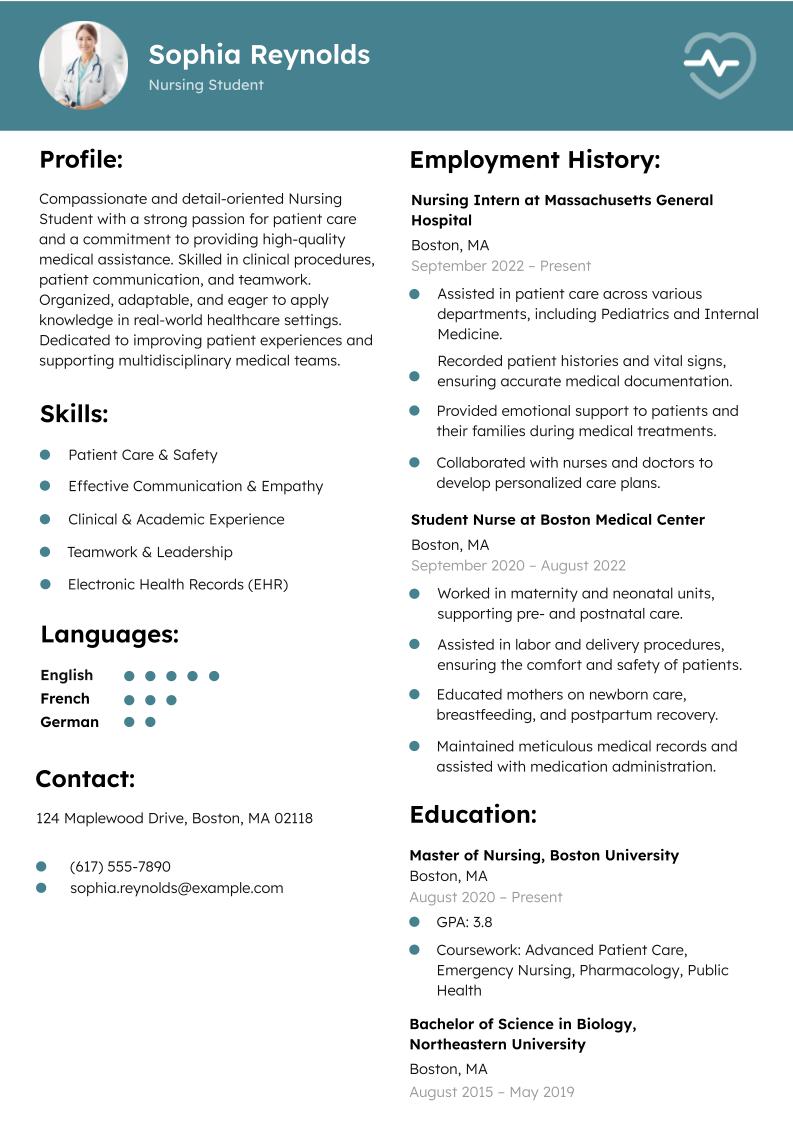
Nursing Student Resume Examples & Templates
In the competitive field of nursing, a well-crafted resume serves as your first impression to potential employers. Nursing Student resume examples offer valuable templates and inspiration, helping…
For more preparation strategies, visit our Nurse Interview Questions.

Final Checks: Proofreading & Formatting for Your Nurse Resume
A polished, error-free nurse resume speaks to your attention to detail, which is critical in the nursing profession. Make sure to:
- Use a clean, professional font (e.g., Arial, Calibri, or Times New Roman).
- Keep margins consistent.
- Double-check spelling, grammar, and punctuation.
- Use consistent bullet points and spacing.
If you need additional guidance on professional standards and continuing education, check out the American NursesAssociation (external link) for up-to-date resources.

Conclusion
A Nurse resume that clearly communicates your expertise, accomplishments, and commitment to patient care can open doors to new opportunities in hospitals, clinics, and other healthcare settings. By focusing on clarity, quantifying your achievements, and using modern tools like Rezoom, you’ll stand out to employers and recruiters. Combine well-crafted bullet points, compelling summaries, and strategic keywords for maximum impact.
Remember: the key to success is to keep refining your resume. Adapt it for each specific role and highlight the most relevant parts of your background. Good luck with your nursing career!