Correctional Officer, Florida CJSTC Certified Darnell Whitfield
Detention Deputy
[email protected] | (352) 555-0134 | Ocala, United States
Profile
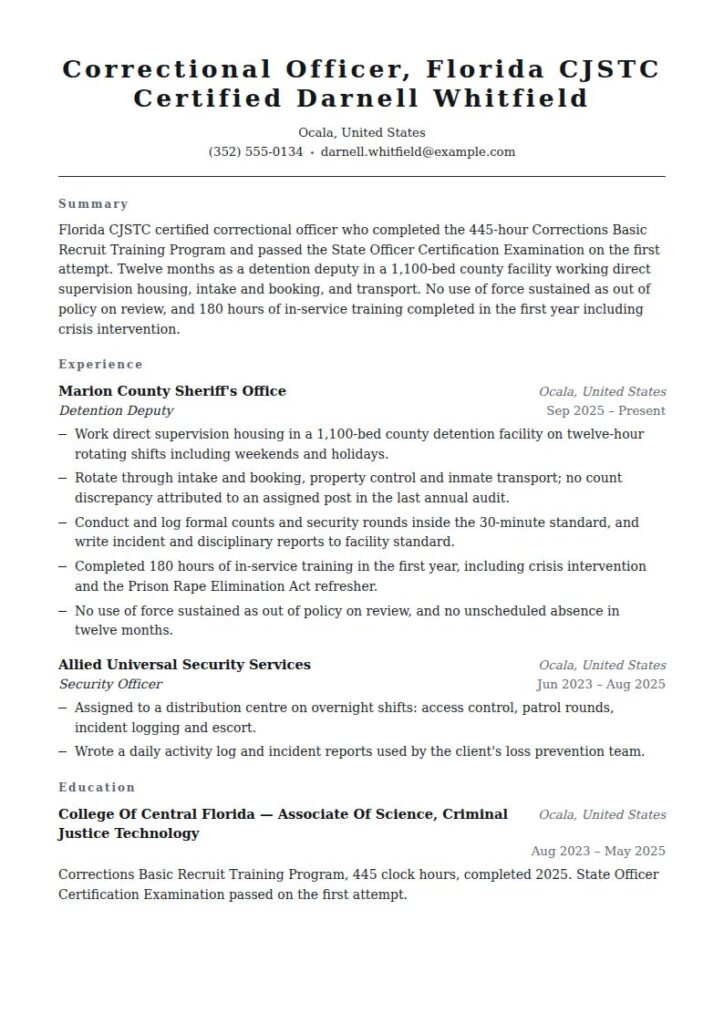
Florida CJSTC certified correctional officer who completed the 445-hour Corrections Basic Recruit Training Program and passed the State Officer Certification Examination on the first attempt. Twelve months as a detention deputy in a 1,100-bed county facility working direct supervision housing, intake and booking, and transport. No use of force sustained as out of policy on review, and 180 hours of in-service training completed in the first year including crisis intervention.
Work Experience
09/2025 - Present, Detention Deputy, Marion County Sheriff's Office, Ocala, United States
- Work direct supervision housing in a 1,100-bed county detention facility on twelve-hour rotating shifts including weekends and holidays.
- Rotate through intake and booking, property control and inmate transport; no count discrepancy attributed to an assigned post in the last annual audit.
- Conduct and log formal counts and security rounds inside the 30-minute standard, and write incident and disciplinary reports to facility standard.
- Completed 180 hours of in-service training in the first year, including crisis intervention and the Prison Rape Elimination Act refresher.
- No use of force sustained as out of policy on review, and no unscheduled absence in twelve months.
06/2023 - 08/2025, Security Officer, Allied Universal Security Services, Ocala, United States
- Assigned to a distribution centre on overnight shifts: access control, patrol rounds, incident logging and escort.
- Wrote a daily activity log and incident reports used by the client's loss prevention team.
Education
08/2023 - 05/2025, Associate of Science, Criminal Justice Technology, College of Central Florida, Ocala, United States
Corrections Basic Recruit Training Program, 445 clock hours, completed 2025. State Officer Certification Examination passed on the first attempt.
Skills
Direct supervision housing, 70
Intake, booking and property control, 75
Formal count and security rounds, 80
Verbal de-escalation, 70
Incident and disciplinary report writing, 75
Offender management system entry, 65
Languages
English, native
Spanish, beginner
Certificates
07/2025, Florida Correctional Officer Certification, Florida Criminal Justice Standards and Training Commission, FL-CO-318742
Corrections discipline. Active.
01/2026, CPR and First Aid, American Red Cross
Summary
A correctional officer resume is a one to two page document naming your state certification, your academy completion, and the posts you have worked. This guide gives you three adaptable versions, the section that survives a background investigation, and current Bureau of Labor Statistics pay and outlook for a declining occupation.
Correctional Officer resume examples by experience level
A correctional officer resume is a one to two page document that names your state certification, the academy you completed, the facility type you have worked in, and the posts you have stood.
It is also the first document in a screening process, and that is the part most applicants misread. Corrections hiring is a clearance rather than a competition: statutory minimums, a basic abilities test, an academy, a certification exam, a background investigation, a medical examination, a drug screen, and in many agencies a psychological evaluation. The resume's job is to show, in a form an investigator can verify, that you will clear every gate without a surprise.
Resume guide for a correctional officer resume
This guide and the corresponding correctional officer resume example will cover:
- How to write a correctional officer resume, section by section
- Why the file is written for a background investigation, not a manager
- Three adaptable summaries: new officer, experienced officer and supervisor
- How county jail, state prison and federal Bureau of Prisons hiring differ
- What the job market and the pay look like, including the decline
How to write a correctional officer resume
Six sections: contact header, summary, certification and training, employment history with no gaps, education and skills. One page for your first five years, two once you have supervised a shift or carried a specialist post.
Certification comes first because it is a legal gate. In Florida, section 943.13 of the Florida Statutes sets the floor before an agency may employ you: at least 18 years of age for corrections, United States citizenship, a high school diploma or equivalent, no felony conviction and no misdemeanor conviction involving perjury or a false statement, fingerprints processed by the state and the FBI, a passed background investigation including drug testing, and a physical examination (Florida Department of Law Enforcement, 2026).
| Section | What it is answering | Where it goes |
|---|---|---|
| Certification and academy | Can this agency legally put this person on a post? | Under the summary |
| Employment history | Are there gaps an investigator must chase? | Reverse chronological, with months |
| Posts and assignments | What has this person been responsible for? | Inside each role, named |
| Education and training | Which in-service hours are current? | Grouped, with dates |
Account for every month, because an investigator will
A corrections background investigation is a records exercise. The Federal Bureau of Prisons describes its own as law enforcement and criminal record checks, credit verification, and inquiries with previous employers and personal references (Federal Bureau of Prisons, hiring process, 2026). State and county investigators run the same shape of check.
So an unexplained six-month gap becomes a suitability concern. Write months as well as years, and fill gaps with whatever was true: study, caregiving, a seasonal job, deployment. A boring explanation closes the question; silence opens it.
Run the finished file through the free Rezoom ATS resume checker before you submit. Government portals parse the document before a person reads it.
Choosing the best resume format for a correctional officer resume
Reverse chronological, with months. Nothing else survives a background investigation cleanly.
Functional and skills-based formats drop the dates, which is exactly what the file exists to supply. An investigator who cannot build a timeline from your resume will build one from you in an interview instead.
Include your contact information
| ✅ Right | ❌ Wrong |
|---|---|
| Darnell Whitfield | Darnell Whitfield |
| Correctional Officer, Florida CJSTC Certified | Hardworking professional seeking new opportunity |
| Florida Correctional Officer Certification #FL-CO-318742 | Certified officer |
| (352) 555-0134, [email protected], Ocala, FL | (352) 555-0134, [email protected] |
Put the certification number on the page: the agency checks the state registry anyway. Use a plain email address in your own name, since it is read by someone judging suitability.
Make use of a summary
Four lines: certification status, facility type and years, the posts you have covered, and one measured piece of responsibility.
Florida CJSTC certified correctional officer who completed the 445-hour Corrections Basic Recruit Training Program and passed the State Officer Certification Examination on the first attempt. Twelve months as a detention deputy in a 1,100-bed county facility working direct supervision housing, intake and booking, and transport. No use of force sustained as out of policy on review, and 180 hours of in-service training completed in the first year including crisis intervention.
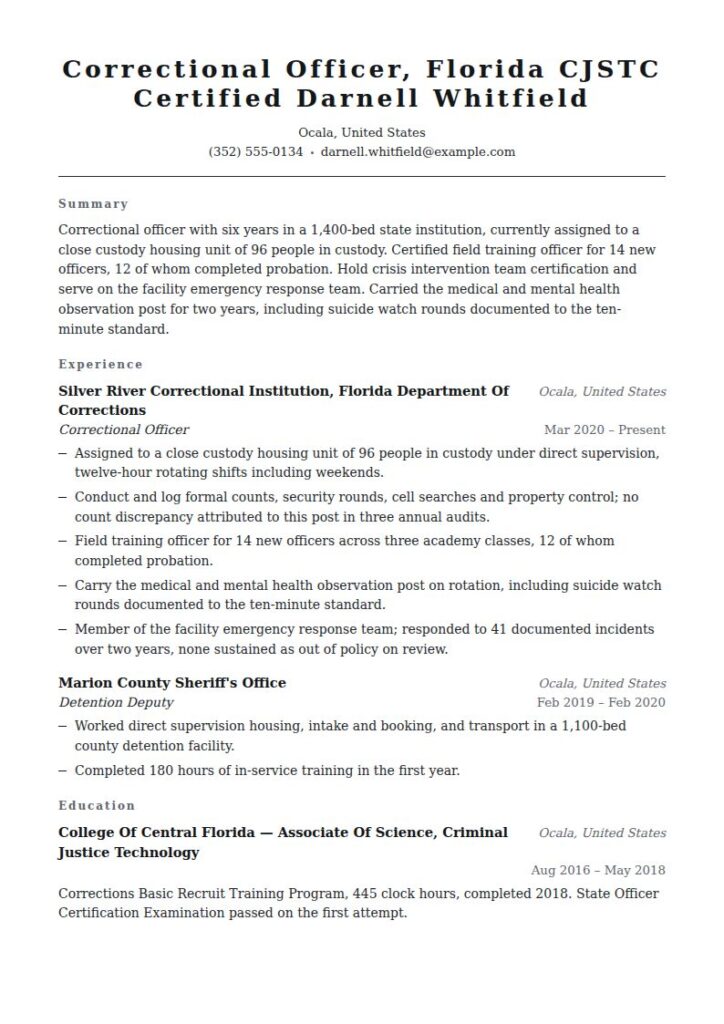
Correctional officer with six years in a 1,400-bed state institution, currently assigned to a close custody housing unit of 96 people in custody. Certified field training officer for 14 new officers, 12 of whom completed probation. Hold crisis intervention team certification and serve on the facility emergency response team. Carried the medical and mental health observation post for two years, including suicide watch rounds documented to the ten-minute standard.
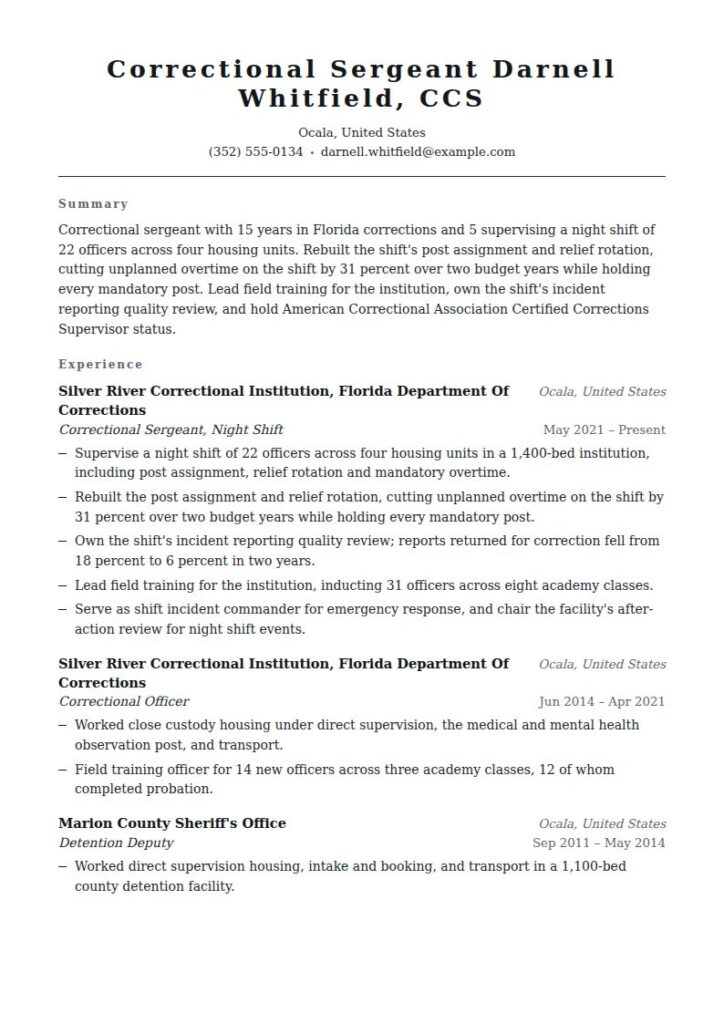
Correctional sergeant with 15 years in Florida corrections and 5 supervising a night shift of 22 officers across four housing units. Rebuilt the shift's post assignment and relief rotation, cutting unplanned overtime on the shift by 31 percent over two budget years while holding every mandatory post. Lead field training for the institution, own the shift's incident reporting quality review, and hold American Correctional Association Certified Corrections Supervisor status.
Right vs wrong: the same correctional officer summary, twice
| ✅ Right | ❌ Wrong |
|---|---|
| Six years in a 1,400-bed state institution, assigned to a close custody unit of 96 people in custody. | Experienced corrections professional with a strong work ethic and a passion for public safety. |
| Field training officer for 14 new officers, 12 of whom completed probation. | Trained new staff and helped them succeed in a challenging environment. |
| Carried the mental health observation post for two years, rounds documented to the ten-minute standard. | Responsible for inmate welfare and facility security at all times. |
The right column can be verified by one phone call to the institution. The left cannot be verified by anything, and an unverifiable claim is treated as noise.
Outline your employment history
Facility, agency, city, custody level, bed count, and dates with months. Then three to five bullets, each naming a post and carrying a number.
| Instead of | Use |
|---|---|
| Supervised inmates in a correctional facility | Worked direct supervision housing for a 64-bed close custody unit, one officer to the unit, twelve-hour shifts |
| Maintained security and order | Logged formal counts four times per shift and security rounds inside the 30-minute standard |
| Responded to incidents | Responded to 41 documented incidents over two years on the facility emergency response team |
| Trained new staff | Field training officer for 14 new officers across three academy classes; 12 completed probation |
Correctional Officer, Silver River Correctional Institution, Florida Department of Corrections, Ocala, FL, March 2020 to Present
Assigned to a close custody housing unit of 96 people in custody under direct supervision, twelve-hour rotating shifts including weekends.
Conduct and log formal counts, security rounds, cell searches and property control; no count discrepancy attributed to this post in three annual audits.
Field training officer for 14 new officers across three academy classes, 12 of whom completed probation, and a member of the facility emergency response team: 41 documented incidents over two years, none sustained as out of policy.
Use neutral, professional language for the people in your custody. Reviewers read this section as a sample of how you write an incident report.
Write the file for the background investigation, not for a hiring manager
This is what separates a corrections resume from every other resume you have written, and why a strong one looks unusually plain. The agency is not asking whether you are the best of forty; it is asking whether you will get through the process without failing a gate. Four things clear a file.
A continuous timeline with months. No gap over thirty days without a line explaining it, and no short job quietly dropped: the investigator finds it on the employment history form anyway, and an omission reads as a discrepancy.
Verifiable employers. Full legal name, city and the supervisor's title, not a nickname for the site. "Contract security at the plant" costs an investigator a week; a named company and site costs a phone call.
Certification written the way the registry writes it. Issuing authority, discipline, number, status. "Corrections certified" leaves the reader guessing which state and whether it is current.
Nothing that contradicts the packet. Rounding seven months to a year, or moving a separation from terminated to resigned, is a suitability finding rather than a typo. Agencies fail more candidates on non-disclosure than on the underlying facts.
The three systems screen on the same things, to different standards:
| County jail | State prison | Federal Bureau of Prisons | |
|---|---|---|---|
| Employer | Sheriff's office or county corrections | State department of corrections | Justice Department, applied for on USAJOBS |
| Share of officers | 40% in local government | 52% in state government | 4% in federal government |
| Median annual wage, May 2025 | $58,500 | $59,990 | $74,630 |
| Age ceiling | Set by state statute, often none | Set by state statute, often none | Appointment before your 37th birthday |
| Population | Mostly pre-trial and short sentences | Sentenced, classified by custody level | Sentenced federal population |
Source: BLS Occupational Outlook Handbook, May 2025 wage data by industry; Federal Bureau of Prisons hiring process, 2026.
The federal route has the hard deadline: initial appointment into Bureau of Prisons law enforcement positions must be prior to your 37th birthday, with narrow exceptions for hard-to-fill professional roles (Federal Bureau of Prisons, 2026). It also adds a physical standard tested at the academy, since new employees attend the Staff Training Academy at the Federal Law Enforcement Training Center in Glynco, Georgia within their first 60 days, where the Physical Abilities Test includes an obstacle course within 58 seconds and dragging a 75-pound dummy 694 feet within three minutes (Federal Bureau of Prisons, 2026).
Build a snapshot of your key skills
Ten to fourteen entries in four groups: custody, interaction, documentation and systems.
Custody and security: Direct supervision housing, Formal count and security rounds, Cell and area search, Contraband interdiction, Transport and escort, Intake and booking, Emergency response team
Interaction: Verbal de-escalation, Crisis intervention, Suicide watch observation, Prison Rape Elimination Act standards
Documentation: Incident and use-of-force reporting, Disciplinary reports, Chain of custody, Post order compliance, Court testimony
Systems: Offender management system, Security control room, Body-worn camera policy
List your education, certification and training
Certification first with its number and status, then the academy with its hours, then in-service training and degrees.
Florida Correctional Officer Certification, Criminal Justice Standards and Training Commission, #FL-CO-318742, active, issued 2020
Corrections Basic Recruit Training Program, 445 clock hours, Ocala, FL, 2020. State Officer Certification Examination passed first attempt.
In-service: Crisis Intervention Team, 40 hours (2024). Field Training Officer, 40 hours (2023). Prison Rape Elimination Act refresher (2026). Firearms requalification, current. CPR and first aid, American Red Cross (2026).
Certified Corrections Supervisor, American Correctional Association (2025)
Associate of Science, Criminal Justice Technology, College of Central Florida, Ocala, FL, 2019
Florida's Corrections Basic Recruit Training Program runs 445 clock hours at a Criminal Justice Standards and Training Commission certified training centre (Broward College programme catalogue, 2026). Hours differ by state, so write your own number rather than "completed the academy": recruiters elsewhere read it as a rough equivalency test.
Choose the right layout and design
Single column, plain type at 11 or 12 point, clear headings, no photograph, no graphics. Government applicant systems parse these into a structured record, and two-column templates, text boxes and icons are where parsing breaks.
Give months as well as years on every role. Put the certification number, issuing authority and status in the first block. Name the facility type, custody level and bed count. Describe posts by name: intake, transport, control room, close custody housing, medical observation. List academy hours and in-service training with dates.
Do not leave an unexplained gap. Do not drop a short job you think looks bad, since non-disclosure fails more candidates than the job would have. Do not use slang for people in custody. Do not imply a use-of-force finding you did not receive. Do not use a two-column template for a government portal.
Correctional officer job market and outlook
A large occupation in decline, with openings almost entirely from people leaving rather than new posts.
| Measure | Value |
|---|---|
| Correctional officer and bailiff jobs, 2025 | 415,800 |
| Projected employment, 2035 | 385,900 |
| Projected change, 2025-35 | -7% (decline), -29,900 |
| Projected annual openings | ~30,000 |
| Typical entry-level education | High school diploma or equivalent |
| On-the-job training | Moderate-term on-the-job training |
| Median annual wage, correctional officers and jailers, May 2025 | $58,940 |
Source: U.S. Bureau of Labor Statistics, Occupational Outlook Handbook, 2025-35 projections and May 2025 wage data.
Be honest with yourself about that projection. The Bureau of Labor Statistics attributes the decline to laws requiring shorter prison terms, alternatives to prison, and community-based programmes that reduce the number of people held (BLS Occupational Outlook Handbook, 27 August 2026). This is not a field to enter expecting growth.
Thirty thousand openings a year in a job that is disappearing
Correctional officer and bailiff employment is projected to fall 7 percent between 2025 and 2035, from 415,800 jobs to 385,900, while still producing about 30,000 openings a year, essentially all from workers leaving (BLS Occupational Outlook Handbook, 27 August 2026).
The scale of the work has not gone away. Local jails held 657,500 people in custody at midyear 2024 (Bureau of Justice Statistics, December 2025), and the United States prison population stood at 1,254,200 at year end 2023 (Bureau of Justice Statistics, September 2025).
Agencies are not growing but constantly refilling, so the constraint is clearance rather than competition. That is why a resume that is easy to verify beats one that is impressive.
What salary you can expect as a correctional officer
The median annual wage for correctional officers and jailers was $58,940 as of May 2025, with the lowest 10 percent under $42,760 and the highest 10 percent over $93,220 (BLS, May 2025). Bailiffs, counted in the same occupational group, had a median of $56,600.
Most of that spread is sector and geography rather than negotiation. Federal government pays a median of $74,630 against $59,990 in state government and $58,500 in local government (BLS, May 2025). A Bureau of Prisons posting at the GL-06 grade in 2026 advertised $54,443 at the lowest step for the Rest of US locality up to $85,561 at the top step in the San Jose to San Francisco to Oakland locality.
What a resume can move is what carries a differential or a step: shift differential, a specialist post, field training officer status, emergency response team membership, a supervisory promotion, and in federal hiring the graduate credit that qualifies you at GL-06. All are awarded against documentation, so list them with dates and hours.
Key takeaways for a correctional officer resume
- Lead with the certification: issuing authority, discipline, number and status.
- Write for a background investigation, with months and no unexplained gaps.
- Name posts, custody level and bed count rather than "supervised inmates".
- Put the academy hour count on the page; it is your equivalency across states.
- Use neutral, professional language about people in custody.
- Decide early between county, state and federal, because federal has an age ceiling.
- Keep the resume, application and questionnaire consistent to the month.
Build your correctional officer resume in 15 minutes.
Related government resume examples
- Federal resume
- Government resume
- City manager resume
- Postal service worker resume
- Police officer resume
- Firefighter resume
- Security officer resume
- Security guard resume
- Military resume
- Criminology resume
- Juvenile counselor resume
- Case manager resume
Pair it with a matching correctional officer cover letter.
Correctional officer resume questions, answered
How long should a correctional officer resume be?
One page for your first five years, two once you have supervised a shift or run field training.
Do I need the academy before I apply?
It depends on the agency: some sponsor you through the academy after hiring, others require certification first. In Florida you may complete a Commission-approved programme and pass the State Officer Certification Examination independently, but must gain sworn employment within four years of starting training or repeat it (Florida Department of Law Enforcement, 2026).
What disqualifies you from a correctional officer job?
The statutory floor varies by state. Florida bars anyone convicted of a felony or of a misdemeanor involving perjury or a false statement, and requires a passed background investigation including drug testing (Florida Department of Law Enforcement, 2026). Beyond the statute, agencies fail candidates on recent drug use, undisclosed history and inconsistency.
What do I put on a correctional officer resume with no experience?
The academy, if you have it, with hours and exam result. Then any work that maps onto the post: security, military service, healthcare support, or retail where you handled conflict. Name the transferable parts: shift work, documentation, de-escalation, working to a written post order.
Should I list use-of-force incidents?
Not individually, and never in a way that implies a finding. What belongs on the page is the pattern and the outcome: the number of documented incidents you responded to, and that none was sustained as out of policy, if that is true. If any was, disclose it on the background questionnaire instead.
How do I write about people in custody?
Use neutral, professional terms: people in custody, residents, or the population of your unit. Avoid slang and anything adversarial. Reviewers treat the resume as a sample of your written register, and the same words appear in reports read in court years later.