Bethany Kolstad Agricultural Engineer, Machine Systems, PE Ames, 50010, United States [email protected] · (515) 555-0136
11 September 2026
Ms. Priscilla Vandenberg Planting Products Engineering Meridian Machine Works Des Moines, United States
Application for Machine Systems Engineer, Meridian Machine Works
Dear Ms. Vandenberg,
I am applying for the Machine Systems Engineer post on your planting product team. I design closed-loop hydraulic and electronic control systems for off-highway equipment, and I have spent eight years doing it for row crop implements, which is the part of the job that took me longest to learn and would take a new hire longest too.
The work closest to your posting is a row unit downforce system. The product ran an open-loop spring arrangement that operators set once in the morning and never revisited, which meant seed depth drifted as soil conditions changed across a field. I designed a closed-loop hydraulic system with load sensing on each row unit, and built the field validation around replicated, instrumented trials in two soil types rather than the demonstration plots we had been using. Seed depth variation fell 41 percent, and the configuration became standard across the line. The validation change mattered as much as the design: three decisions that had previously been made on operator impression were made on data instead.
I would want to work on the compatibility problem I saw referenced in your posting. On my current line I built the ISO 11783 task controller interface that let three third-party rate controllers run on one implement, which removed a complaint that had been about a fifth of dealer service calls. That work is unglamorous and it is usually what determines whether a good machine is liked in the field.
I am a licensed PE in Iowa and Nebraska in agricultural and biological engineering, I sit on an ASABE standards committee for machinery systems, and I can start at four weeks' notice. Thank you for your time.
Sincerely, Bethany Kolstad, PE
Summary
An agricultural engineer cover letter usually has to be read by somebody who does not use that job title. This guide gives you a full adaptable letter, the translation habit that makes domain work legible to adjacent hiring managers, what changes when you write to a federal agency, and the openings that get a strong file read twice.
Agricultural Engineer cover letter examples by experience level
An agricultural engineer cover letter is a one-page letter that translates domain work into engineering a stranger can assign.
That is the specific problem of this occupation. There were 1,500 agricultural engineer jobs in the United States in 2025 and about 100 projected openings a year (BLS Occupational Outlook Handbook, 2025-35 projections), so the person reading your letter is very often a mechanical, controls, civil or process engineering manager who has never hired an agricultural engineer before and is not sure what they are getting.
Guide to an agricultural engineer cover letter
This guide and the corresponding agricultural engineer cover letter example will cover:
- How to structure the letter, paragraph by paragraph
- The translation habit that makes domain work legible to any engineering manager
- One project, described so both kinds of reader can use it
- What changes when you write to a federal agency
- The openings that get a strong file read twice
How to write an agricultural engineer cover letter
| Paragraph | Its job | Length |
|---|---|---|
| Opening | The post, the engineering discipline you bring, and the domain behind it | 2 to 3 sentences |
| Evidence | One system: what it had to do, what you designed, how it was measured | 4 to 6 sentences |
| Fit | Why their product or program, and what you would take on | 3 to 4 sentences |
| Close | Licensure, availability, thank you | 2 sentences |
Lead with the engineering, follow with the field
The instinct is to open by explaining agricultural engineering. Do not. A manager who wanted a lecture on the discipline would have read the degree line on your resume.
Open with the engineering discipline the posting is actually asking for, and let the agriculture arrive as the setting: "I design closed-loop hydraulic control systems, most recently for row crop planting equipment." That sentence works whether the reader is an agricultural engineering manager or a controls one.
Keep doing it for the rest of the letter. The domain gives you the problems; the engineering gives you the language everyone shares.
An agricultural engineer cover letter example you can adapt
Dear Ms. Vandenberg,
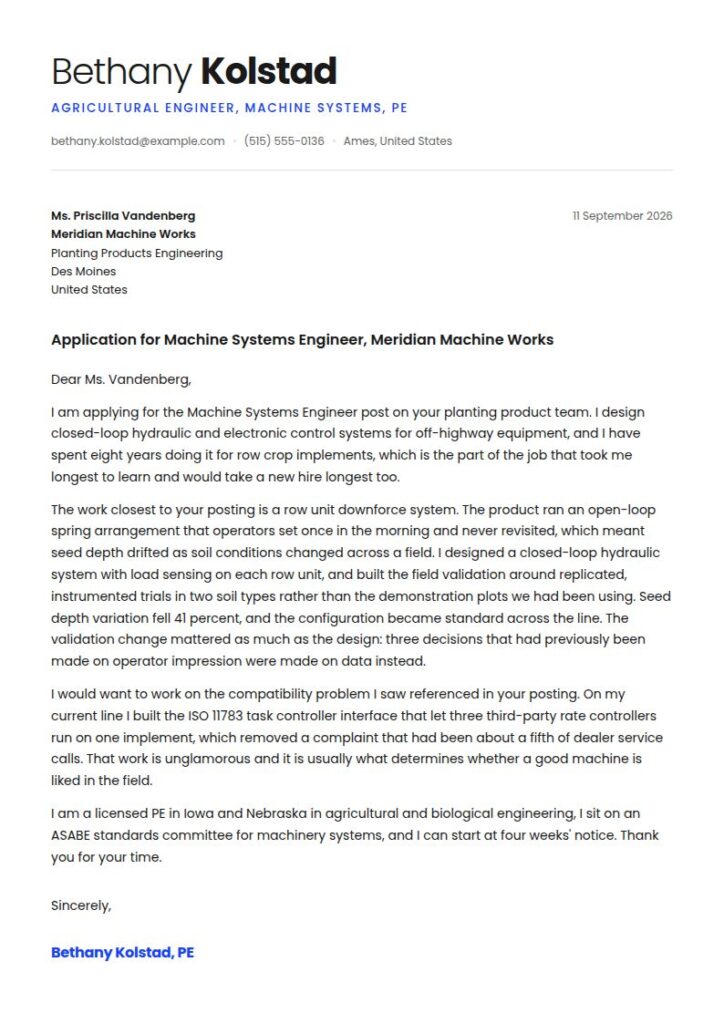
I am applying for the Machine Systems Engineer post on your planting product team. I design closed-loop hydraulic and electronic control systems for off-highway equipment, and I have spent eight years doing it for row crop implements, which is the part of the job that took me longest to learn and would take a new hire longest too.
The work closest to your posting is a row unit downforce system. The product ran an open-loop spring arrangement that operators set once in the morning and never revisited, which meant seed depth drifted as soil conditions changed across a field. I designed a closed-loop hydraulic system with load sensing on each row unit, and built the field validation around replicated, instrumented trials in two soil types rather than the demonstration plots we had been using. Seed depth variation fell 41 percent, and the configuration became standard across the line. The validation change mattered as much as the design: three decisions that had previously been made on operator impression were made on data instead.
I would want to work on the compatibility problem I saw referenced in your posting. On my current line I built the ISO 11783 task controller interface that let three third-party rate controllers run on one implement, which removed a complaint that had been about a fifth of dealer service calls. That work is unglamorous and it is usually what determines whether a good machine is liked in the field.
I am a licensed PE in Iowa and Nebraska in agricultural and biological engineering, I sit on an ASABE standards committee for machinery systems, and I can start at four weeks' notice. Thank you for your time.
Sincerely, Bethany Kolstad, PE
Openings that work
| Instead of | Use |
|---|---|
| I am an agricultural engineer with a passion for feeding the world | I design closed-loop hydraulic and electronic control systems for off-highway equipment |
| Agricultural engineering combines several disciplines, which means | I have spent eight years on row crop implements, which is the part that takes longest to learn |
| I have experience with precision agriculture technology | I built the ISO 11783 task controller interface that let three third-party rate controllers run on one implement |
| I would be a great fit for your team | Seed depth variation fell 41 percent and the configuration became standard across the line |
What counts as evidence
| Kind of evidence | What it looks like in a sentence |
|---|---|
| A designed system | Closed-loop hydraulic downforce with load sensing on each row unit |
| A measured result | Seed depth variation fell 41 percent in replicated field trials |
| Method quality | Instrumented trials in two soil types, not demonstration plots |
| Integration work | ISO 11783 task controller interface running three third-party rate controllers |
| A business consequence | Removed a complaint accounting for about a fifth of dealer service calls |
| Standards | Voting member of an ASABE standards committee for machinery systems |
Method quality is the row that separates this field. Agriculture is full of results measured on one field on one day, so saying your trials were replicated and instrumented tells a manager something real about how you work.
Writing to an employer who does not use the title
Open with the engineering discipline in the posting, then bring the domain in as context. Translate every acronym in three words. Give one system in full, with what it had to do, what you designed and how it was measured. Say how the result was measured, not just what it was. Name the standards you work to. Say plainly which part of the domain would take a new hire longest to learn, since that is the argument for hiring you over a generalist.
Do not spend a paragraph explaining what agricultural engineering is. Do not assume a reader knows ISO 11783, ASABE test standards or what a task controller does. Do not describe an individual farm, cooperative or landowner client. Do not apologize for the degree title or call yourself "technically an agricultural engineer". Do not send the same letter to an equipment manufacturer and a federal agency.
A small occupation, spread across five kinds of employer
Agricultural engineering employment sits at 1,500 jobs in 2025, projected to reach 1,600 by 2035, a 7 percent increase, with about 100 openings a year and a median annual wage of $98,590 (BLS Occupational Outlook Handbook, May 2025 wages and 2025-35 projections).
Those jobs are unusually distributed. Professional, scientific and technical services holds 27 percent at a $98,710 median, the federal government 21 percent at $101,480, colleges and universities 17 percent at $86,970, manufacturing 11 percent at $96,290 and state government 7 percent at $103,230 (BLS Occupational Outlook Handbook, May 2025).
Nearly half the occupation therefore works for a government or a university. That is the practical reason to keep two letters: one for industry, where the reader wants a system and a number, and one for an agency, where the reader is matching your text against a written position description.
Writing to a federal agency
A federal or state agency letter is a different document. The posting is built on a position description with qualification statements, and the first screen is a check against those statements rather than a judgment about your engineering.
Use their words. If the announcement asks for experience in the design of soil and water conservation practices, write "design of soil and water conservation practices" and then give the evidence, rather than writing "conservation projects" and hoping the mapping is obvious. Keep the same honesty about method: surveyed drainage areas, hydrologic calculations, the practice standards you designed to. The tone is more formal, but the structure holds.
Length, format and sending it
One page, four paragraphs, 250 to 400 words. PDF unless the portal says otherwise, named for yourself and the post: bethany-kolstad-machine-systems-engineer-cover-letter.pdf.
Address a person. Engineering managers at equipment manufacturers are usually findable, and in a field this small the chance that a named reader knows someone you have worked with is high.
Use the same figures as your resume so the two agree. Our agricultural engineer resume example is written with the numbers used here, and the Rezoom ATS resume checker will tell you whether the pair parses cleanly.
Key takeaways
- Open with the engineering discipline in the posting, not with the degree title.
- Let agriculture be the setting rather than the subject.
- Give one system in full: the requirement, the design, the measurement.
- Say how the result was measured, because method quality is the real differentiator.
- Translate every acronym in three words.
- Name the part of the domain that would take a new hire longest to learn.
- Keep a separate, more formal letter for agency applications.
Write your agricultural engineer cover letter in 10 minutes.
Agricultural engineer cover letter questions, answered
How long should an agricultural engineer cover letter be?
One page, four paragraphs, 250 to 400 words. The same length works for industry and for agencies; what changes is the vocabulary and how closely you track the posting's own words.
Should I apply for jobs that are not titled agricultural engineer?
Yes, and that is the main way people in this field get hired. The occupation holds about 1,500 jobs with roughly 100 openings a year (BLS Occupational Outlook Handbook, 2025-35 projections), while the same work appears under product engineer, machine systems engineer, controls engineer, water resources engineer and process engineer. Search by the work, then write the letter in the posting's language.
How do I explain my degree to a manager who has not heard of it?
Do not explain it; demonstrate it. One sentence of engineering the manager recognizes, followed by the domain as context, does what a paragraph of explanation cannot. The degree line on the resume is enough once the letter has established what you can do.
Does ASABE membership belong in the letter?
Committee work does. ASABE is the American Society of Agricultural and Biological Engineers, an ANSI-accredited standards developer that coordinates the US position in fifteen distinct areas of international standards development (ASABE, accessed September 2026). Saying you are a voting member of a standards committee tells a reader something checkable and rare. Plain membership belongs on the resume, not in the letter.
What do I write with no full-time experience yet?
Write the senior design project as the evidence paragraph: what the system had to do, what you designed, how you tested it, what the result was. Add any farm, shop or dealership work in engineering terms, because an employer who builds machines values someone who has repaired them. Then the FE result with a date.